
WWII Grand Strategy Buyer’s Guide
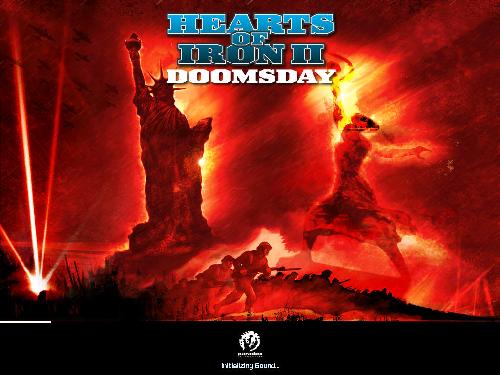
Hearts of Iron 2: Doomsday
Summary: Grognard’s delight. Name a detail, it’s in there. Great game play and realism, but takes a hefty commitment to complete a game. Casual gamers will be overwhelmed.
Developer: Paradox
Publisher: Paradox
Scope: A global war
Players: Each player controls a nation. Player can change nation after save. All nations playable. Want to play as Argentina and invade Chile?
Multi-player: LAN / Internet against one other human player
Game Play: Real time. Game resolution down to the minute, but time passage can be speeded up so that days pass quickly. Daylight tracked so that combat tends to decrease in regions currently in night. Orders to units have some delay. Can increase / decrease / speed and pause game. Pop-up message boxes give player update of key events.
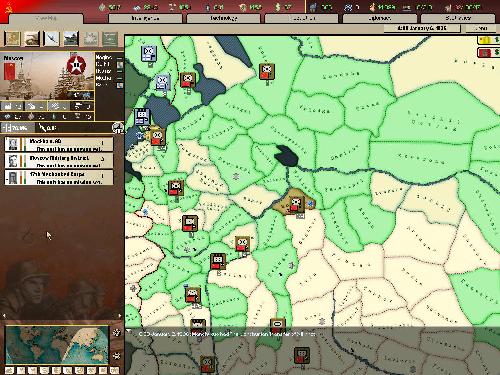
Map: Region based. Small regions; France has over 40 regions for example. Each region rated for infrastructure, fortifications, economic characteristics, terrain and special purpose facilities. Nuclear reactors, airbases, rocket test facilities, and industry can all be purchased.
Units: Basic unit is a division, air or naval group. These can be grouped into corps by the player, and assigned to HQ units, and given historic commanders. Game includes hundreds of historic generals each with a portrait and historic ratings and rank. Divisions can also be assigned specialized brigades, such as tank destroyers, or artillery. Stacking is not limited. NATO symbols or abstracted icons can be used on map. Player can rename units.
Combat: Combat resolved real time. Attack coordination feature allows units attacking from several regions assault at the same hour. Effects of night taken into account. Combat may take several hours or days to resolve. Results are usually that one side is forced to retreat and both sides take losses in material and readiness.
Strategic War: Game has automated convoy system that can be disrupted by submarines and raiders. Strategic bombers reduce output of regions. Fighter aircraft and regional anti-air defend production facilities.
Diplomacy: Deep diplomatic engine. Each nation has a full model of its government and policies. Player can slowly move his nation towards interventionism for example. Alliances can be made and broken. Other countries can be influenced by diplomatic and covert means. Want Germany to have Belgium as an ally? Support a fascist coup, and then invite them to ally with you. Not easy to do in the game, but possible. Full espionage model allows players to do nasty things to their neighbors. Diplomacy is a game unto itself.
Economy: Production based on output of controlled regions. Investment in infrastructure and industry increases output and capabilities. Raw materials such as iron and rare minerals required to build units. These materials either produced in home nation, or traded on the international market. Oil required to move mechanized units. Population also tracked to man industry or units. It takes a realistic amount of time to build units; with some naval units taking years.
Technology: Historic research teams like Heinkel and Curtis-Wright can be engaged to develop improved types of units. Industry upgrades like the production of synthetic oil also possible. It takes a realistic amount of time and production capacity to upgrade units.
Events: Many historic events are scripted, but can be affected by player’s actions. Events such as the Austrian Anschluss occur historically, but can be changed by game events. Diplomacy can bring early entry, and non-historic alliances, like Spain and Germany.
Scenarios: The game contains numerous scenarios that focus on specific campaigns, such as the Battle of the Bulge, or are more general, such as the 1941 Day of Infamy. Scenarios start in 1936 and end in the Doomsday scenario (Soviets vs. the West) in 1946.
Atmosphere: Wealth of historic detail and portraits really pull the player into this game. Management of information as well as units is critical to playing. This game is not for the faint of heart.
Mod Support: Editing tool allows players to change most aspects of the game. Many user-created scenarios including World War I scenarios.
Other Points: Doomsday is a stand-alone expansion of Hearts of Iron 2. Series based on Europa Universalis game engine, but many changes have been made to support 20th century warfare.
[continued on next page]

I have owned and played this game for a couple of years now. It is always enjoyable and I like the fact that you can take Russia out of the picture and see how the world would be with only a one front ware.
Hearts of Iron 2 has about as much realism as a glossy version of Risk. The game has a “face” of realism but the mechanics of the game don’t give realistic results. The game system can be appreciated by itself without any of the WW2 references painted on but if you ignore the game system and expect to get results based on the WW2 stuff you will be disappointed.
Hearts of Iron 2 Doomsday is a great, but very complex, grand strategy wargame. There is no such thing as a quick game and the learning curve is a little steep. That said, it is a thoroughly enjoyable game. It presents the entire world and ever aspect of the war while giving you, the player, the opportunity to follow or change history. The results are indeed realistic, but with the great number of factors contributing to each situation it can be hard to understand at times why things happen the way they do. All that said, for anyone looking for a serious and long running grand strategy World War II game, you can’t beat Hearts of Iron 2 Doomsday.
Hearts of iron is the most comprehensive ww II strategy game ever created. It is awesome in scope, time consuming and very addictive.
Ive played all of these games and Strategic Command is a good measure better than the other 2. The game lets you focus on playing it rather than micro managing it. It has plenty of units, a good uncomplicated tech tree, an excellent (best really) editor, lots of mods made, excellent interface, high playability without even reading the instructions, and its fun.
Economics, Spys, and Diplomacy is simple which lets you focus on what players really want to do with WW2, move armies.
Graphics are the least appealing of all the games but it has high visibility. There is no trying to figure out what the map is, its obvious where units are and what their strengths are.
Overall very well built and streamlined. The company really cares about the game and keeps putting out a better and better product.