
WWII Grand Strategy Buyer’s Guide
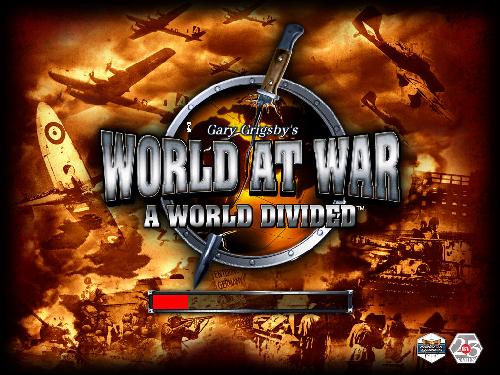
Gary Grigsby’s World at War, A World Divided
Summary: Game seems like light fare on the surface, but is actually fairly complex. Game style is unique and does not follow convention. Optional supply rules put a logistics leash on operations, making the game more realistic. PBEM and Internet play supports up to six human players. Great multi-player game, and for those gamers who like a bit of complexity with their fun.
Developer: 2 by 3
Publisher: Matrix Games
Scope: The entire war
Players: Six players, either human or AI. Japan, Germany, Italy, China, Soviet
Union or US/UK.
Multiplayer: PBEM, hot seat or Internet / LAN
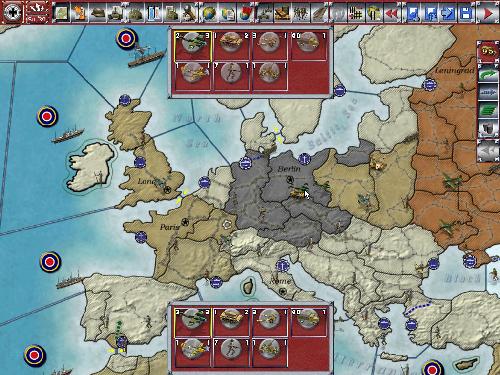
Game Play: Turn based, you-go-I-go, each turn equals 3 months. Player moves many units into region from multiple locations then conducts combat in just that region. After all movement, player goes to production phase.
Map: Regional map of the entire globe. Very large regions; Germany only has two.
Units: Abstract unit size. Infantry, militia, tank, fighter, tac and heavy bomber, naval air, light and heavy naval, sub, carrier, airborne and supply units. Units gain experience. No stacking limit.
Combat: Moving player moves all attacking units to target region, then conducts combat, results are immediate. Break-through like results are possible by phasing armored attacks. Optional supply rules require consumable supply units to attack. Results modified by unit type, technology level, terrain, unit experience and supply level.
Strategic War: Sea lanes must be kept open to ship supplies and units. Submarines can attack transport pipeline. Air attack can destroy rail, resource and production in regions. Can set up spy rings to steal technology and determine enemy strength. Strategic movement counts rail capacity by region.
Diplomacy: Minimal options. Can declare war, set up trade treaties. Can veto potential allies from entering your alliance.
Economy: Units produced with realistic production times. Can upgrade factories by region and build supply units. Resources and production facilities required to create units. Can improve production by purchasing factories.
Technology: Can research increased unit capabilities, like defense and air attack. Units automatically upgrade.
Events: Dynamic based on player’s actions. US and Soviet entry scripted if Axis do not attack.
Scenarios: Full war from 1939, 41, 42, 43, 44 and a 46-48 US/UK vs. Soviet what if scenario.
Atmosphere: Sound effects and graphics are very nice and add to experience. Movie reels pop up to announce major events like the fall of France. Most game info provided spreadsheet style.
Mod Support: No editor, but full documentation of files that need to be changed so that users can create their own scenarios.
Other Points: This game is an expansion of the previous game, Gary Grigsby’s World at War. Numerous improvements have been made to original game.
[continued on next page]

I have owned and played this game for a couple of years now. It is always enjoyable and I like the fact that you can take Russia out of the picture and see how the world would be with only a one front ware.
Hearts of Iron 2 has about as much realism as a glossy version of Risk. The game has a “face” of realism but the mechanics of the game don’t give realistic results. The game system can be appreciated by itself without any of the WW2 references painted on but if you ignore the game system and expect to get results based on the WW2 stuff you will be disappointed.
Hearts of Iron 2 Doomsday is a great, but very complex, grand strategy wargame. There is no such thing as a quick game and the learning curve is a little steep. That said, it is a thoroughly enjoyable game. It presents the entire world and ever aspect of the war while giving you, the player, the opportunity to follow or change history. The results are indeed realistic, but with the great number of factors contributing to each situation it can be hard to understand at times why things happen the way they do. All that said, for anyone looking for a serious and long running grand strategy World War II game, you can’t beat Hearts of Iron 2 Doomsday.
Hearts of iron is the most comprehensive ww II strategy game ever created. It is awesome in scope, time consuming and very addictive.
Ive played all of these games and Strategic Command is a good measure better than the other 2. The game lets you focus on playing it rather than micro managing it. It has plenty of units, a good uncomplicated tech tree, an excellent (best really) editor, lots of mods made, excellent interface, high playability without even reading the instructions, and its fun.
Economics, Spys, and Diplomacy is simple which lets you focus on what players really want to do with WW2, move armies.
Graphics are the least appealing of all the games but it has high visibility. There is no trying to figure out what the map is, its obvious where units are and what their strengths are.
Overall very well built and streamlined. The company really cares about the game and keeps putting out a better and better product.