


WW2: Time of Wrath – Developer Notes
Leszek Lisowski, the Project Leader on the upcoming World War II grand strategy wargame WW2: Time of Wrath, shares his thoughts on the creation of a historical wargame in an ArmchairGeneral.com exclusive. WW2: Time of Wrath is scheduled for a July 2009 release by Matrix Games.
Many, many hours
There is much more behind creating a historical wargame like WW2: Time of Wrath than just designing and programming and being creative. There are hundreds of hours spent on researching data to make the game reflect reality. This includes searching through maps, books, comparing sources when one author states something opposite to the other. There are whole days spent in libraries looking through materials only available on site or under supervision. This is the real story of researching and creating a wargame.
Finding every division and corps that should be included in the game isn’t an easy task. You not only need to find their names and locations, but also an exact composition. Only then you can determine what technological level and strength a unit should have in game terms.
Apart from that you need to consider what to do with the smaller and understrength units, should they be combined into one unit? Perhaps separate them but give them lower strength so they are thus more susceptible to quick destruction? We spent a lot of our design time focused on the other fronts of warfare: the air and naval war. Air forces are grouped into air divisions and air armies, and placed on the terrain where they operated. The navy was divided into fleets and placed where they were at the specific start time of each scenario.
Overall, I really think that this amount of work is worth the effort. Unit names now are in accordance with the national pronunciation and real Order of Battle. Soviet riflemen units are now called Strelkovaja Divizija with correct numbers instead of some name like XX Infantry division. Units are now placed on the map in the same region as they were stationed in reality, so if you print out a historical map and cover your monitor, you should have similar data visible. Thanks to this policy, there are now more units on the map. Put the greatly improved and expanded Order of Battle together with the smarter AI, which now knows how to properly create front lines and exploit them, and the game shows it’s real depth and value.
The map
Hexes
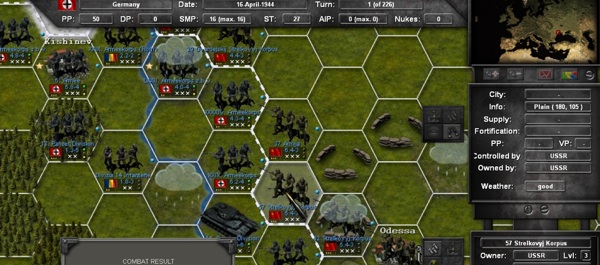
The first thing to catch your eye is the hexes. Lots and lots of hexes. Why have we decided on them? The answer is simple: firstly, the distance from one hex to the other is always the same. Secondly, we grew up on hexes. In the distant times of our youth, when computers weren’t so popular, we used to set up giant boards on the floor or a table and carefully put counters on them (who else had his dog run through the board?). Luckily gaming on this scale is now much easier. Any game can be started in a couple of minutes and it doesn’t disturb other residents and family life.
Size
The map comprises Europe, North Africa, and a part of Middle East. On the west edge of the map there is a small area representing the United States.The map of course might be smaller or bigger but we wanted to to cover the whole European and Mediterranean Theater without a gigantic map or, on the other end, without limiting the player’s options. Farther to the east and south was nothing really important for the situation in Europe. The United States had a huge influence on the war in Europe so we also decided that it should be represented on-map.
Cities
There are over two hundred fifty cities on the map. They can be divided into a few oftypes. There are main supply sources which are generally capitals, ordinary cities, ports, andfinally resources. Cities are very important because the whole management of your militaryand economy is based on cities.
Why so many cities and why choose to include the particular ones that are in thegame? We tried to reconcile the game mechanics with the importance of the cities from thepolitical, economic, and military point of view. If we were to pick just one condition to declare a location a major or minor supply source, then some of the capitals wouldn’t qualify for the right category, or some regions would have to be turned into giant metropolises.
Your Command
Allies vs. Soviets vs. Axis
We’ve decided in Time of Wrath to allow players, to control the countries they wouldlike to. So there is no problem if a player would like to control more than one or even everycountry of an alliance and try to coordinate their actions on all fronts. This is something that we have always wanted to implement.
We decided the best way to implement this was to give every country controlled by aplayer its own turn. In some ways this slows gameplay down but we believe the separate turnsfor each nation make management much smoother in the long run. It’s also important to remember that the diplomatic actions that the player can undertake are on the basis of a nation and thus having a separate turn for each country makes diplomacy a lot more sensible. Encouraging a country to join the alliance, organizing elections, or declaring a war all must be done on the national level.
Victory Points
This is quite an important matter to note. Every city on the map might have VPs. A country that doesn’t control any of its national cities with VPs is eliminated from the game.We’ve decided that such a solution is the best in order to ensure good game flow and at the same time mark the important cities from the military point of view. So in other words protect your cities and their VPs or the game might end quickly.
Production Points
A very important matter that had to be resolved is the way to address the economic power of a particular country. We were aware of the fact that in order to ensure good game dynamics we had to design this part of the game in a very clear and understandable way. In the end we decided on one parameter called Production Points. Production Points are used for buying new troops, advancing technology levels or replacing losses. Thanks to this solution, it is very easy to determine what you can buy, and how big your army can be.
Events
From time to time at the end of a turn a player might be informed about some historical event. In general, he will be able to make a decision on how to react to this event which can influence gameplay in minor or major ways. This particular area of the game has been overhauled and expanded substantially. Player’s will find that this portion of the game is quite important. We have implemented a lot of events. Some of them are very simple and just give player a free military unit, which is worth few PP, but some of them can occur only in very detailed circumstances and can have very significant impact on the course of the game.
We also decided to sometimes really challenge the player with difficult decisions and very often a player will have to decide between two equally bad or good options. Thanks to that the game becomes something more than just pushing units forward and really brings to life the historical setting.
Land Warfare
We’ve mentioned the map and countries already, now let’s focus on military units. Without a doubt, WW2: Time of Wrath focuses on military land operations, supported by air and naval power, of which you will hear a bit more later.
Units can be divided into couple of categories. In terms of scale, we have divisions and corps with technology levels from one to five. In terms of ground unit types we have infantry, motorized infantry, armored units and paratroopers. We believe this is the most logical and concise setup possible as it allows a player to use various doctrines from Armored Spearhead to Human Wave and everything in between.
A player can buy any of those unit types right from the start. But the level is limited by the technology level of the particular field of research. In order to allow for more flexibility with the composition of armies we’ve decided not to block the possibility of buying units that are lower levels than your current tech allows for. Thanks to that even in the end of the game it is possible to deploy cheap and small units which can be used as a perfect protection forces or on less important fronts.
We wanted to make the style of battles resemble those from the board games we use to play long time ago. That is why we have decided to characterize units by just two main parameters – Strength and Action Points (AP).
APs are used for moving and attacking and can be used in any order. So a unit can move, attack and the move again, or it can attack couple of times. The player has complete freedom in that regard. We didn’t want to bind players and force them to attack only once at the beginning or at the end of the turn. This kind of freedom gives a lot more flexibility in planning tactics. I admit that it took us a lot of time to determine the best size for the units. Of course we knew that for such a scale, divisions and corps would be most natural. In the end we decided that a corps will be a little over three times stronger than a division to simulate battalions that were attached irectly to each corps. At the same time we decided that a corps should be a bit slower than a division based on their expanded structure and increased administration.
This design gives the player more strategic and tactical choices, many weaker units can establish a longer front border, but fewer strong units can easily break through them and we wanted each player to be able to make this decision on his own.
Naval Warfare
In Time of Wrath we decided to implement an entirely new system of fleet management as opposed to management of the air force and army. We did this because we wanted to be consistent with the way the navies were presented on the main map. Since you can’t stack naval units and the scale is organized into fleets by default, we have transferred most of the actions concerning management onto a completely different screen.
To avoid micromanagement we have divided each Navy into groups, which can freely combine into fleets. Fleets can operate as regular task forces or they can be set to raider duty and hunt for enemy convoys. It should be noted that every group in a fleet of raiders acts on its own.
As we are on the subject of groups, let’s delve into how they work. We decided to give each “ship” its own strength points. 5 for CV, 3 for BB, 2 for CA, 1 for DD and 0.5 for SS. In order to make the fleet management easier we have combined single ships into slightly larger combat groups. So when building a carrier group we get 1 CV and 5 DDs, in case of a battle group it’s 1 BB and 5 DDs, patrol group consists of 1 CA and 3 DDs, while a submarine group is made of 4 SSs.
We are aware that this sort of organization doesn’t fully represent the characteristics and structure of fleets in any particular country, but we’ve feel this kind of unification is necessary in order to reduce micromanagement and to give every major country a fighting chance.
At the beginning of a scenario, the player may find many units without the maximum strength points or with a lowered maximum strength. All of this is the effect of our effort to accurately reflect the actual situation of the navy of the particular country. We found this solution to be most suitable for the diversity in equipment found from country to country, for example Coastal Battleships or Escort Carriers.
Naturally we haven’t forgotten about transport ships and amphibious assaults. In these situations we have interaction between the main map and the fleet management screen, so loading and unloading troops is done at the main map as it’s the place for land unit management and transport movement is handled through the fleet screen.
Air Warfare
The main task of the air force is to support army operations. As you might be aware, the organizational difference between individual countries was huge. In addition there was a huge diversity in aircraft and how they should be used. The first major division we made was the separation of the strategic air force from the rest. Then we decided that based on the scale WW2: Time of Wrath, there is no need to separate light bombers from fighters. We wanted to allow the player plenty of flexibility in commanding their air force. Also, we introduced air divisions which represent around 400 planes and air armies which represent around 800 planes.
The air force can undertake typical missions like air superiority through attack on enemy air units, attacks on land targets, recon, attacks on a fleet or strategic bombing to damage the enemy’s economy.
The most important novelty is air recon which allows air units to scan enemy territory. It’s best used when playing with limited Fog of War. This feature really helps to plan offensives.
Due to player feedback after the release of WW2: Road to Victory, we decided to implement interaction between naval and air units. Now air units can attack enemy ships in neighboring sea zones. This is a very effective way to deal with enemy fleets. Now the Luftwaffe can give the Royal Navy plenty of trouble when the English fleet is not covered by a Carrier Air Group.
Putting it all together…
Logistics
vWe spent a lot of time thinking about the best way to represent the supply system in a game of this scale. Even though the gameplay is divided into turns, naturally we all are aware that in some way the actions on the board take place simultaneously. Based on that we decided that cutting off a unit from supply when flanked shouldn’t be instant. We also found that managing supply should be connected with an economic system and that it should be somewhat centralized (or in other words distributed vertically). This allows us to simulate the distribution of goods from the homeland all the way out to the front lines. Thus, waging campaigns across large bodies or water or in areas far from your capital will have added danger. This also further reinforces the need to protect one’s rear as a long supply line is very fragile when flanked.
As for how the specific system works, we based the system on four steps:
The first and most important concept is that supply originates from the Main Supply Source (MSS). Most often this is the capital of a particular country, although giants like Soviet Union may have more than one MSS.
Second, the player must also maintain and protect cities which not only produce some limited supply on their own, but also distribute supply of the MSS.
Third, we implemented a supply level system. Its maximum is 30 and it’s reserved for when units have their needs perfectly met. There are many shades of gray in supply, but players will see the effects of poor supply when a unit’s supply level drops below 15.
Fourth, when the supply reaches units they consume the supply to effectively fight and move.
Now that you know how the system works in principle let’s see how it’s all connected. All the cities connected with their MSS by land get the maximum supply. The supply is then sent to units in the vicinity. But every hex between the unit and the closest city reduces unit’s supply by the cost of AP needed to travel this distance by a motorized unit. Complicated? Just keep your units close to the cities.
We were aware that a unit which is cut off is in a really bad situation, but not everything is lost. Instead of a rapid loss of effectiveness and ability, the unit will slowly degrade in every aspect until it drops almost to zero or until the encirclement is broken.
Thanks to this deep raids into enemy territory might change the tide of an entire campaign. Supplying army through sea is also a really important part of war, which is why we have implemented a convoy system. Thanks to the new convoy system it is possible to send supplies to places separated by enemy territory or sea. Just mark the source and target port and the amount to be sent and ships will depart. Of course the enemy will generally be waiting for this to happen so it is wise to send some of your naval ships on the convoy’s route.
This makes the war effort on sea really important, both for those who want to keep troops supplied and those who want break the supply routes.
Combat
We really tried to make combat user-friendly and very easy to carry out. The only thing the player must do is to indicate the unit he wants to attack with and then the enemy unit that should be attacked. If the attack is supposed to be carried out by multiple units the procedure looks a bit different. First indicate the enemy unit, then select all of the player’s units assigned to attack (maximum six), then finally select the enemy unit again. As this kind of a synchronized attack requires advanced coordination and preparation time, a unit can only participate in one multi-unit attack per turn.
To give the player an estimation of the combat result, it’s always wise to look at the predicted results table next to the map to determine the proportions of offensive and defensive power. Attacking a stronger opponent isn’t always the best idea.
After all unit selection is finished, the attack commences and the computer calculates the modifiers involved with that instance of combat.. Now all the player can do is hope for good luck because the last step is a “dice roll”. Exactly like in a board game!
Weather
As we remember Napoleon’s and Hitler’s adventures into Russia, in Time of Wrath we made weather a very important factor.
We didn’t want to just recreate weather. Instead, to challenge a player and to make the game more unique, we decided to implement algorithms that will simulate the climate, so the snow and mud will appear as it was in reality. We have divided map into small areas and allowed for rain or snow in each area based on the climate of the area. As a result, weather is realistically modeled but it is not necessarily historically accurate on a hex by hex basis for each turn.
In other words, there is a random generator that calculates what weather could be on every single hex on the map. This of course can interfere with land and air units. Moving and attacking in bad weather is much harder than in good conditions, so thanks to this system it’s very important to plan offensives in proper weather conditions.
Another thing that makes this feature so important is that we wanted to show the differences of the weather’s impact on specific nations based on their level of bad weather training and equipment. So we implemented a modifier for each country to define how high an impact the impact weather will have on a country’s units.
Reports
They say that information is power, so to make everyone who likes to read reports happy, we produce a lot of reports. Turn after turn, they inform the player about the situation in the game. There is the possibility to, among others, look through inflicted and received casualties, naval and strategic bombardments, combat results, etc.
Easy on the Eyes…
In Wastelands Interactive we are not only developers but also wargamers and gamers in general. All of us like to play games, but we also all have different preferences and different hardware on which we play.
Many of the decisions we made about graphics are probably immediately clear to most people – when a customer looks at the game, WW2: Time of Wrath needs to look good. Of course this means something different for everyone, as everyone has different taste. Another decision was that all the information shown in our new interface must be easily readable, both on the game map and on the information panel.
In terms of GUI improvements, the player will see that we have cleared and replaced all the information about a selected hex or unit. Additionally, we have added an ownership view, which, together with smooth zoom out, allows the player to easily see current strategic situation.
Furthemore, the only sensible way to combine the system requirements and artistic tastes of all our players is by giving people the ability to customize the view to their screen size. We’ve heard from a lot of players that the 1024×768 resolution found in the original game is not enough, so we decided to expand the resolution possibilities to accommodate resolutions from netbook-size all the way up to 1920 widescreen in windowed mode as well as in fullscreen. (Want more? Let us know!) Another major graphical change is now the terrain is being displayed. Apart from the view in which the trees, hills etc. are modeled, you can switch the game into a classical view. This view is intended to look just like a classic board game where instead of trees and hills there are colored hexes. While we know a lot of gamers will enjoy our new graphics, we realize that others place a priority on high contrast and clarity, that’s what the classic view is for. That’s not all, either. We all know there are enthusiasts for both counters and 3D unit models so we give the player the choice to use either.
We have big plans to further improve the GUI too. With a free update after release we also plan to include a unit border system where the player can see a colored border around a counter or model which can display a variety of information like weather, remaining AP, etc. Whether to use the system and what the border displays is entirely up to the player.
By Gamers for Gamers
While designing WW2: Time of Wrath we’ve always remembered what gives us the most pleasure: bursting through Soviet lines to Baku, hanging the red banner of revolution across the Atlantic, or enforcing widespread democracy for the twentieth time. It is from the desire for these sort of unpredictable outcomes that we wanted to make sure gamers could modify our game. Practically everything except the exe file is free to modify.
Thanks to the editor included with the game it is possible to freely change the map setup. In addition all data about units, leaders, countries and modifiers are stored in csv or txt files. Also, every event is listed in easily modifiable xml files. All you need is an ordinary notepad application. And, as always, if you have any questions about modding WW2: Time of Wrath, we at Wastelands Interactive and our steadily growing community is always available to field your questions!
That’s All Folks!
I hope you enjoyed reading the insights behind our design decisions in WW2: Time of Wrath. We feel that we are bringing gamers a truly superior product that is much improved from its predecessor and we strongly encourage anyone who has tried our previous product to take a look at WW2: Time of Wrath. In fact, through Matrix Games we are offering a free “upgrade” to WW2: Time of Wrath for customers who already own the Matrix Games release of WW2: Road to Victory. If you’d like to know more about WW2: Time of Wrath, be sure to visit the game’s website: http://www.matrixgames.com/products/371/details/WW2:.Time.of.Wrath. If you have any more questions or inquiries we’d also be happy to answer any questions in our forums.
On behalf of the whole Wastelands Interactive team, I hope you all enjoy WW2: Time of Wrath!


You know this game almost resembles another great strategy game I use to play (the time of flopy disks) “Panzer general” where you become a general or a field marshal conducting theatre operations !
Man I like this comment and it is so good and I am definetly going to save it. One thing to say the Indepth analysis you have done is greatly remarkable.Who goes that extra mile these days? Bravo! Just another tip you shouldget a Translator Application for your Worldwide Readers !!