
World War 2: Time of Wrath – PC Game Review
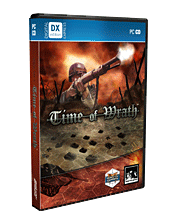
World War 2: Time of Wrath
PC Game. Publisher: Matrix Games. Designer: Wastelands. Available as download $29.95 or CD $39.95.
Passed Inspection: Excellent land and air operational mechanics, nice use of scale
Failed Basic: Poor naval component, ahistoric victory conditions
The ability to attack, move and attack again in any combination adds a fascinating dimension to combat within the week-long turns.
Designing a grand strategic game of World War II in Europe is rather like zeroing in artillery: several rounds are needed. Wasteland’s first effort, World War 2: Road to Victory fell short. The second round, World War 2: Time of Wrath with patch 1.60 beta, is much nearer the mark, but a few more tries are required. This corps/division/fleet turn-based game pits not only countries but the three major ideologies of the time -democracy, fascism and communism – against each other with a player handling any country he chooses. This concept is grand but the execution remains flawed.
{default}Graphics
The default terrain map, covering all of Europe and North Africa, is functional and clear, showing cities, fortifications, rivers and mountains. Weather is depicted by clouds and snow patches on hexes. City hexes have numbers for victory, supply and production points. Nostalgic gamers can opt for a 1980s CGA-style map. The diplomatic map has only capitals for selecting diplomatic actions. Seas are shown as zones and tables noting the number of capital ships and submarines present, with lines connecting possible destinations.
Zoomed-in units can be shown as either sprites or NATO icons, while zoomed-out views have them as national flags. Each unit has its approximate strength and available action points. When selected, an information bar reveals exact and modified strength, commander, efficiency, supply source and modifiers. Selection also illustrates reachable hexes color coded for the number of action points remaining at each hex. Single ships appear static with a health bar on a truly boring screen when a battle occurs.
Gameplay
Land and air combat work very cleverly. When a unit is selected, an action panel appears showing options for the unit. If the unit hasn’t moved and necessary conditions are met, it can be reinforced, enlarged to a corps or improved. Land movement is limited by terrain- and weather-action-point cost; mech units naturally have a longer range. Efficiency suffers greatly if no route can be traced to a supply source. Land units can attack adjacent enemies. If more than one friendly unit is adjacent to a target, they can attack together once for significant enhancement of performance. Possible attacks may continue on an individual unit level. Combat results display losses, columns and die rolls. Surrounded cities may surrender in the turn’s interstice.
The ability to attack, move and attack again in any combination adds a fascinating dimension to combat within the week-long turns. Units can also be moved strategically and by sea using production points. Eligible paratroops and amphibious troops land in highlighted hexes. Commanders can be attached to units and exercise their skills to friendly units within three hexes.
Air units are divided into fighter, tactical bombers and strategic bombers. The first two types can both fly recon missions, but fighters intercept hostile air strikes automatically and can attack discovered enemy air bases, destroying air power on the ground. Tactical bombers hit land units within their range so hard that they can destroy weakened units. These bombers can also be ordered to strike neighboring sea zones. Strategic bombers pummel cities, disrupting production.
Sea combat is the most disappointing component. Players are relegated to shifting naval groups from ports to sea zones via buttons, setting convoy routes, designating fleets as regular or raider and spending production points on repair. Naval combat occurs after land operations. A screen appears when vessels meet but often no action occurs. When it does, players merely choose attacking ships regardless of side and point out targets. The "auto" function at these times cut down slightly on the tediously dismal screens in this tiresome phase. One nice touch is the ability to bombard shore targets.
Research, unit purchase and diplomacy are functions of production points. The first two are handled straightforwardly – "ya pays yer money and ya makes yer choice." Diplomacy has three choices: declare war, exert pressure to bring a neutral into the war and create coup d’états for the same reason. Having an AI-controlled ally can be strange, e.g. Italian units popping up in northeast France when they should be attacking Marseilles. Players should pick future allies for human control during set-up.
Events occur during the turn interstice. Players can sometimes pick an option such as Germany breaking the Ribbentrop pact.
Victory?
This game has three campaigns – starting September 1939, May 1940 or June 1941 – which run over three hundred turns. Overrunning countries yields the necessary production points to invest in new technology, including nukes, to triumph over one or both opposing ideologies. However, the game doesn’t reflect the psychology of the time. Players must occupy every city in a country before it surrenders. Thus, Germany can take the Low Countries and northeast France, destroy the BEF and the flower of the French army while taking Paris but Britain and France still pump units into small towns in the West just to drag out the time. The Russians may have fought for every foot of soil but "open city" was on the tongue of many in the West. The lack of quick surrender undermines the dynamics of the period. The two short scenarios, Poland and Overlord, are more in keeping with the times.
The learning curve for the game isn’t steep despite a mediocre manual and tutorial. With an aggressive AI, World War 2: Time of Wrath only needs a better naval component and tweaking of victory conditions to become a gem. Playing it now is enjoyable with some irritations.
Armchair General score: 80%


Jim Cobb has been playing board wargames since 1961 and computer wargames since 1982. He has been writing incessantly since 1993 to keep his mind off the drivel he deals with as a bureaucrat. He has published in Wargamers Monthly, Computer Gaming World, Computer Games Magazine, Computer Games Online, CombatSim, Armchair General, Subsim, Strategyzone Online, Ganesquad and Gaming Chronicle. If you’re looking for a PBEM patsy, contact Jim; he never wins.

You don’t have to take every city in France to have it surrender. You need take Paris and some major cities though.
Time of Wrath’s interface is a painful RSI inducing experiencing. Click the attacking unit, move and click on the weapon, move and click on the target. move and click on unit again. Attack takes place repeat these multiple moves for all your units several times per turn!
The distance to move the mouse, the thoughtless button positioning, the need to click units more than once.
I struggle to do more than a couple of game turns before rsi and cramp sets in. Be warned if you are prone to this kind of thing.!!!
Are there any good real-time strategy games that have decent graphics? I am looking for one that is not unbelievably hard to play and is set in modern times.
wargame red dragon , panzer corps ,
Some personal notes about Time of wrath.
1) Scale and land warfare: great, it’s a great wargame, finally without the real time strategy system (in my opinion a tactical game may use real time system, not a strategic game!!!). Finally a “monster game”, you can move a lot of counters in a lot of space!!
2) Naval system: Arrrrgghhhh! the opposite of land warfare!!! Too simple, not clear, with a lot of bug (AFTER the 1.70 patch, if you mantain the flag “on” for auto deploy system in naval windows the system collapse and you lose the last turn!)
3) Aircraft system: ?????? You pay 200 pp to create a bomber units. You pay 200 pp (more or less) to buy an armoured corps. With an armoured corp you destroy a lot of enemy units, occupy land, etc etc. Aircraft units are uneffective (You need 3/4 units to reduce 50% one land units, and normally you lose a lot of strenght points (their price is 12 for 1 points!). I think this is a clear problem of balance of the game
4) I.A. is terrible!!! I’m playng with Germany against Russia: computer player create tons and tons of little division and place the units in 4/5 lines all adiacent at the front line. Breakthroug is very difficult, you must “walking on” thousand and thousand of russian units.
5) Some message about some event are…… what kind of message is this??!!??? If you use a text box, please, you can explain better the situation, 5 words more are not so expensive!!!!!!!
Conclusion: The game is, potentially, the best wargame of the last years, but the develop, the naval and aircraft rules and the A.I quality is very, very low
Melli