
Truman & MacArthur – Book Review
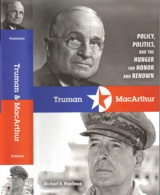 Truman & MacArthur: Policy, Politics, and the Hunger for Honor and Renown. Michael D. Pearlman (Indiana University Press, iupress.indiana.edu, 2008) $29.95, 376 pages, 14 illus., 2 maps.
All human beings are complex and inconsistent: part admirable, party petty.
With an unpopular, undeclared war raging, seemingly dragging on with no end in sight, the American president’s popularity sank to historic lows in national opinion polls. Many thought the diminutive White House occupant was not up to the task of leading the country, questioning his fitness for the office. Polls showed that most citizens viewed Washington with disdain, cynically judging the president’s frequent confrontations with hostile elements in Congress as “business as usual” in the nation’s capital. An overwhelming majority of Americans, however, were convinced that their military forces contained a true national hero – the Army’s field commander in the war zone. The general was articulate, photogenic, charming and not at all shy about appearing in the media. Yet, many perceived that the general’s gallant efforts to achieve battlefield victory were being undermined by Washington politicians and policy wonks who squabbled over war aims, defense budgets, troop levels and even the very nature of the war, itself. Moreover, the war hero was shamelessly exploited by the president, members of Congress, special interest groups and even the media to promote their own competing agendas.
{default}Although the situation as described might, indeed, aptly apply to President George W. Bush, Gen. David Petraeus and the Iraq War in 2008, the scenario actually played out over a half century earlier — the president was Harry S. Truman, the war hero Gen. Douglas MacArthur, and the conflict was the Korean War in 1950-51. And unlike the apparent close relationship between Bush and Petraeus in 2008, in April 1951 Truman and MacArthur clashed publicly and bitterly, taking center stage in what became “the most dramatic crisis in U. S. civil-military relations.”
Michael D. Pearlman, PhD, an award-winning historian, surgically dissects the Truman-MacArthur confrontation in his outstanding new book, Truman & MacArthur: Policy, Politics and the Hunger for Honor and Renown. In doing so, he cuts through over fifty years of partisan mythmaking by the champions of both men to present the most accurate and in-depth account to date of what led Truman to relieve MacArthur of command on April 11, 1951 and the firestorm of controversy that act produced. Pearlman’s insightful account was not written to please advocates for either Truman or MacArthur. The author set himself a different task: “My job, writing some fifty years after the fact, is not to produce another partisan polemic for one individual or the other;” in short, he did not set out – as many books on this subject have done — to make a case for justifying the actions of either man. His meticulously documented, painstakingly researched book removes the shroud of folklore that has clouded the controversy for decades and shatters long held myths — instead of perpetuating them. Despite the fact that any political-military-diplomatic historian of long standing could not possibly embark upon such a book without having at least some preconceptions about the principal actors, Pearlman reveals that “I no longer have certain opinions held when beginning my research several years ago” – evidence of a rare open mindedness about a subject usually dominated by fixed opinions and partisanship. The result, to borrow a well-known news network tag line, is the most “fair and balanced” presentation of this complicated, highly-nuanced civil-military crisis yet published.
Pearlman’s many years of research into the controversy have produced a book that is far from simply another rehash of well known claims and counterclaims by supporters of the feisty president or the larger than life general. And although volumes have been written about both men, Pearlman manages to accomplish in a few perceptive chapters what entire biographies have often failed to deliver – he captures both men’s complex personalities, a critical element of the triad (policy, politics and personality) that made the Truman-MacArthur clash virtually inevitable and which lies at the heart of Pearlman’s analysis.
[continued on next page]

This writer is of the opinion that Mac Arthur knew full well what he was doing in his letter to Joe Martin.
I knew General Mac Arthur.
All he had to do was write a side bar note stating “personal and confidential”
or ” for your eyes only-not for publication”–as he did often.
n this case he did not.
He knew Joe Martin.
He knew Joe Martin would get up on the floor of congress and read it t loud and clear for all the world to hear.
Mac Arthur knew what would happen next.
He knew.
He fell on his sword.
With every good wish.
God bless.
JOHN W. BUGLER
BUGLER.ORG
I heard some very interesting information about a variety of historical events from a WWII/Korean veteran who was personally present and involved in them.My limited research and inquires have not served to disprove the truth of the somewhat detailed information related to me.I hope you can help me determine if what I was told could be true based upon facts you are aware of relating to the following brief statements.Included are:1)that the stand-by third atomic bomb for Japan would not work and was sent to Iwo Jima for trouble shooting.The problem was that a wire had not been hooked up;2)that when Truman had MacArthur relieved of command,he was arrested just after passing through some gate.(Through some communication device Truman heard what was taking place.One of the guards said,He is going for his gun.” Immediately Truman said,”If he does shoot him in the head.Don’t bring him in alive!” MacArthur was then placed under house arrest with guards being around the house; 3)that Truman took refuge at Camp David for about three weeks when MacArthur arrived in the U.S because of a fear that he might try to overthrow the government;and 4)that MacArthur was restricted to a 100 mile radius of his home and he would face charges by Truman if he violated this.>KENNETH PHILLIPS
I attended General Mc Arthur’s last birthday party which was
held at the Waldorf Towers in January of 1963. I had a brief
moment with him afterwards and asked for his assesment of
Harry Truman. With a wry smile and a wink at his friend Larry
Bunker he expressed these words to me. ” THE ONLY THING
NEGATIVE I WILL EVER SAY CONCERNING PRESIDENT
TRUMAN IS THAT HE WAS POORLY ADVISED.”