
The World’s Bloodiest History – Book Review
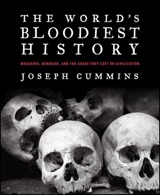 The World’s Bloodiest History: Massacre, Genocide, and the Scars They Left on Civilization. By Joseph Cummins. Fairwinds Press, 2009. 320 pages, softcover. $19.95.
It is a chilling reminder that the dinosaur brain is still present and waiting for an opportunity to take over.
We have meet the enemy and he is us. —Walt Kelly, creator of Pogo
Civilization allows humans to live, love and work together while sublimating, to a degree, personal desires and goals. It has allowed mankind to make great strides in the arts, philosophy, sciences and standards of living. Yet, human beings are still subject to the darker side of nature where the "dinosaur brain" resides with baser passions like hatred and fear that, when they infect a group of "civilized" people, can unleash a destructive miasma that causes untold sorrows to all of humanity. Joseph Cummins examines 18 examples, cases of massacres and/or genocides from the ancient past to today, in The World’s Bloodiest History: Massacre, Genocide, And The Marks They Left On Civilization.
{default}Cummins used two criteria in deciding which historic events would be included in this dark and bloody history: an event’s brutality and its historical impact on civilization.
Curiously, the first chapter deals with the sacking of Carthage by Rome which, while historically noteworthy, I do not feel meets the threshold set by the author’s criteria. First, sackings such as that of Carthage were customary in wars of that period. Second, the author accepts the common fallacy that the Romans actually salted the earth to prevent crops from growing in Carthage’s surrounding area. Looking at the simple facts would prove that "salted the earth" was an analogy and not a statement of fact. Salt in the ancient period was a treasure. Roman troops were PAID in salt (hence, our word salary). The amount of salt needed to do such destruction would be prohibitively expensive no matter how much hatred there was between Rome and Carthage. The suffering of the people of Carthage was severe, but in those times it wasn’t unique and, hence, was not especially brutal for the time. It did however affect the world by removing the one major threat to Roman hegemony of the Mediterranean area.
The next three chapters deal with European affairs, starting with the conquest of Aztecs (or Mexica as they called themselves) by Spanish conquistadors, the classic story of how a technologically more advanced people overthrew and destroyed a more populous society. It affected the course of history in that the wealth that flowed from the Spanish conquest led the rest of Europe to want the resources of the New World for themselves, and so the Americas were opened to exploration and exploitation.
Roughly 50 years after Spain’s destruction of the Aztecs came the next macabre event in the book, the Saint Bartholomew’s Day Massacre, in which over 100,000 Protestant men, women and children were slaughtered in a single week by the French army in concert with Catholic clergy. For a religion founded on peace, love and kindness to one another, Christians often seem to find new and unique ways to kill in the name of God. While there was a schism between Protestant and Catholic faiths, the real powder keg in this massacre was political. However, the author rightly notes that, overall, this massacre didn’t have as much effect in the political affairs of France as it did in intensifying the schism between Protestant and Catholic theologies that is still felt to some degree today.
The last chapter in this group deals with what was a relatively minor affair locally that had significant impact on the world at large-the Indian attack on the East India Company that resulted in the black hole of Calcutta, a small prison cell so crammed with English prisoners that a number of them were crushed to death. Following this incident India lost its independence and Great Britain claimed the country as the jewel of the Imperial crown.
Next come three American chapters, starting with the massacre of California-bound settlers by Mormons in the Mountain Meadows Massacre. The betrayal, murder and kidnappings committed by Mormons in this affair were shocking and led to one of the first major punitive campaigns by the U.S. Army in the West. The campaign served as a training ground for soldiers on both sides of the American Civil War and set the stage for further campaigns that brought the West under control of the U.S. government.
The chapter dealing with the Sand Creek Massacre of Cheyenne and Arapaho Indians in Colorado during the American Civil War is a fascinating read, but I have to respectfully disagree with the author’s overreaching conclusion that Sand Creek tainted all negotiations between whites and Native Americans thereafter. I do not believe that is factually sustainable, as each tribe was nominally in competition directly or indirectly with the others.
The last American chapter deals with the 1873 Colfax Massacre in Louisiana, an event I had never heard of although I lived in Louisiana for a short period. The chapter was a fascinating read of how two groups fought to achieve political dominance (Southern whites) or political and social equality (Freedmen and their white sympathizers). Not only did the federal government fail to protect those they were pledged to protect, but the Supreme Court also ruled in a case based on the massacre that only the states were Constitutionally prohibited from depriving citizens of their rights-individuals were not bound by the federal statues, and the state would have to enforce the laws. Thus, true civil equality and rights were postponed for 81 years.
The following five chapters deal with the world wars. The Armenian genocide that began in 1915 is rightly held up as a reprehensible act with no real justification. At best, it was a major overreaction to minor acts of provocation. Perhaps the Turkish government was right in claiming it was an act of incompetence instead of malice, but that does not excuse the Turkish Government for what happened. One surprising aspect was the use of Kurds to help in the killing. This would be eerily repeated in World War II by those who willingly aided the Germans in the Jewish Holocaust.
If the genocide against the Armenians was incompetence, the rape of Nanking by the Japanese Army was nothing short of premeditated, from the Army Headquarters’ orders to kill ALL Chinese prisoners of war (POWs) to beheading civilians to "toughen" the troops. A surprising hero who helped defend the defenseless Chinese was John Rabe, a German businessman who was head of the Nazi Party organization in Nanking. It leads one to wonder how the good doctor would have reacted if the victims were Jews. We would hope he would have felt same the revulsion and scorn as he did for the Japanese.
The next chapter deals with the Katyn Forest massacre of Polish POWs and Polish intelligentsia by the Soviets. As a student of World War II, this chapter offered very little in the way of new information to me except that the site of the massacre wasn’t in some inaccessible spot but was close to a major railway center.
The Germans get the next two chapters, the massacre of Jews in the Ukraine at Babi Yar and the Malmedy Massacre of American POWs during the Battle of the Bulge. In Babi Yar the author makes his only real historical mistake, describing the Einsatzgruppen (SS Action Group dedicated to collecting Jews and other "undesirables" for extermination) as company-sized units when they were actually regimental size or larger. In the Malmedy chapter, the author points out that after learning of the slaughter of POWs, American troops murdered Germans or wouldn’t allow them to surrender. If his point is that Allies were capable of atrocities, he would have been better served by citing Omar Bradley’s tacit consent to killing German snipers after Normandy. That the Allies would be less inclined to take prisoners after Malmedy is understandable. Does that make it right? No, but one should not be surprised when savagery is met with savagery.
The next two chapters move into the 1960s. The chapter on a massacre at Sharpeville, South Africa, resonated with me as akin to the Kent State massacre in the United States. Both had one side protesting (Sharpeville: internal passports; Kent State: Vietnam War) and attempting to draw a reaction from the government. In both cases the protesters were blocked by government forces (Sharpeville: National Police, Kent State: Army National Guard) that were tired and overly stressed and were issued weapons with live ammo. In both cases gunfire supposedly rang out from the protestor’s side, and government forces then fired into the crowd, killing and wounding indiscriminately. Surprisingly, in Sharpeville black police officers were more brutal than their white counterparts. One would think they would have had more sympathy for their protesting brethren.
The other chapter, the 1968 massacre at My Lai in Vietnam, caused the most visceral reaction for me. I was living in Georgia during the time of Lt. William Calley’s court martial and watched soldiers who were about to testify say one thing in front of the news cameras, then go inside and testify to something else. It always left a vague unease over the fundamental fairness of the court martial-not that it was unwarranted, but that Lt. Calley was the only person charged and convicted of this crime.
The final chapters examine four of the worst stains on human history, beginning with the murderous reign of Pol Pot, AKA Citizen Number 1, and the genocide of the Cambodian people under the aegis of communism. The crimes against the intelligentsia were compounded by the crimes against the urban populace in the name of agrarian reform.
Next is the 1989 massacre at Tiananmen Square that shocked the world by brazenly crushing peaceful reformists. It continues to haunt the Chinese government in a world that is not ready to forgive or forget. One of the cruel ironies that Tiananmen means "Gate of Heavenly Peace."
The next chapter deals with what is perhaps the greatest tragedy and crime of the latter part of the 20th century, the genocide of the Tutsi people by the Hutu in Rwanda and Burundi in which an estimated 800,000-plus men, women and children were slaughtered. Approximately 150,000 of that number were moderate Tutsis who opposed the tribal cleansing.
The final chapter, and perhaps the most chilling, details the massacre of Muslims in Bosnia by Serbians and Bosnian Serbs virtually in front of UN Peacekeepers. Worse, the commander of the UN forces was seen having a drink and later shaking hands with the Serbian commander. It is a chilling reminder that the dinosaur brain is still present and waiting for an opportunity to take over if the civilized world lets its guard down.
The book is well written, though a bit grim and moralistic. A couple of typographical errors and one sentence without punctuation or spaces were the only errors spotted. Truthfully, the reading is so grim that finding these errors provided a bit of much-needed levity. The chapters are logically constructed and contain interesting sidebars. The illustrations are plentiful and of good quality, if also grim. Not light reading by any stretch, this book is worthy of a place in the libraries of historians and politicians alike. Its stories of the past warn us about the future. Recommended.

Dear Reviewer,
My name is Joseph Cummins and I am the author of The World’s Bloodiest History. I appreciate your generally positive review of my book, even if there are historical points where we disagree. However, I feel compelled to point out that your statement that “the author accepts the common fallacy that the Romans actually salted the earth to prevent crops from growing in Carthage’s surrounding area” is false. What I actually say in the book, on page 23, is the opposite; I point out that “it is a latter invention that he [Scipio] cursed the city and sowed its fields with salt.”
Sincerely, Joseph Cummins