

Tactics 101 040 – The Ground Tactical Plan in Air Assault
The Hub of the Matter
The Ground Tactical Plan
“It may be of interest to future generals to realize that one makes plans to fit circumstances and does not try to create circumstances to fit plans. That way lies danger”. – Gen. George S. Patton
LAST MONTH
In our last article, we focused on two basic things. First, we highlighted the various types of helicopters utilized in air assault operations. Each of these ‘birds’ has a distinct role in the conduct of an air assault. Second, we provided you a primer on air assault terminology. As we always stress, everyone must be talking the same language. These basics will assist you in your understanding of the remainder of the articles tied to air assault operations.
THIS MONTH
In this article, we will begin getting into some detail on the key components of an air assault operation. We will begin with the Ground Tactical Plan. Clearly, everything revolves around the operations on the ground. We will discuss what is addressed in the plan, how to utilize all your assets in the plan, and some keys to success. To get the blood flowing a bit, we will start with a ‘there we were’ story.
INTRODUCTION
Summer 1985, Debnam Pass in the Fort Irwin Mojave Desert in California: The 4th Motorized Rifle Battalion (MRB) of the 32nd Guards Motorized Rifle Regiment (GMRR) (Opposing Forces or OPFOR) is assigned the mission to defend Debnam Pass against a heavy/light Brigade Combat Team (BCT). As a heavy/light BCT, the Blue brigade consists of an Armor Battalion Task Force (TF), a Mechanized Battalion TF, and an Air Assault Battalion.
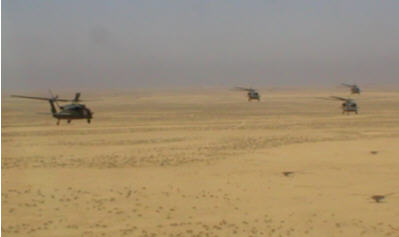
Before we begin — Debnam Pass is narrow gap in a rugged mountain complex north of Fort Irwin proper. The gap chokes down to around 600 meters at its narrowest point and forms a 2 km lane from west to east.
So there we were …
During prep, around 18 hours before we expected the attack, the sky to our west filled with Blackhawk Helicopters. It appeared that the enemy was coming much sooner than we expected. We scrambled our BMP’s and Tanks to their fighting positions while the infantry clamored up the walls of the narrow pass to their holes in the desert.
The Blackhawks set down on the west side of a hilltop about 6km away from us. In just a minute, the birds were back up and headed back in the direction from which they came. It had all happened too fast for us to react to, at a time we hadn’t expected, and in a location that seemed useless to them.
We were on the edge for the rest of the day and into the night. As the sun set, there was still no sign of the infantry that must have emerged from those helicopters. Around 2300, the valley filled with the unmistakable sound of engine noise from armored vehicles. Soon, we realized there were six Sheridan tanks making there way towards us. These were armored recon vehicles (no longer in the inventory). We had a brief engagement with the Sheridan’s in which one or two of them were hit and the rest withdrew. Again, nothing came of it and we waited.
A few hours later, I heard a noise behind my position. I looked from my hatch and couldn’t see anything, but I could clearly hear voices. As I concentrated, it soon became apparent that I was seeing the troops who had unloaded from the helicopters some 15 hours earlier. A company of infantrymen was descending upon me and I knew I was done for.
This unit knew what it was doing. They knew our motorized rifle battalion had firepower, air defense, artillery support and mobility so they didn’t try to land on top of us. They also didn’t land in an open area that we could easily drive to. They landed within the security zone and immediately faded into the rugged mountain terrain that our armor could not negotiate. We had to wait for them and they came in the dead of night from the rear. The time and place was excellent and played to the Air Assault Task Force (AATF) strengths.
The AATF hit the middle of our line and took out a platoon’s worth of armor. They then moved quickly to the rugged valley walls where they harassed us all night. They kept us up and distracted, they weakened our position, and undoubtedly gained and passed on valuable intelligence about our disposition. Their overall plan was a success and their ground tactical plan was well conceived and executed. That’s the topic for this segment—the ground tactical plan.
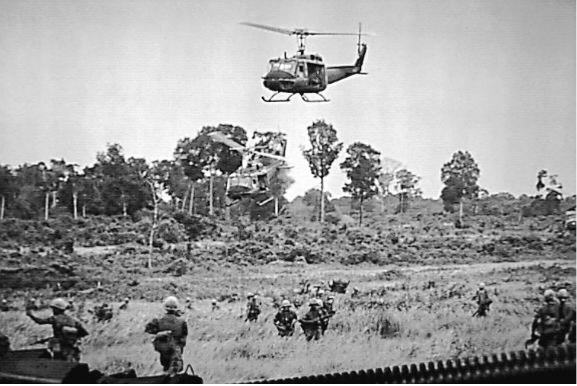
Let’s do a quick review—all air assault missions include five nested and complete sub-plans.
1. Ground Tactical Plan (AATF CDR)
2. Landing Plan (AMC)
3. Air Movement Plan (AMC)
4. Loading Plan (AATF CDR)
5. Staging Plan (AATF CDR)
AATF CDR – Air Assault Task Force Commander; an infantry company, battalion, brigade, or division commander
AMC – Air Mission Commander; an aviation troop or battalion commander
Remember that we use the reverse planning sequence. We start at the objective and work our way back to the line of departure. For an air assault, we start at the ground tactical plan (GTP) and work back to the beginning, the staging plan. Even within the GTP, we start at the objective and work back.
What is the GTP?
The Ground Tactical Plan is commanded by the AATF Commander and encompasses the specific actions in the objective area to ultimately accomplish the mission and address subsequent operations. The ground tactical plan is the actual mission itself and
is ideally the same as any other infantry mission, except that it is designed to capitalize on the speed and mobility of the helicopter to achieve surprise and increase the probability of mission success. The ground tactical plan is the baseline for all other planning.
Defining the Objective.
Since the objective is the mission, it follows that planning begins with defining and breaking down the objective. The AATF Commander and staff must ask themselves a few key questions, which we will go through in detail.
Is the objective terrain oriented? To answer this question you have to look at your mission statement. Tasks like seize, secure, or occupy imply a terrain oriented objective. Has your unit been assigned the task control a key piece of dirt? This is common. Some examples of terrain-oriented tasks are to seize the far side of a river crossing in order to provide security for the crossing forces. Another common task is to seize a defile in order to allow follow on forces to pass through safely. An AATF might be tasked to seize high ground that dominates an avenue of approach or main supply route.
So, what if it is a terrain oriented objective—what then? You must determine whether it is defended or not. It may well be a piece of ground that is only important when related to the friendly scheme of maneuver and thus, may not be defended. This is often the case when seizing far side objectives in a river crossing operation. If the objective is undefended then the goal is to get on it as soon as possible and establish a hasty defense in order to retain it should the enemy counterattack. To set up the hasty defense, the Commander must determine from where and in what direction will the enemy counterattack. He must also consider the enemy composition—will he come with armor or infantry or a mix. The AATF must also be ready to defend against enemy air and artillery. On the other hand, the terrain might be key to both sides. In this case, its seizure will be opposed.
Is the objective enemy oriented? If this is the case then the mission is to eliminate an enemy force and the associated tasks would include destroy, clear or defeat an enemy force, obstacle, or fortification. An example of an enemy oriented objective would be the Eben-Emael fortress during WWII. Eben-Emael was a Belgian fortress between Liège and Maastricht defending the border. On 10 May 1940, 78 German paratroopers landed on the fortress with gliders and used shaped charges to penetrate the bunkers. By 11 May, the fortress surrendered. The glider assault of the fortress would probably be an air assault today. Planning for an enemy oriented objective is the same as planning for an attack on any enemy position.
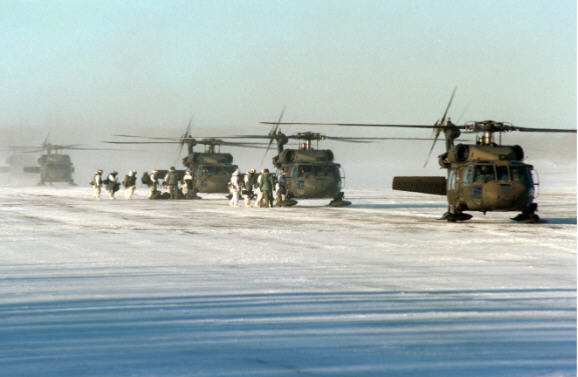
Landing Zone (LZ) Selection
This is based on the above definition of the objective. Once you determine if it is terrain or enemy oriented you must then determine if it is defended. We’ll assume it is defended for the rest of this discussion. Next, we need to know if the defense is strong or weak. Is it covered by air defense artillery (ADA)? Is there artillery near by? Is there a mobile reserve near by? Are they strong or weak? How mobile are they? Can surprise be achieved? All these factors come into play when picking your landing zones.
Landing on the objective—vertical envelopment. Vertical envelopment is high risk regardless of the situation. It is attempted when surprise can be accomplished—for example you don’t attempt a vertical envelopment in the desert where everyone in the world can see your birds coming. It might be possible in mountainous or dense forest where the approach is masked and the sound is lost and surprise is possible. It can be executed when the defense of the objective is non-existent or extremely weak; where ADA is weak; reserves are weak or immobile; and artillery is easily suppressed or out of range. Vertical envelopment can also occur when significant deception or other operations distract the enemy.
Landing near the objective. This is the most common approach. In this case; the objective is lightly defended, artillery and reserves exist, but are either suppressed or not within range to be rapidly responsive—you can clear the LZ and move to the objective or arrange LZ defenses before they arrive.
Landing far from the objective. This is an excellent option when time is available for the AATF to move to the objective. Landing away from the objective on a seemingly unimportant LZ plants phantoms in the defenders mind—where did the troops go when the birds left? This option is taken when the objective is strongly defended, has good ADA and powerful and mobile reserves, and is within range of supporting artillery.
All in all, intelligence preparation of the battlefield is key, since the enemy situation must be ascertained along the flight path as well as in and around the objective. We’ll now make our way through some of the basic planning factors for the ground tactical plan.
GTP Planning Factors
Recon and Surveillance (find and track the enemy). Reconnaissance involves finding the LZ, the enemy, the reserves, the artillery and the air defense artillery among other things. Surveillance involves keeping eyes on the target once it’s been found.
The first eyes to go down range will most likely by one or more unmanned aerial vehicles (UAV). The AATF Commander usually focuses the UAV on the most dangerous threats: air defense and artillery. The division long-range surveillance detachment (LRSD) goes next, probably targeted by what the UAV found. The LRSD will keep eyes on the most dangerous targets and report.
The R&S assets above are usually controlled above the level of the AATF Commander, but the battalion Scouts and Pathfinders are his to direct. The Pathfinders will find the landing zones while the scouts will find the objectives.
Pathfinders are airborne specialists that go in advance of airborne and air assault operations. They came into existence during WWII in the wake of an airborne debacle during the Anzio Operation in Italy. The Anzio paratroopers were dropped all over the place, and none too close to the assigned objectives. It was determined that airborne scouts were needed. For an airborne operation to succeed the Army needed people on the ground before the paratroopers arrived. They would verify Landing Zone suitability, keep up to date with the weather and talk in the inbound aircraft.
Today’s Pathfinders are usually organized in 12 man teams. They are specially trained and equipped to perform their tasks. Air assault or airborne, the Pathfinders usually parachute in at night prior to the mission. Once on the ground the Pathfinder team moves to the proposed landing zone (LZ). When they find it they have several tasks to execute:
- Measure the LZ in order to determine how many aircraft it can handle
- Determine the formation that accommodates the most birds
- Eliminate obstacles on the LZ
- Mark the LZ so that incoming birds can see where to land (day or night)
- Take weather and wind readings on the surface and at altitude
- Establish ground to air (GTA) communications
- Determine land heading and direction for incoming birds
- Provide air traffic control (ATC) for the LZ
- Provide terminal guidance and control LZ operations
As you can see, when Pathfinders are available they are invaluable. The first birds into the Pathfinder cleared LZ should be the AATF Scouts.
Your Scouts should be tasked to find your objectives and sub-objectives. They should also recon the route from the LZ to the objective. Once on site, they can establish surveillance to report on activity in and around the objective. Scouts can also over watch key roads and trails that reinforcements might take to relieve the defenders. Planning, sequencing, and directing your scouts are key. They must know what to look for, what to report, and when and where to be in place.
Once the ground R&S assets are in place and are reporting, the mission can ‘lift off’. At this point, the R&S asset becomes the observation helicopters (OH) or scout birds. Scout birds usually fly in tandem with attack helicopters. The scouts identify targets and the attack helicopters hit them—unless the scouts are armed which is more and more common. The lead aerial recon looks for enemy artillery, ADA and reserves enroute. He also looks for groups of small unit infantry who can present small arms for air defense (SAFAD) threat.
Main Effort (concentrate combat power at the decisive point). Based on the nature of the objective and the composition of its defenders, the AATF must designate and resource his main effort—the force that will achieve the decisive results on the objective. You must determine what is the main effort (ME) task and purpose—seize, secure, retain for terrain oriented objectives and destroy, clear, defeat for enemy oriented objectives.
Weighting the ME (task organization). It isn’t always best to load down the ME with the most stuff: sometimes it’s best to keep them as light and nimble as possible. The Commander must ensure that they can breach obstacles if the mission requires and that they have mortars and AT in support—again, if it’s required. As with any objective, the Commander must assess the enemy on target and then decide what it will take to dominate them. In an air assault, this decision is tough since birds must be arranged to get the required men and equipment in place at a given time.
Supporting Efforts. Everything these guys do is designed to make the ME succeed. They shape the battlefield for the ME by fixing and controlling the enemy in depth. Supporting efforts can fix, suppress, isolate, block, deny, contain, support by fire, or attack by fire. SE units may be augmented by UAV, ADA, CAS, FA, AH indirect fire (IDF) to include mortars. They may also include engineers for mobility, countermobility and survivability.
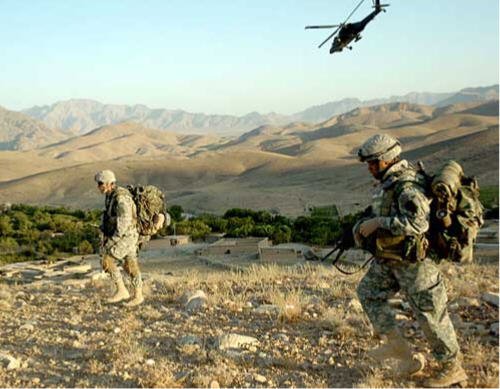
Missions
Secure and defend. This mission is normally executed in two phases and is conducted when the objective must be seized and retained. The limited staying power of the AATF dictates early linkup with ground units, reinforcement, or extraction. The first phase is an attack to secure terrain—usually done in a single-lift insertion of sufficient combat power to defeat the enemy on the objective. The second phase is the defense to retain the objective. The AATF normally establishes an airhead: a perimeter defense that controls all terrain essential to holding the objective. The airhead provides operating space for combat, CS, and CSS units and includes LZs for simultaneous landing of artillery, follow-on forces, and supplies. The airhead is small to defend, but large enough to permit defense-in-depth and maneuver of reserves. As a rule, the area an infantry battalion can defend is 3 to 5 kilometers in diameter. Size is dictated by mission, enemy, terrain, and combat power.
In-stride breach. This rapid technique uses standard actions on contact and normal movement techniques and consists of preplanned and rehearsed breaching actions. The in-stride breach takes advantage of surprise and initiative to get through the obstacle without losing momentum. The AATF uses an in-stride breach against either weak defenders or simple obstacles.
Deliberate breach. This is used when the AATF must attack a strong defense or a complex obstacle system. The deliberate breach requires the far side of the obstacle be secured by an assault force either before or during the reduction.
Assault breach. This technique is used to break a dismounted force by assaulting through obstacles onto the enemy position. Depending on the size and difficulty of the defensive obstacle system, the assault breaching procedure can be a variation of either the in-stride or deliberate breaching technique.
Covert breach. This technique is used to pass secretly through obstacles. The covert breach uses elements of the deliberate or in-stride breach. Surprise is the main factor in the decision to conduct a covert breach. Covert breaching requires stealth to reduce the obstacle.
Breach Organization. The commander will organize the support, breach, and assault forces with the necessary assets to accomplish their missions. The support force mission is to prevent the enemy from interfering with the breaching operation. Suppression is critical, therefore the AATF allocates direct-fire and indirect-fire systems to achieve a support force ratio of three-to-one. The support force must isolate the battlefield with fires and suppress enemy fires covering the obstacle; fix the enemy and destroy weapons that can bring fires on the breaching force; and control obscuration smoke. The breach force breaks through the obstacle and creates lanes for the attacking force to pass through. They also mark the lanes at entry points for the assault and follow-on forces.
The breach force is a combined arms force including engineers with breaching assets and enough infantry to provide local security and suppressive fires. Lastly comes the assault force whose role is to destroy or dislodge the enemy on the far side of the obstacle. The assault force may help the support force while the breach force reduces the obstacle or, if the obstacle is lightly defended, be combined with the breach force. The Commander must leave enough combat power to overcome any defenders beyond the obstacle after breaching is accomplished.
Utilizing All Your Assets
Synchronization of CS and CSS is critical to all operations and air assault is no exception. Below we will highlight some things to think about when planning to utilize all your assets.
Antiarmor. The TOW HMMWV unit selects TOW positions where it can provide direct-fire support. The commander can also use the MK 19, the .50-cal machine gun, or the M60 machine gun instead of the TOWs based on the enemy situation. The antiarmor company can provide mobility and firepower as the reserve.
Artillery. The AATF fire plan takes into account multiple contingencies and may be synchronized with attack aviation, close air, and mortars.
Mortars. Mortar priority is normally to the main effort. They usually collocate with other units for security.
Air Defense. The AATF will normally have Stingers attached whose mission is to provide security for the command post or the main body. ADA elements can also operate from key terrain over watching the objective. ADA units usually must have support to provide their security.
Engineers. Engineers identify breach points, conduct route reconnaissance, determine bridge classifications, and find or make bypass routes where required. Using demolitions and chain saws, engineers clear LZs for further support.
Aviation. Aviation units conduct recon, guide forces to the enemy, provide lift and fire support, direct artillery, assist with command and control, and protect the flanks. Attack helicopters can reinforce when anti-armor firepower is used to block the enemy.
Close Air Support. Air controllers position forward with attacking units to direct the speed and accuracy of CAS. To reduce fratricide, the battalion may issue aircraft identification panels or use other means such as colored smoke to identify its soldiers.
Command Posts. The commander positions himself to receive information during the mission. He plans ahead for shifting assets or committing the reserve and decides when to move the command post.
Culminating Point.
The culminating point is the moment when the strength of the attacker, including its reserves, no longer exceeds that of the defender. Attacking beyond this point may cause overextension and increases the chance of defeat. The AATF must attain its decisive objectives before this point.
Attackers lose momentum when they encounter heavily defended areas that cannot be bypassed. They could also reach the culminating point when ammo runs low; when soldiers become exhausted; equipment losses mount; reserves are unavailable; the defender is reinforced; or the defender counterattacks with fresh troops. The AATF establishes hasty defenses when the attack loses momentum.
Consolidation and Reorganization (C&R).
Consolidation of the objective and reorganization of the unit are critical to success. Both must be planned before the mission.
Consolidation. Consolidation is the organizing and strengthening a newly captured position for defense. Consolidation can be the rapid re-distribution of forces to defeat the counterattack; or preparation for defense. The AATF consolidates on the objective only if the mission or situation requires since it is preferable to consolidate on terrain adjacent to the objective. Disadvantages to consolidating on the objective include the fact that the enemy knows the terrain and might have fires and counterattacks planned there.
In consolidation, the first step is to establish security. This is accomplished as soon as each assault element occupies its position. Each unit emplaces OPs to monitor the likely enemy avenues of approach. Next the units must destroy, capture, or cause the withdrawal of all enemy vehicles and soldiers on their respective objectives and then position forces in a hasty defense. Commanders consider follow-on missions when positioning forces during consolidation. Attacking elements occupy enemy positions only when necessary, such as when indirect fire is incoming. Anti-armor units cover mounted avenues of approach while infantry covers dismounted avenues of approach. Fires are planned and target reference points (TRPs) are designated during consolidation. Reconnaissance begins is initiated by mounted and dismounted patrols along enemy avenues of approach. The AATF must also prepare for on-order and follow on missions (branches and sequels). The most likely on-order mission is to continue the attack. Intelligence gathered during recon is used to adjust plans for contingency missions.
Reorganization. This includes all actions to prepare for further attack or pursuit of the enemy. Reorganization is continuous throughout the attack and includes the following steps:
- Replace key soldiers; leadership positions must be filled and, when heavy losses occur, companies can be reconstituted from the remnants of other companies.
- Report unit status; units inform the commander of their location and status.
- Evacuate required casualties, EPWs, and damaged equipment.
- Redistribute supplies, ammunition, and equipment within the units as needed and as time permits and plan for further operations.
- Fragmental orders (FRAGO) are issued as required and command posts are positioned for the conduct of further operations.
Elements of the ground tactical plan.
Remember, the entire air assault revolves around the ground tactical plan. If you cannot complete your mission then there is no need for an air assault. Plan this portion first and in detail and then work your way through the other four plans ensuring that they support your ground plan. You only modify the ground plan when the other plans cannot support such as when the LZ’s are insufficient or the air routes and timing cannot support your scheme of maneuver.
REVIEW
The ground tactical plan for an air assault operation contains the same elements as any other infantry attack but differs in that it is prepared to capitalize on speed and mobility in order to achieve surprise. Assault echelons are placed on or near the objective and organized so as to be capable of immediate seizure of objectives and rapid consolidation for subsequent operations. If adequate combat power cannot be introduced quickly into the objective area, then the air assault force must land away from the objective and build up combat power. The air assault force then assaults like any other infantry unit and the effectiveness of the air assault operation is diminished. The scheme of maneuver may assume a variety of possibilities depending on the commander’s evaluation of METT-T including, in particular, the availability of LZs in the area. The plan should include:
(1) Missions of all task force elements and methods for employment.
(2) Zones of attack, sectors, or areas of operations with graphic control measures.
(3) Task organization to include command relationships.
(4) Location and size of reserves.
(5) Fire support to include graphic control measures.
(6) Combat service support.
NEXT MONTH
Working our way back, in our next article we will focus on the landing plan. Obviously, to have any chances in making the ground tactical plan a success; you must first get on the ground. In our article, we will detail how to get the troops on the ground.
AIR ASSAULT!!
