




Tactics 101 032 – Obstacle Emplacement
THE ART AND SCIENCE OF OBSTACLE EMPLACEMENT

“An obstacle loses 50% of its value if you stand back from it, allowing the enemy to reconnoitre the approaches and subsequently to cross without interference.”
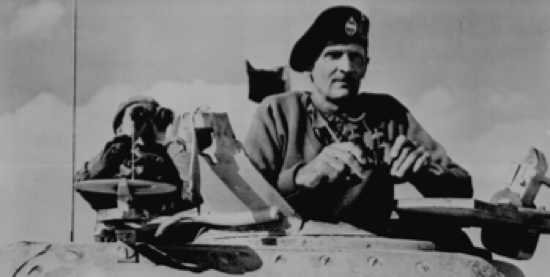
— Field Marshal Bernard Montgomery (pictured below)
LAST MONTH
In our last article, we focused on the planning of the engagement area. Our discussion keyed on answering several key questions. These included: 1) What is an engagement area? 2) Why is it important? 3) What is the Commander’s thought process in planning an engagement area? 4) What are the steps in building an engagement area? 5) What are the keys to success in building an engagement area and ultimately achieving success?
THIS MONTH
During last month’s article, we emphasized the critical relationship between indirect fires, direct fires, and obstacles in the execution of a defense. Certainly, an obstacle plan which has been developed with this relationship in mind greatly increases the potential for success in the defense. However, devising and implementing this plan is no simple endeavor. It is a blend of both art and science that is not acquired by a commander and his staff overnight.
This month, we will begin a two-part series on obstacle emplacement. In our first article, we will set the conditions by addressing some key concepts and terminology as it relates to obstacles. In our next article, we will put it all together and go through the process of planning an obstacle system.
To set the conditions we will answer the following questions: 1) What is an obstacle? 2) What is the difference between an existing obstacle and a reinforcing obstacle? 3) What are the types of reinforcing obstacles you may utilize? 4) What are the four types of obstacle effects we want to achieve on the battlefield? 5) How do we integrate each of these effects with direct and indirect fires?
THE BASICS – KEY TERMINOLOGY
Let’s begin with some basic terminology as it relates to our subject. First, what is an obstacle in ‘Tactics 101’ terms?
Definition:
“An obstruction designed or employed to disrupt, fix, turn, or block the maneuver of your enemy. This action should ultimately result in additional losses in personnel, resources, and time to your opponent”. Critical in any discussion of an obstacle is that it has a purpose. It is constructed with a distinct purpose and intent in mind. If an obstacle does not have a purpose or intent, the construction of it is a complete waste of time and resources.
Why Obstacles?
Obstacles are vital in the defense for several reasons. First, they are utilized to influence the maneuver of an attacking enemy. Second, as discussed earlier they are a key factor in greatly improving the lethality of a unit’s indirect and direct fires. Finally, they can protect a unit from enemy attack and provide valuable time to repel that attack.
Types of Obstacles
There are two basic types of obstacles – existing and reinforcing. Existing obstacles are just that – obstacles already existing on the battlefield. They can be of the natural variety such as rivers, hills and mountains, and forested areas. Or they can be of the cultural kind (man-made terrain features) such as population centers, bridges/canals, and railroad embankments/tracks. It is the wise commander who can best utilize existing obstacles in his defense. After all, the price in terms of resources to emplace them is basically free. In these economic times; that is important!
Reinforcing obstacles are physically constructed, emplaced, or detonated by a force to achieve a specific purpose against his opponent. We further sub-divide reinforcing obstacles into two categories – tactical and protective. Let’s discuss each.
Tactical – These are obstacles utilized by a force to hinder, influence, or deny completely the ability of its’ enemy to maneuver. Obviously, these obstacles should be completely integrated with a unit’s indirect and direct fire plans and any friendly maneuver the unit has planned (counterattacks etc…). Because of this integration, they must have a distinct purpose which is tied to the fire plans.
Protective – As the name suggests these obstacles are emplaced by a force to protect themselves from their opponent’s final assault of their defensive positions. In the simplest of terms, this is the unit’s last line of defense before a potential enemy breakthrough of their battle position.
Types of Reinforcing Obstacles
Anyone with even a remote interest of military history has seen countless types of reinforcing obstacles. It seems that almost anything has been used by a force as an obstacle. If it was planned and prepared properly and integrated with fire and maneuver it was probably effective. We can categorize these various obstacles into the following five areas: contaminates, constructed, demolitions, expedients, and land mines. Let’s discuss each in order to assist us in understanding next month’s article in planning and preparing obstacles.
Contaminates
When you think of obstacles, contaminates may not directly come to mind. However, the use of nuclear and chemical weapons has certainly been employed in the past as we are all well aware. In terms of utilizing contaminates, in particular chemical weapons, perhaps the best example is the old Soviet doctrine. For those who remember the Cold War Days, Soviet doctrine addressed extensively the use of persistent and non-persistent agents in the defense. In their doctrine, chemicals were clearly utilized as an obstacle. They would tie-in agents to potentially seal off pieces of terrain (block) and cause chaos (disrupt).
Those of you who fought the OPFOR at the National Training Center during the conventional fight days can remember this use. The OPFOR had several purposes for chem. For example, they would utilize them to potentially take away avenues of approach from the BLUEFOR. This was especially true when they were constrained in terms of troop strength. They would also fire agents at or near the BLUEFOR reserve (when located) to fix or even block their future maneuver. The OPFOR’s use of contaminates was instrumental in their success.
Of course, the use of contaminates can many times be a crap shoot because of the weather and environment. Winds and temperature can greatly affect their use and can even cause contaminates to be an obstacle against you. They are the proverbial high payoff-high risk endeavor.
Constructed
As the name suggests, constructed obstacles are those emplaced by Soldiers and their equipment. These obstacles normally require significant sweat on the part of Soldiers to emplace, hard hours by mechanical equipment, and a well-developed logistical and movement plan to ensure the correct resources and equipment get to the right place at the right time. Critical in the emplacement of constructed obstacles is making sure obstacles are emplaced in the right location. You will never see morale drop so much in a Soldier as when he is told that the obstacles he assisted in constructing must be tore down because it was put in the wrong place.
Examples of constructed obstacles include the use of wire (concertina, barbed, etc…), digging tank ditches, placing log cribs in mounted avenues of approach, and tying in hedgehogs and tetrahedrons into an obstacle plan. In most cases, you find obstacle systems consist of an array of individual constructed obstacles.

Demolitions
Watch any war film (or film for that matter) and you are likely to see your share of demolition obstacles. Additionally, study historical battles and engagements and quite possibly you will discover that demolitions played a key part in influencing the outcome. We break demolitions into two groups – preliminary and reserved. There are several differences between the two. Preliminary demolitions are not vital to a commander’s plan and they can be detonated whenever the tactical situation warrants. On the other hand, reserved demolitions are essential to the accomplishment of the plan and require a written demolition order to execute. Typical uses for demolitions are blowing craters in roads and runways, blowing track apart on railroads, destroying bridges and tunnels, demolishing buildings, and destroying dams to cause flooding.
Expedients
Remember the old episodes of McGyver? Now there was a man who could use expedients! In the world of obstacles, expedients are anything you can find to utilize as an obstacle. It is in the urban operations environment in which you really see a vast array of expedients used as obstacles. Some rubble here, some old cars there and in the ingenious mind of the Soldier you have all the resources you need to create a formidable obstacle. Expedients can really be of huge value on the battlefield. They do not tax the logistical system and if crafted properly they can truly blend into the environment. Consequently, the surprise factor to your enemy can be significant.
Land Mines
When you think of obstacles, land mines quickly come to mind. Unfortunately, as we frequently see in the news, the tragic effects of mines are found years after conflicts have ceased. Since the days before World War II, we have seen an unbelievable rise in the number, uses, and technology of land mines. In fact, it is estimated today there are almost 3,000 types of mines and fuses.
Land mines can be of the anti-tank (AT) or anti-personnel (AP) type. It is in the field of anti-personnel mines that have come under severe scrutiny in the past years. The Unites States, in particular has imposed extremely severe restrictions on the use of AP mines on the battlefield. However, there are other countries or groups who have not imposed these restrictions. Thus, they may utilize AP mines separately or mixed with AT mines.
Land mines can serve numerous roles. First, they are a significant resource in assisting units achieve the obstacle effect they desire. Second, assisting in achieving this effect can truly increase the lethality of a unit’s direct and indirect fire systems. Third, AT mines can inflict vehicle casualties in their own right. These can be of the catastrophic type or more than likely of the mobility type. These mobility casualties occur when a vehicle hits a mine and the explosion damages a vehicle’s suspension system (track, wheels, etc…). This damage makes the vehicle immovable and now makes the vehicle an obstacle itself. Finally, mines can have a huge psychological impact on the battlefield. The sight of a mine exploding and damaging a lead vehicle within a unit can dramatically impact the psyche of the Soldiers in that unit. This can lead to units either conducting actions haphazardly or at the other end of the spectrum becoming paralyzed in thought and action.
We term land mines as either conventional or scatterable. Let’s discuss each.
Conventional mines could be termed as “old school.” These mines are either emplaced by hand (not always a fun task) or by a mine-laying vehicle. Mines are either emplaced in a distinct pattern or simply placed randomly. The major characteristic of a conventional mine is that they do not self-destruct. These mines will stay armed until they are either detonated or disarmed (again, not a fun task). Generally, the task of emplacing these types of mines is time and Soldier intensive.
With technology has come the arrival of the second type of mine – scatterable. Scatterable mines are significantly different from conventional mines. First, these mines are not emplaced by a Soldier’s hands. Technology enables these types of mines to be emplaced by a variety of means including artillery pieces, helicopter, and fixed wing aircraft. Second, scatterable mines do self-destruct after a period of time. With that said, let’s discuss in very simple terms how these mines work.
After being delivered by the aforementioned means, the individual mines hit the ground and after a short period of time (minutes) become armed. These mines are now active and will detonate if a vehicle hits the tripwires extending from the mine. The arming of the mine also activates the self-destruct timer within the mine. Once the duration is complete, the mine self-destructs in place. The duration of the mines is from a matter of a few hours to a period of weeks.
The advantages of these mines are numerous. These include: 1) Because of the delivery means; an obstacle utilizing the means can be emplaced quickly. 2) Again, the delivery means enables the mines to get to locations that conventional mines may not be able to get to. 3) Since they do not require a Soldier to physically emplace; valuable time is saved so these Soldiers can be utilized elsewhere. 4) Technology has made these mines much more lethal than conventional mines. 5) Their relatively small size (as compared to conventional mines) places a great deal less stress on a unit’s logistical system.
Scatterable mines are not without their challenges. First, the delivery means (especially since they are generally delivered through the air) requires detailed coordination. Second, because of their small size and various camouflage patterns; these mines can also cause causalities to friendly vehicles who do not know the minefields have been emplaced. Third, although the delivery means are accurate; scatterable mines simply will not be as accurately emplaced as a hand emplaced conventional minefield. Finally, there is a dud rate on these mines. This occurs principally because the mines land in positions that do not enable them to arm or utilize the trip wires. However, in total, these challenges pale in comparison to the distinct advantages of the scatterable mine.

Obstacle Effects

One of the key things the commander must decide is what effect (s) he wants his obstacles to achieve for him. Effects must be synchronized with the indirect/direct fire plans and any potential maneuver in the defense. When the commander discusses the use of obstacles in his defensive plan; he needs to talk in terms of effects. He doesn’t need to tell his staff how many mines he wants here or how he wants his obstacles to look like. That is why he has expertise on his staff. The commander tells the staff what effects he wants and lets his experts determine how to achieve the effect. Let’s discuss the four commonly used effects in obstacle emplacement. We will provide a general overview of the effect and then address how it is synchronized with fires.
Disrupt – If a Commander is concerned about the mass the enemy can attack his defense with; he will want to break up that attacking formation before it reaches his main battle positions. In that case, in terms of obstacle effect he will ask to emplace disruption obstacles. The object of these obstacles is to disrupt the enemy’s march formation, put some chaos in his command and control, upset his timing and synchronization of his assets, and cause him to commit his breaching assets too early. The commander believes if he is successful in the above, the enemy will move into his main engagement area piecemeal (or in smaller formations) negating his mass. These smaller units will enable his forces to have more lethality with his fires.

In the above sketch, you see obstacles emplaced to persuade the force to seek a bypass around the obstacles (avoiding a breach). As the enemy moves into the bypass, they begin receiving a combinition of indirect fires and longer range direct fires (ant-tank missile systems etc.) The longer range systems are used, since as discussed above, disruption obstacles are emplaced forward of the main engagement area. Again, we want this forward obstacle system to cause our enemy to commit resources early so they are not available later when he needs them. If the enemy decides to breach rather than bypass, we shift fires into the obstacles and make his breach extremely painful!
Turn – When a Commander wants to take advantage of his quick firing weapon systems and desires his enemy to provide flanking shots to him; he will ask for obstacles to provide a turning effect. The Commander wants these obstacles to assist in making his opponent maneuver in a specific direction. Achieving this effect, can be challenging for a unit to accomplish for several reasons. First, the positioning of the obstacles must not be so obvious that the enemy quickly realizes that you want him to turn. Remember, the enemy thinks too! Second, there must be an identifiable bypass for the enemy to maneuver thru. Finally, the overall situation must entice the enemy Commander to want to make the turn.

The first thing that must be attained in setting conditions for the turn is a strong anchor point (the beginning of the obstacle complex which entices the enemy to turn). There are several things the Commander should do in developing this formidable anchor point. First, he should utilize the existing terrain. If at all possible, the anchor point is tied in existing terrain which is extremely difficult for the enemy to maneuver through (i.e. rocky terrain, hills or mountains, water obstacles). Second, the area around the anchor point must be heavily covered with effective indirect and direct fires. This is done to ensure the enemy does not conduct a successful breach of the obstacle at the anchor point. After all, if the enemy does not receive this fire; it is quite possible he will attempt to breach at the anchor point. Thus, there will be no possibility he will execute the turn. Third, if the unit has sufficient dismounted infantry; they should be dug-in near the anchor point. This assists in strenghening the anchor point and assits in “persuading” the enemy to turn.
Once the enemy has committed to the turn, you must have a comprehensive and synchronized direct and indirect fire plan to achieve success in the defense. Critical in this is not to show your hand too early. The Commander must enable a sufficient number of enemy vehicles to make the turn, thus providing lucrative flank shots to the defender. This fire plan should include things such as: 1) trigger lines; 2) unit sectors; 3) what types of friendly vehicles fire at what types of enemy vehicles. For example, tanks fire at tanks, fighting vehicles fire at troop carriers, etc… If this detail is not planned, a unit will not be able to take full advantage of the targets it will be presented during th enemy turn.
Fix. The effect fix does not mean completely stopping an enemy attack (that is block which we will discuss next). What it does mean is the commander wants obstacles to sufficiently slow down the advance of the enemy attack towards him so he can place effective fires thus leading to success. With that in mind, the obstacle system is generally positioned in depth. This then makes the opponent breach several obstacles consequently slowing his attack momentum. Fixing obstacles are not only utilized in a deliberate defense, but are very effective when a unit needs to conduct a retrograde operation (retirement, withdrawal, delay). These obstacles buy a unit time which is so critical in a retrograde. Note: fix and disrupt may sound similar. The difference is that disrupt obstacles are further away from the main defense area and chiefly involve indirect fires. The disrupt effect is generally desired before the enemy reaches the main engagement area.

The beginning of the obstacle system generally starts at the maximum effective range of your longest direct fire weapon (this should be the beginning of the engagment area). Thus, if you possess anti-tank weapons which have an effective range of say 3,000 meters; then the first fixing obstacles should be placed at that distance. These systems should begin firing when targets present themselves. Again, we are attempting to slow down his advance. It is amazing what a few effective direct fire (coupled with indirect fire) shots will do to the momentum of an attack. The formation of the obstacl esystem should be such as it encourages the enemy to maneuver in a line formation versus a column. This provides more targets to engage. As the enemy progresses through the obstacle system, he should encounter more obstacles and more intense fires. The commander should plan indirect fire targets near areas where he believes the enemy may attempt to bypass the obstacle system.
Block – The most intensive effect a Commander may desire is block. The objective of blocking obstacles is to literally stop the maneuver of the enemy. These obstacle systems are very complex, employed throughout the depth and width of the engagement area and are resource intensive (materials utilized, man-hours to construct, etc…). These obstacles are synchronized completely with all fires with the sole purpose of destroying the enemy in that engagement area. The complex of blocking obstacles is firmly tied into the terrain so there are no potential bypasses for the enemy to maneuver around.

The integration of obstacles and fires is critical here. As the enemy moves into the obstacle complex and moves their breaching assets, fires are focused on destroying those vital resources. Throughout the battle position, weapon systems are positioned so they can engage targets effectively in the engagement area. They must take advantage of the effect of the obstacle system. As the enemy becomes bottled up in the engagement area due to ineffective breaching; he should pounded by close air support and artillery. In combination, this should lead to a true “kill zone.”
What Does the Graphic Mean?
In graphics, every line, arrow, etc. has a meaning. Obstacle effects are no different! In case you see these graphics on a mapsheet or overlay, here is what they mean.
The first question that always comes up is: What is relationship between the direction of the arrows and the the direction of the enemy attack? The answer is — the arrows always follow the direction of the enemy attack. With that establsihed, here is what the other symbols for obstacle effects mean.

Disrupt – The shorter arrows specify where the enemy is disrupted by obstacles. The longer arrow identifies where there is a bypass for the enemy to maneuver. This bypass area is covered by direct and indirect fires.
 Turn – The heel of the arrow indicates the anchor point for the obstacle. The direction of the arrow is the desired turn direction for the enemy to maneuver.

Fix – The irregular part of the symbol indicates where enemy maneuver is drastically slowed down by the placement of obstacles.

Block – The ends of the vertical line show the limit of advance for the enemy. This line also designates the width of the obstacles or where they are tied into existing terrain obstacles. The horizontal line is relative to the depth of the obstacles.
A REVIEW
Perhaps, the biggest takeaway from this month is that effects drive the train. A commander at any level must articulate to his staff/Soldiers what he wants his obstacles to achieve. This in turn should be completely synchronized with the unit’s direct and indirect fire plans. Obstacles cannot be emplaced without a specific intent. This is a complete waste of resources and emplacing obstacles is certainly resource intensive. Be it turn, fix, disrupt, or block this effect must be understand by all those on the ground.
NEXT MONTH
In our next article, we will provide you a planning process on how to develop an obstacle plan. We will discuss resourcing, capabilities, and the importance of knowing that even under the best conditions you cannot do everything you want to do. Again, obstacle planning is not executed in a vacuum. From the beginning it must be synchronized with all your assets to make your obstacles as effective as possible.
