

Tactics 101 031 – The Engagement Area
2) Pre-Leader’s Recon. A good technique to use in the recon is to first quickly study the terrain where you will place your defensive positions and tentatively mark them. This simply gives you the lay of the land and makes you more knowledgeable for the reminder of the recon.
3) Higher Leader’s Recon. It is likely you will be part of your higher commander’s recon. Armed with a good background of your potential defensive positions, you can now be an active contributor to this recon. It is at this recon that you will receive early intent and find out if he has selected TRPs which you may be responsible for.
4) Internal Leader’s Recon. After completion of the higher commander’s recon, it is now your turn. Have your subordinate ready so they can quickly meet you in the engagement area. Drive the parts of engagement area in which you are responsible for. You will likely designate your own TRPs. Mark them and go through the same thought process and actions as discussed earlier.
{default}5) Finalize Positions. Following the recon of the Engagement Area, go back to your tentative fighting positions and adjust as necessary. Ensure your positions can accomplish the tasks assigned at the TRPs and are integrated with the obstacle plan. Remember it is far less resource intensive to move fighting positions than remove obstacles and start anew. Once this is confirmed then stake in your positions. This sets a blueprint for engineers or soldiers to begin constructing the positions. Additionally, besides finalize primary positions, you should also select alternate and supplementary positions. This of course will be developed after the primary positions.
6) Direct fire planning. The initial preparation of fighting positions should also initiate direct fire planning. We will discuss this in a future article, but it should include things such as: maximum engagement lines, trigger lines, sectors of fire, breaking up the engagement area into smaller pieces, fire commands etc… As we have harped on, this direct fire plan must be integrated with the obstacle plan and your indirect fire plan.
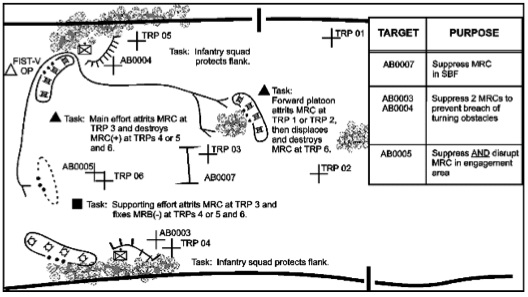
6. Plan and Integrate your Indirect Fire Assets. The commander who focuses his attention on his direct fire weapons and neglects his indirect fire assets is setting the conditions for defeat. The good commander understands how each complements one another. He knows where he may have some shortcomings in one area and how the other area can compensate for those. There are several actions the commander and his staff should do to best assist in the process planning and integrating his indirect fire assets. These include the following:
– Above all, the commander must understand what the purpose of his indirect fires is. He must define how indirect fires will assist him in achieving his overall concept within the engagement area.
– Where within the engagement area or outside the engagement area is indirect fires needed to complement the obstacle plan and direct fire plan. This will become targets.
[continued on next page]

mr sutherland please drop me aline. been waiting for some time now.
This is serious work. Why is it made so difficult to follow it? As far as I can tell…one must tediously seek articles in this series by paging through all the stuff in the college page by page?
Surely there must be a better way?
Mike In Phoenix
Mike, on the ACG home page type “Tactics 101” in the search box; be sure you enclose Tactics 101 in quotation marks. That will bring up links to each article in the series.
TY, GDS,
Will do…have the folks at AG considered adding the wikibook function? Might be outstanding.