

Tactics 101: 030 – Planning the Defense
In our example, the circles that radiate from the kill zone are used to orient battle positions or to assign platoon sectors. The engagement area is built around the Kill Zone. Contingencies are covered through the emplacement of alternate and supplementary positions and the placement of the reserve. Reserve courses of action are planned for reinforcement and / or counterattack. Mobility lanes are built to facilitate repositioning, counterattacks, and rearward passage of lines of security forces.
All of the control measures are designed to control the defense fires and the maneuver. Checkpoints, targets, target reference points, and trigger lines etc, help in reporting and employment of weapons systems.
Hardening the Engagement Area
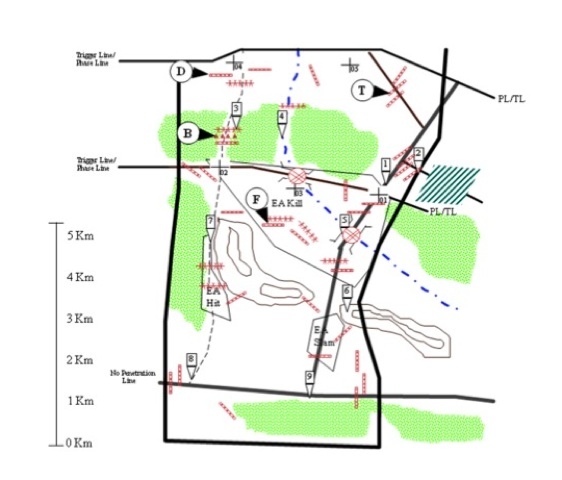 Next, the commander hardens the engagement area with obstacles that are in direct support of the direct and indirect fire plans. The obstacle intent graphics (we will discuss obstacles in great detail in a future article) need to be placed over the maneuver and fires overlays to ensure complimentary effects and integration. The obstacle intent graphics are then turned into a target list that is prioritized and emplaced. Once an obstacle is physically emplaced on the ground, the intent symbol is replaced by the actual obstacle graphic.
A commander utilizes obstacles to disrupt his opponent’s initial synchronization and formations and break up his ability to deploy smoothly. As the enemy moves in closer, obstacles are used to begin to turn him into the engagement area, providing flank shots for his units. Once the enemy is in the engagement area, obstacles fix him there so he can be destroyed in detail. Blocking obstacles are used as a last line of defense to prevent the enemy from over running defensive positions and to deny secondary avenues of approach. They also seal off flank threats.
{default}Obstacles can be deceptive in nature in the way they are built and in the way defending forces position around them during preparation. The combined effect is that the attacker is overwhelmed by decisions. If he breaches, then he has to sit in artillery. If he bypasses, then he has to turn a flank to the defender. The enemy can never be allowed to deal with a single system at any given time.
REVIEW
Hopefully, this article has provided you a ‘way’ to plan your defense. Planning a defense is a difficult endeavor. If you try to get a 100% solution, you will use all your available time in planning. Consequently, you will have little time for preparation. It is the preparation of the defense that will pay the huge dividends during the execution phase. As in all tactics, the key to success in planning the defense is knowing yourself, the enemy, and the terrain. With this as a base, you have set the conditions for planning a successful defense.
NEXT MONTH
Within this past article, we discussed many times the critical action of determining an engagement area and how this drives the planning and preparation of most defenses. Certainly, a significant number of battles are won or lost by the planning and preparation of the engagement area. Next month we will focus on this critical concept. Our discussion will include a commander’s thought process in designating an engagement area and the vital relationship between obstacles, indirect fires, and direct fires in the engagement area. We will address both the art and science of engagement area planning, preparation, and execution.

mr sutherland(black 6) i would to talk to you about a unit that fought in desert storm. Bco 3/15 infantry. also about a driver that was said to be the best bradley driver ever produced by the US ARMY. let me know if you want to talk about tactics.
Armchair General staff cannot respond here. Please read
disclaimer just above this text box before posting.
Ozone! How are you? Are you still in? I seem to remember the
unit you’re talking about but I can’t remember a great driver. I
do remember a fairly mediocre driver who needed constant
supervision to keep his vehicle running!
Lets talk!