
Tactics 101: 030 – Planning the Defense
Engagement Area Assessment
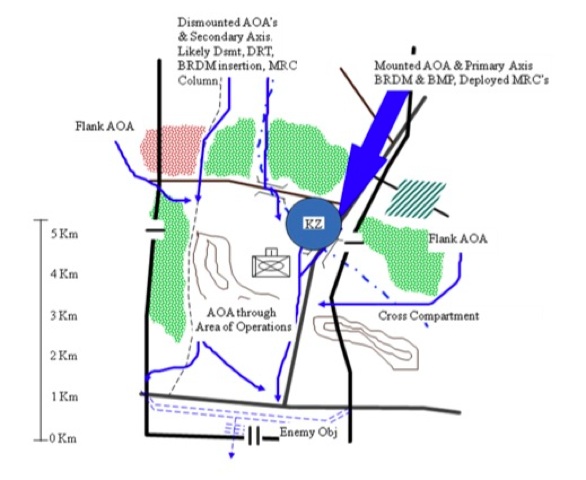 The commander must now size up his sector to see if he can kill where he wants to. Systems and Soldiers must be positioned around the KZ/Engagement Area to ensure that fires are massed there. To assist in this, the commander will designate Target Reference Points (TRPs) to concentrate his fires.
The dimensions of the sector combined with terrain analysis (utilizing the OAKOC model) provide the commander an indication of how to position his Systems and Soldiers. As a reminder OAKOC stands for the following:
O – Observation and Fields of Fire
A – Avenues of Approach
K – Key Terrain
O – Obstacles
C – Cover and Concealment
Please see the following article for more discussion of this subject:
Tactics 101: 002. The Importance of Mission Analysis in Planning.
Through this analysis, the commander is not only looking for width and depth, but also looking for line of sight and the feasibility of effective weapons employment. Depending on the type of terrain, intervisibility (IV) lines may be critical to success. As an example, those who have ever taken part in a conventional fight at the National Training Center (Fort Irwin) know the importance of owning the IV lines. He who sees first – shoots first!
Fires (mainly indirect) beyond the KZ/Engagement Area are designed to attrite the enemy, cause confusion within the formation and strip away some of his key assets. These key assets can be anything that the commander believes his opponent needs to conduct a successful attack through his defense. These may include engineer mobility assets, fire support radar, recon assets, etc…
Fires (mainly direct, but combined with well-placed indirect fires) in the KZ/Engagement Area are designed to inflict maximum damage upon the enemy. These fires should make the enemy commander wish he never maneuvered into the area.
Fires around the KZ/Engagement Area are designed to attrite forces trying to bypass this area of death and destruction.
In total, this analysis will provide the blueprint for the commander to formulate the Engagement Area. With the Engagement Area formed and a complete understanding as to the purpose of both his direct and indirect fires, the commander now positions his forces (weapon systems).
Circular Weapons Positioning (A Technique)
Direct fire analysis shows the commander where systems need to be physically located to deliver fires at the point where he wants to achieve success against the enemy. As we have discussed in many earlier articles, this is likely to be the decisive point of the operation. One technique a commander may utilize in positioning his killing systems is called the circular weapons positioning technique. This is a tool used to focus the preponderance of a unit’s weapons onto the decisive point.
[continued on next page]

mr sutherland(black 6) i would to talk to you about a unit that fought in desert storm. Bco 3/15 infantry. also about a driver that was said to be the best bradley driver ever produced by the US ARMY. let me know if you want to talk about tactics.
Armchair General staff cannot respond here. Please read
disclaimer just above this text box before posting.
Ozone! How are you? Are you still in? I seem to remember the
unit you’re talking about but I can’t remember a great driver. I
do remember a fairly mediocre driver who needed constant
supervision to keep his vehicle running!
Lets talk!