




Special Report from Afghanistan: A Strategic Threat

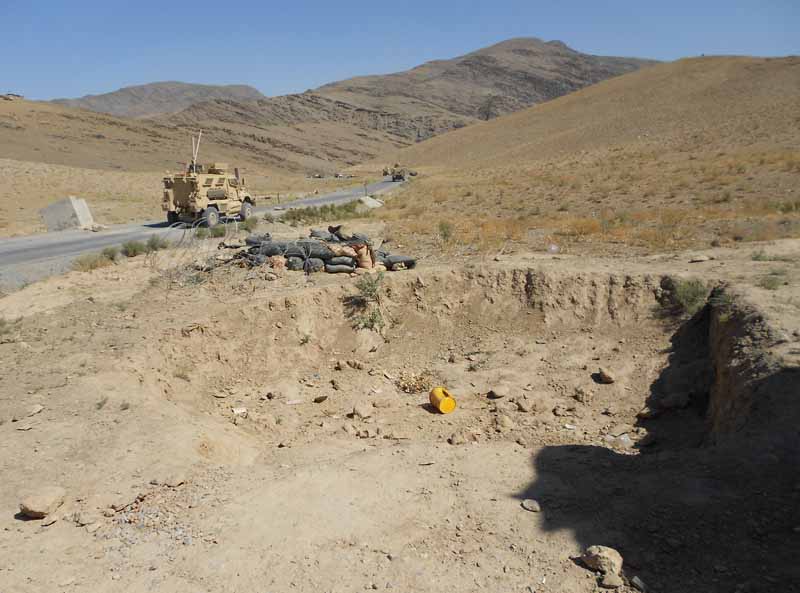

The Tangi Valley is a stubbornly violent insurgent safe-haven connecting Wardak and Logar Provinces. It was in this valley in August 2011 that 38 people – including 22 Navy Seals and seven Afghan commandos – were killed when their helicopter was shot by a rocket-propelled grenade (RPG) as they attempted to reinforce Army Rangers pinned down in the valley below. It was the greatest loss of U.S. troops in a single incident since the beginning of the war. The Taliban don’t stay in the Tangi Valley, either. On September 11, 2011, the tenth anniversary of the 9/11 attacks, Taliban insurgents from the Tangi Valley attacked Combat Outpost (COP) Sayed Abad – about 12 kilometers from the Tangi Valley along Highway 1, the vital artery connecting Kabul to Kandahar. The insurgents used a truck-bomb larger than the one that destroyed the Murrah Federal Building in Oklahoma City in 1995. Seventy-seven U.S. service members were wounded and four Afghan civilians, including a three-year-old girl, were killed.
{default}On September 29, 2012, a platoon from Task Force Bayonet (173d Airborne Brigade) left COP Sayed Abad for a fateful patrol to the Tangi Valley that would shake the partnership between the U.S.-led coalition and the Afghan National Army (ANA) to its core.
The 16-man anti-tank platoon was headed for an ANA checkpoint at the mouth of the Tangi Valley to conduct biometrics – taking the fingerprints of civilians passing through the checkpoint, looking for insurgents. When the platoon arrived at the checkpoint, they found six Afghan soldiers manning the post, stopping cars, checking for suspicious activity. As the platoon set up their equipment and began operations, the atmosphere was cordial. An Afghan soldier offered the platoon’s Afghan interpreter chai (hot tea) and candies. Along with the platoon’s interpreter, the platoon sergeant, four American soldiers, and a civilian law enforcement professional (LEP, a retired American cop working with soldiers in Afghanistan) were dismounted at the checkpoint. The U.S. and Afghan soldiers joked about the last time the Americans had visited the checkpoint; they had been attacked by insurgents from deeper inside the Tangi Valley.
After 45 minutes, the atmosphere suddenly turned. Two Afghan soldiers raised their weapons and fired, instantly killing the platoon sergeant and the law enforcement professional. Three more soldiers were wounded before the gunner for the M249 (squad automatic weapon or SAW) and the platoon leader, firing from the passenger seat of his nearby vehicle, silenced the Afghan attackers. As more U.S. soldiers rushed to the scene to treat the wounded, the platoon took more fire from a compound a few dozen feet away; they responded by clearing the compound with rifles and grenades. As they tried to load up and evacuate their casualties, the platoon took more fire, this time from insurgents deeper in the Tangi Valley. As the platoon departed the checkpoint, about 90 minutes after they had arrived, two Americans and two Afghan soldiers were dead and three U.S. soldiers and four Afghan soldiers were wounded (two of these Afghans would later die of their wounds). Sgt. 1st Class Daniel Metcalfe, the slain platoon sergeant, was the 52d American killed this year in an insider attack and the 2,000th American service member killed in Afghanistan since the beginning of the war.
As of yet, no explanation for the attack has been found. There was no cultural affront that sparked the incident. Several of the Afghan soldiers involved were from northern, non-Pashtun provinces, their families beyond the reach of Taliban intimidation. It is as if this evil reached out from the Tangi Valley and infected these men’s souls.
The Afghan National Army has reluctantly admitted that the engagement was initiated by Afghan soldiers, and has pledged to take action to identify future insider threats before they can attack. But they must act fast. The American public is quickly losing patience.
The views expressed in this article are those of the author and do not reflect the official policy or position of the Department of Defense or the U.S. Government.
Lt.Col. Pat Proctor is currently deployed to eastern Afghanistan, serving as the chief of plans for the 1st Infantry Division. He is a veteran of both the Iraq and Afghan wars and the author of Task Force Patriot and the End of Combat Operations in Iraq. He is also a doctoral candidate in history at Kansas State University.

Do we know what ANA unit it was? Can it be narrowed down to Corps, BDE, and Kandak?
Regarding: “There was no cultural affront that sparked the incident.”
Would it matter if there was? Are we supposed to accept such actions as excusable if the perpetrators were culturally offended? [Rhetorical questions not aimed at the author but rather at the high priests of “soccer ball COIN” who have been preaching that essentially everything that goes wrong in wretchedly poor, hopelessly violent failed states is somehow all our fault.]
I think we all know why this is happening – a successful campaign by elements of the Taliban to expel Western forces from the country by accelerating the evaporation of Western public support for the stability/security/COIN/whatever-it-is-being-called-at-the-moment efforts there.
From the the very beginning of the shift away from destroying al Qaida and toward nation-building in Afghanistan, I have been shaking my head. Even if the West manages to turn Afghanistan into Kansas, so normal and boring that ten people drop dead every day from sheer boredom, it will not do significant, permanent damage to al Qaida or its affiliates. The enemies’ fates are not tied to that of Afghanistan. The scope of the overall mission there is far too wide.
So called “nation building” (known by many other names including “reconstruction and stabilization” “conflict prevention” et al within the “interagency”) is COIN!!!! It is right to expect the ANA to overlook some western clumsiness culturally, but it is also “meet and right” to expect greater “understanding” from our “boots on the ground” until they shoot, then they aren’t ANA and are fair game!!
Viper,
The unit was, I believe, 1st Company, 4th Kandak, 4th BDE, 203rd Corps.
Mark,
I agree with everything you said–except running down Kansas. I live there 🙂
I simply mention the lack of a cultural affront because this is the typical explanation Afghan officials provide as to why this is happening.
Sir would it be possible to get pictures of the men and the ones from the article. My brother was the LEP killed. We have set up a memorial facebook page and post for Sgt Metcalfe and my brother Kevin. Thank You.
Maybe they just don’t like military occupations, whether they’re culturally sympathetic or not. After all, we wouldn’t accept one; we even have an entire genre of fantasy movies where we defend the homeland against foreign invaders (remember, for example the ludicrous and soon to be remade “Red Dawn” where Nicaraguans, who presumably hitchhiked their way up here, take over the country.)
We don’t even accept other countries establishing military bases on our soil, even though we seem to think that we have some inalienable right to everyone else’s soil for our bases.
It’s not at all confusing that people would opt for the relatively stable and well-paying jobs with the army or police, while resenting and chafing against the invaders who are trying to set up those selfsame proxy forces.
@ Pat – Interesting, if I remember correctly thats the recon company. Funny that they would be being used as static security, but not surprising given that every ANA soldier I have ever met besides Medics want, claim, and try to be Infantry instead of their MOS.
@Mark – Dead on target, except that Pete is correct in that “Nation building” is COIN. He is correct to a point. But the inference that Nation Building includes converting their political system to democracy is part of the problem. These people are NOT Democratic, at least not in the outback, and they never will be in any forseeable future. TRUE COIN involves working WITHIN the tribal system, not trying to change it to meet our sensibilities. If change will come, it will come of it’s own accord, not tied to our help or as a condition.
Best example I have seen to show others who have not been there is an essay called “One Tribe at a Time” by MAJ Jim Gant.
HE gets it.
That is exactly what happen. i was the FO for this platoon. i was shot by both of the ANA soldiers 4 shots to the lower stomach, and the other guy shot me in the back once. My platoon sgt was standing next to me on my left side. after i hit the ground from my wounds( the 4 shots broke my right pelvis and the round bounced around and broke my left leg, the one through the back hit my spleen and large intestine)i crawled in to that small sand bag hut close to the road. on my way there the second gun man shot me in the back. i flipped over and shot back at two men by the green building killing one of them and injuring the second one. i then crawled the rest of the way to get in to cover. i started to take off my gear to stop the bleeding but i could not breath due to my lungs starting to collapse. anyway just saying that you have your facts right.
The attack was coordinated it had to be .. we got shot from indiders and taliban at the same time.. its all corrupt. ROE is hurting us. I lost friends that day. It should never happen again.. but sadly it has.
Were you there? My brother was LEP Kevin ORourke.
yeah lang was there. and Kevin was a great man.
Absolutely! If I had to guess, I would say the Taliban called the ANA at the checkpoint and said, “Get rid of the Americans or we’ll get rid of you.”
The LEP killed was my brother Kevin ORourke a retired Sgt from the New York City Police Dept. He was with the elite Emergency Service Unit. He was at both world trade center bombings and when he retired he spent time helping after Katrina and evacuating people in Haiti. Sgt Metcalfe and Kevin were great people.
Probably Pat, or as I think it was already planned, I do want to know who was the idiot that made them go back to same spot when you got shot 10 days prior to this, They don’t put in the article but SFC Metcalfe, before he died, shot down the Afn soldier!!! What happened that day was nothing but bullshit
Brendan, Kevin and Sfc Metcalfe were both great people… Not a day goes by I don’t think about them and this attack. I was one of the wounded there. Kevin was truly the Law Enforcement professional, he was an expert at his job and had a lot of experience.
Brian, Thank you for your service and your response. I hope your recovery is going well. Please contact me borourke15@gmail.com or facebook. I live in NY let me know where you are. I have been slowly getting contact info from those that were there and had the pleasure of meeting Scott this past summer.
Brian, Thank you for your service and your response. I hope your recovery is going well. Please contact me borourke15 at gmail .com or facebook. I live in NY let me know where you are. I have been slowly getting contact info from those that were there and had the pleasure of meeting Scott this past summer.
I was there in the aftermath of this fight and got the opportunity to spend time with some of the members of this platoon. This platoon displayed incredible valor under the most difficult circumstances. I am honored to have spent the little time with them that I did. I felt their story had to be told.
Sir would it be possible to get pictures of the men and the ones from the article. My brother was the LEP killed. We have set up a memorial facebook page and post for Sgt Metcalfe and my brother Kevin. Thank You.
Brendan,
I will email you…
THANK YOU! Would also love to contact the SAW operator on that day. NEED to say thank you.