




Simpsonville Civil War Massacre
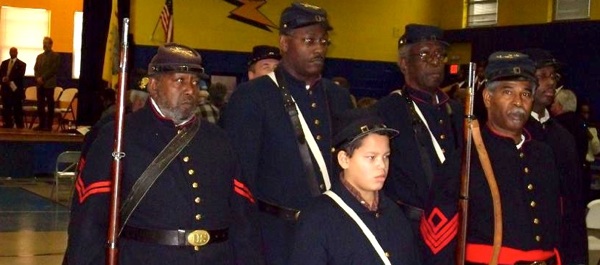
Twenty-two men died in the ambush and six African-American soldiers later died of their wounds.
One of Kentucky’s most vicious Civil War engagements has been largely forgotten for more than 144 years. However, a new historical marker will commemorate the sacrifices of 28 members of the 5th U.S. Colored Cavalry who died in an ambush near Simpsonville, January 25, 1865. A group of 15 Confederate guerillas ambushed the soldiers while they were taking a herd of 900 cattle to Louisville.
{default}Charles Long, past president of the Shelby County Historical Society, said traveling on a narrow dirt road exposed the African-American soldiers. He said it’s unclear if they returned fire, and if they were abandoned by their white officers.
"They were attacked from the rear and murdered viciously,” Long said.
According to a newspaper account, the guerillas attacked "yelling like very devils and shooting their pistols in the air."
Twenty-two men died in the ambush and six African-American soldiers later died of their wounds. Long said the Union army, encamped in Louisville, was indifferent to the ambush. No ambulances were sent until three days after the battle, and the dead soldiers are still listed as missing in action. The citizens of Simpsonville helped care for the wounded and buried the dead nearby in a mass grave. Long said there is no evidence the white officers were ever disciplined for abandoning their men.
Members of the Simpsonville Trim #2 United Brothers of Friendship Lodge, an African-American fraternal organization, created a cemetery at the site of the mass grave and maintained it until 1965 when the last member died. About 180 graves have been located in the abandoned cemetery.
However, the incident was largely unknown, even to local residents and historians.
Steve Eden, mayor of Simpsonville for 15 years, said he didn’t know the cemetery existed or even that the massacre had occurred until he learned about the efforts to build a memorial marker.
Neither did Jerry Miller, a member of the Shelby County Historical Society who helped spearhead the effort to fund a memorial marker. Miller only learned about the event three years ago when he was conducting genealogy research and read the diary of one of his ancestors that described the event.
“I’ve lived in this area 50 years, and I’d never heard of this,” he said. “I’m a Civil War buff and I’ve never heard of this. I couldn’t believe it.”
 David Brown, of Columbia, Maryland, said the incident was overlooked because the soldiers killed were African-Americans. He is the great-great-grandson of Private Samuel Truehart, a soldier who served in the 5th Colored Cavalry. Brown is an amateur historian and has conducted research on the 5th Colored Cavalry.
“White MIAs would not have been forgotten for 144 years,” he said.
State Representative Brad Montell said the ambush was one of the most horrific incidents in Kentucky during the Civil War.
Commemorating the ambush is important to Kentucky because so many of the state’s African-Americans contributed to the war. Kentucky was a slave state "not in rebellion" and was one of the last loyal states to begin enlisting African-Americans in 1864. However, Kentucky enlisted the second highest number of African-American soldiers and more than 10,000 were mustered at Camp Nelson.
 The 5th Colored Cavalry was also formed at Camp Nelson and more than 1,400 joined the regiment under the command of Col. Jame Brisbin, a well-known abolitionist. All the officers were white, but the NCOs were black.
Because Kentucky was not subject to the Emancipation Proclamation, enlisting was the easiest way for many slaves to obtain their freedom, and many of them joined the 5th Colored Cavalry.
The 5th Colored Cavalry also participated in the Battle of Saltville in October 1864, where at least 50 African-American soldiers were captured and then executed. The soldiers of the 5th Colored Cavalry attacked the entrenched Confederate defenders but were unable to seize the saltworks, which was their objective. They received no reinforcements and were eventually forced to withdraw, leaving behind some of their wounded.
The Confederate defenders executed the wounded and any other African-American soldiers they had captured.
 The historic marker was unveiled at a ceremony at the Whitney M. Young Job Corps Center in Simpsonville, and the marker will be displayed on US 60 west of Simpsonville near the job center.
The ceremony included musical performances and several historical interpretations.
The text of the marker reads:
Horrible massacre
On January 25, 1865, Co. E. 5th United States Colored Cavalry (USCT) attacked by Confederate guerillas while driving herd of 900 cattle to Louisville. About 22 men killed and at least eight severely wounded. Based at Camp Nelson, nearly all of the recruits were former slaves. The 5th also fought in 1864 Saltville battles.
Reverse:
African American Cemetery
The 5th USCC troopers killed 1865 Simpsonville slaughter were buried in a mass grave by local residents. Area used as African American cemetery. Members of the Trim #2 United Brothers of Friendship Lodge operated the cemetery until the last member died in 1965. Lodge hall located in Simpsonville.

To be perfectly clear, the diary in which I read about the massacre was that of Julia Tevis, headmistress of the Science Hill Acadamy in Shelbyville. I was trying to determine if my ancestor, Emily Barry, had been a teacher at Science Hill. The microfilmed diary is available to researchers at the Thomas D. Clark Center for Kentucky History in Frankfort, KY.
Hi, I’m a journalism student working on a multimedia project about the Massacre of Simpsonville. I was wondering where exactly in the diary you found her witness. I have been looking through what I think is the right diary, but I can’t seem to find anything.
Just to “flesh out”, and / or correct a few items.
First, The 28 “who died” is not a certain number. Originally 30 men were listed as “Missing In Action” after the fight at Simpsonville. Twenty-two men still are listed MIA on the muster rolls. Of those 22 MIAs, only Sgt. Lampkins, Pvt. Ford, and Pvt. Hackley have any notation on their records that say they died at Simpsonville. Of the other 8 original MIAs, all were actually wounded in action, some more severely than others. The final status of those is as follows: 3 died later of wounds or complications in the hospital at New Albany, Indiana, 1 was discharged for disability, 1 more man was still hospitalized over a year later and likely disabled, and 3 later returned to duty.
Richard George, a militia captain at the time, states, “Only one shot was fired by a soldier, and it went wild”. A guerrilla, who claimed to have been involved, said the troopers wounded one of the raiders. As to the white officers, Capt. George said one white officer “came out from under the store” after the attack was over, and rode off to Louisville without any thought to his men. The “Cincinnati Daily Gazette” (dated for the 28th) stated, “three of the negro officers were loafing in the tavern at the time”. This should read “negro’s officers” as no blacks could have been officers at that time.
According to communications recorded in “The War of the Rebellion: A Compilation of the Official Records of the Union and Confederate Armies”, ambulances were sent out early on the 26th.
More can be found by going to: http://www.freewwebs.com/5thusccsimpsonville
When one reads about the Cival War it is usually the large battles or the best known officers on either side who is written about. I find these small actions to be great!!!
The soldiers killed should be given the upmost respect for serving their country. The town should give some care and maintain this Cemetary to respect those buried there!
Let me see if I have this straight, A group of Black Cavalry in Company strength was ambushed by 15 Confederate Guerillas, and you call the result a massacre? In another action, the 5th US Colored Cavalry had its wounded shot. In all, 22 5th Cavalrymen were killed and 8 wounded (with 6 later died). Where is the massacre? Fiasco, yes! Incompetence, sure! But you need to show the Confederates did murder and killed large numbers to call it a massacre!
Lots of times in this war the ball was started by shooting the other guys in the back. That does not mean 15 guys should route 30 or more so easily.
Richard Pruitt
….I bet you dont dispute the “Boston Massacre” where only 5 people died. :/ it’s a massacre when multiple unarmed/underarmed persons are strategically attacked and killed…..jerk.
wasnt most of these soldiers unarmed or lightly armed?
If so, then it should be called a massacre.
Im glad they finally put a marker on/close to the site
of this massacre in Simpsonville, Kentucky.
The term “massacre” was used in newspaper reports, as was the term “slaughter”. We used both words on the highway historical marker for that reason.
I have never been able to prove how the 5th was armed, but my belief is that they would, at best, have carried infantry rifles and not cavalry carbines. If they were able to get a shot off, they would have had to dismount to get off a second shot. Since the guerrillas were said to have carried one or two revolvers each, they would be able to get off 6-12 shots before reloading.
Half the company was in front of the herd of 900 cattle, so there were approximately 40 men behind, separated by over 1/2 mile of beeves.
My research on this “event” still continues… I do know now, that there were at least 44 casualties among the black troops. Besides the 22 MIAs (at least 4 known KIA by pension records); there were 6 who died from wounds, or related illness before leaving hospital; 6 definitely disabled; 2 in hospital at muster out, and likely disabled; and 7 wounded, but returned to duty later.
As to their weaponry, the best I have been able to determine thus far is that they were armed with Enfield Infantry rifle; very hard to handle on horseback…. From the reports I have of the time, there may have been a lot of them with “fouled” powder, as they were up late in the night in snow rounding up the cattle.
As to “incompetence”, etc., I fully agree. The officers were incompetent, and cared very little for their charges. Most of the officers were brought up from enlisted status to command “colored” troops. Lt. Flint was a private in the Michigan Cavalry prior to his assignment to the 5th USCC. He was arrested over this event, but cleared. Capt. Shuck was not charged, but later “cashiered” over other problems in the unit….
if you read magruder’s confession he says they killed several of these men by the end of meeting by just going amongst the cattle and murdering them .His statement was “he got plenty of wool that day” , but didn’t say how many men he actually murdered.
he states they (union men)fired on dick mitchell thinking he was alone and then came out after him . then the guerilla’s commenced firing and killing many of these union men. He states this group of men had no officers or if they did they sure didn’t appear. I would say they killed several men here. lets not sugar coat this murderous act.
Without a doubt this was one of the saddest days in Kentucky history and the troops leaders shouldve been charged and put in the brig.
When Terry & I 1st moved to Shelbyville from California we were coming home on I60 E. I saw all these graves to the right & stopped to look. When I realized what it was I was in awe. I had him come see & told him, “This is from the Civil War. It happened right down the street from where we live now! This is our history; the things I learned about all through school & college & I am right here in front of it. It’s real, not just in a book.”
SPOT ON Richard Pruitt, There are a number of things about this that seem entirely fabricated.