




Shock Tactics on the Ancient Battlefield
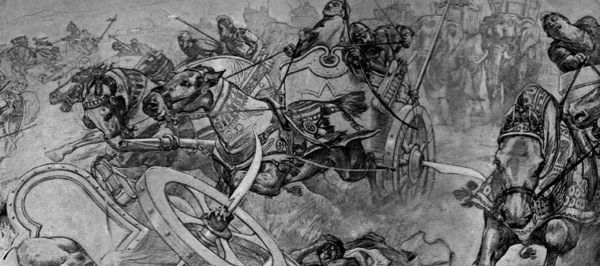
The first mobile instrument to be used as a shock tactic in warfare was the chariot.
The January 2009 issue of Armchair General magazine presents our cover story article, “50 Battles That Shaped Our World.” Several of these key battles were fought by the armies of ancient Greece and Rome. This article by Vincent Lopez, currently a student in Norwich University’s acclaimed Master of Arts in Military History program, examines the impact (quite literally) of ancient armies’ shock tactics. – Editor
{default}Shocking the Mind of the Battlefield
Shock Tactics During the Greco-Roman Wars
According to Clausewitz’s dictum, “war is the conduct of policy by other means”. If this is the case, then the Greeks and Romans were masters of this policy. Through the writing of Herodotus, Thucydides, Plutarch and many more historians, we see evidence of great nations entering into combat during the times of ancient Greece and Rome. Knowledge of the Persian wars, Peloponnesian War, Alexander’s conquest of Persia, Rome’s conquest of Greece, the Punic Wars, and multitudes of others can be found in the writings that ancient historians left behind. What we can deduce from these ancient manuscripts is twofold. First was the necessity of armies to press large numbers of their male population into service for the state. Manpower was essential to these ancient armies as, usually, the army that acquired more soldiers into its service was far more likely to achieve victory through attrition warfare. This was especially evident in the case with the armies of ancient Rome, though both Greek and Roman civilizations depended more on heavy infantry deployment than on cavalry and light infantry operations. The second aspect of warfare which can be deduced from the ancient record was a seemingly unavoidable reliance on shock tactics to defeat the enemy through sheer psychological impact.
Although armies in the ancient Greco-Roman era of warfare emphasized shock tactics, examination of this subject reveals that coverage of it is quite sparse. The focus of most historians consisted mainly of information: the war’s outcomes; battles that took place; locations and dates of battles; causes of battles; and principal commanders. Yet, few works contained the ramifications of psychological events that took place before, during, and/or after the battle through the use of shock tactics. Specifically, the methods of psychological warfare that were a factor in the battles’ and wars’ outcomes were lacking serious research. Although some historians did cover psychological shock tactics in Greek and Roman military history, such accounts are rare.
For example, W.W. Tarn, in his book Alexander the Great, chronicles the events of the life of the Macedonian king, but unfortunately, he does not go into much detail of the psychological shock tactics in Alexander’s campaigns in Asia Minor, Persia, and in Greece. He does make mention of particular morale concerns after the conquest of Persia, yet, with little more than a paragraph being given in this regard; it is not enough to get a well defined grasp of the consequences of these morale implications. N.G.L. Hammond’s History of Greece to 322 B.C. focused on the typical who, what, when, where, and why version of ancient Greek events. There is very little mention of the psychological shock tactics in Greece’s armies. It does convey information which, if properly researched, could help to recognize psychological shock tactics.
Most articles which have been published seem to also lack any significant research regarding psychological shock tactics in antiquity. B.D. Hoyos wrote “Hannibal: What Kind of Genius?” This article took a counter-active stance on Hannibal, explaining that although Hannibal was an excellent general, he was not the ‘Genius’ today’s culture typically perceives him to be. In the article, he mentions integration practices with war but not shock tactics used in battle.
While some historians have attempted to include the psychological shock tactics in ancient Mediterranean warfare, there were a select few that attempted to give the topic more attention than others. One historian, Parth Bose, covered some psychological shock tactics of Alexander in his book, Alexander the Great’s Art of Strategy: The Timeless Leadership Lessons of History’s Greatest Empire Builder. He mentions psychological shock tactics not addressed by Tarn. Yet, this type of analysis is still waiting to be done for Greco-Roman military history.
Ancient, as well as modern shock tactics undoubtedly have always had crucial effects on psychological developments throughout warfare. The psyche of troops on the battlefield depended largely on how their commander was able to maintain order, handle different situations, and prepare for battle. Troop morale was, and still is, extremely fragile, being swayed for better or worse with one simple act. Many of these factors also depended largely on the preparations made by army leaders before the battle began. Knowing that sheer force alone would not always give an army victory, every detail and possibility had to be examined to give a favorable outcome. Failure of an army to secure logistics or success of an army to raid an enemy’s logistics could easily give one army a morale advantage over another. I intend to explore the psychological tactics, also known as shock tactics, which were employed in the Ancient Mediterranean world through battles between the Greeks and Persians and the Wars of the Early Roman Republic, ending with an examination of how these shock tactics were employed within the battle of Zama.
Shock Force I: Chariots
The first mobile instrument to be used as a shock tactic in warfare was the chariot, which reached its zenith in the Hittite civilization and pre-Ptolemaic Egyptian civilization. Chariots revolutionized warfare, becoming the elite striking arm of most Iron Age armies. However, the chariot lost its psychological effectiveness before the Classical period, with regards to Greek and Roman warfare. The first of two attempts to use chariots that do occur in the time frame we are examining is that of King Darius III at the Battle of Gaugamela, in 331 B.C.E. These chariots had no effect on the battle, as the Macedonian army had developed efficient and effective countermeasures to deal with them. Darius had the chariots equipped with long blades (scythes), hence their name, “scythed chariots.” To be sure, these scythed chariots could cut a man in half, and an untrained army would have broken ranks at the first sight of their comrades being split in two. Unfortunately for Darius, his plan to use scythed chariots for shock tactics had no effect. Recognizing that chariots were more fragile and not as mobile as cavalry, Alexander’s center, the Macedonian phalanxes, assumed a wider formation, allowing the scythed chariots to ride past the first line and directly into the sarissa (long pike) of the second line. Horses and drivers were impaled, stopping the scythed chariots with ease and reducing their effectiveness in battle to nothing. The second attempt was by Antiochus the Great at Magnesia who, while fighting against the Romans, suffered the same result as Darius III. With these two battles as examples, we can safely say that scythed chariots and chariots in general, had lost their effectiveness and could no longer be used for shock tactics.
Shock Force II: Cavalry
Cavalry was first used effectively for shock by the Assyrian Empire, but was not adopted widely in Greece. Philip II of Macedon was the first to assimilate heavy and light cavalry into a Greek army. He also replaced the traditional seven-foot spear with the longer nine-foot spear (counter-weighted for added balance) that could easily outrange the spears of enemy cavalry. This reformation revolutionized warfare in the Greek world and later assisted Philip’s son, Alexander, with the conquest of the Persian Empire. Giving credit to Philip for successfully integrating cavalry into his army, we can certainly give Alexander credit for perfecting its use as a shock tactic. The most common use of cavalry in the ancient Mediterranean world was against other cavalry. The goal was to engage enemy cavalry with your own, with the hope that that your cavalry’s superiority would drive the enemy cavalry from the field. This would leave the infantry of both armies to fight until the winning cavalry flanked and routed the enemy infantry. This flanking maneuver was the most successful way of using cavalry as a shock tactic. The danger in this was twofold. First, a commander was gambling that his cavalry would defeat the enemy’s, and, second, that his cavalry would not pursue the enemy cavalry too far, lest it take itself out of the main battle at the critical moment. In 216 B.C.E., Hannibal Barca had successfully used this tactic to rout a much larger Roman force. The battle that not only showed the Romans the value of cavalry, but also demonstrated to a young, up-and-coming Roman leader named Publius Cornelius Scipio how to use this tactic.
The second method of using cavalry for shock tactics was to charge directly into enemy infantry. This was the weaker of the two tactics in antiquity, as a well disciplined phalanx with spear or sarissa could defeat this tactic easily. In this era before the invention of the stirrup, this tactic relied on skillful horsemanship and a resolute and unflinching will of the horsemen to advance. It also required a gap or weak place in the enemy line to break through. Moreover, war horses in this era had no armor protection, and could easily be impaled easily upon spear and sarissa. Alexander’s success in using this cavalry tactic was demonstrated in his victory over Darius III at Gaugamela. Alexander knew when and where to strike, exercised perfect control of the cavalry charge, and exhibited firm leadership with his ability to stop and reform for the next attack. At Gaugamela, Alexander held his elite Companion cavalry back, waiting for the chance to strike. Once he saw his moment, he arranged his cavalry into a wedge formation and charged directly towards the Persian front line. The Companion cavalry smashed into the Persian center, quickly killing Darius’ Royal Guard, causing a vast drop in Persian morale. Darius, at the sight of Alexander’s strength, turned and fled. As Alexander was about to chase Darius, he obtained a message that his loyal general Parmenion was about to be overrun. He quickly reformed his ranks and led his cavalry to assist Parmenion. Yet, Alexander was the exception to the rule in antiquity. This use of the direct cavalry charge for shock tactics would not truly be efficient again until the much later development of Parthian Cataphracts and Medieval Knights.
Shock Force III: Elephants
As far as shock tactics are concerned, war elephants were the tanks of the ancient world. The first known encounter of a Greek-Macedonian army with elephants was at Gaugamela, in which Alexander’s army faced off against fifteen Indian elephants, though we do not know the details as to the effect they had. Since Alexander won the battle, it seems likely the elephants’ effects were negligible. The next test of Alexander’s army against elephants was in 327 B.C.E., where his Indian army opponent employed two hundred elephants at the Battle of Hydaspes. Having already faced elephants, Alexander must have had some idea as to how to deal with them. While he managed to steal victory once again, his army suffered greatly and refused to continue further into India. His army did not break while fighting the mass charge of two hundred elephants, but the effects of these animals had set in. The Macedonian army’s will was successfully destroyed; the elephants had succeeded, even in defeat, as a shock tactic which had lasting psychological effects.
In the year 280 B.C.E., Pyrrhus, king of Epirus, came to defend the Greek city, Tarentum, from Roman aggression. Pyrrhus entered Italy with a professional army consisting of twenty five thousand troops and twenty elephants. He is also credited with being the first commander to place towers atop elephants, providing a platform from which his archers could rain arrows from above onto their opponents. At the Battle of Heraclea, Roman forces were awed by the sight of elephants. Pausanias wrote, “When on this occasion they came in sight the Romans were seized with panic, and did not believe they were animals”. The elephants quickly demoralized the Romans and they soon panicked. As the ground shook, one could only imagine the fear that overcame each soldier, unaware of how to deal with the new threat. The mere smell of an elephant was hated by horses, creating the inability of cavalry to charge, and causing the horses to flee. Understandably, this caused the morale of the Romans to drop during the battle. Those who were not frozen with fear ran away. Pyrrhus went on to be undefeated against Rome in battle, but, ultimately, he lost the war.
All elephants were not created equal, smaller ones panicking at the sight of larger elephants. This was the situation at the Battle of Rhaphia, where, according to Polybius, Ptolemy had a contingent of smaller Libyan elephants run away from a group of much larger Indian elephants. The elephants used by Ptolemy would most likely have been the extinct African Forest Elephants, which stood 2.35 meters tall. The average Indian elephant stood 3 meters tall. Therefore, due to fear, most of the Libyan elephants became uncontrollable and ran away.
When fighting against infantry trained to withstand elephant charges, elephants could become disoriented and enraged when light infantry pelted them with darts and javelins. If this did not break the charge, other infantry would close with the beasts and cut their hamstring tendons. Enraged elephants had a tendency to charge their own infantry formations, forcing the mahout to kill the animal with a spike through its neck. Therefore, the most useful deployment of elephants in battle for shock tactics was against cavalry and infantry not trained to fight them; otherwise the tank of the ancient world became ineffective in even a danger to friendly troops.
The Role of Fear
There are multiple ways to make an army’s morale drop. When the ancient Greeks and Romans looked to create an example for psychological impact, they sought to instill fear in the hearts of enemy troops. When the newly crowned Macedonian king, Alexander, took the throne, he was immediately rejected by the Greek city-states, who rebelled against the Macedonian’s rule. Knowing the he had to display dominance and power, the young king decided to break the spirit of the rebelling city-states. In 335 B.C.E., he began to march his army into Greece, stopping at the city of Thebes, a main instigator of the mass rebellion. Alexander gave the Thebans a chance to surrender their leaders, an apparently benevolent tactic meant to show Alexander wanted to avoid conflict. However, the Thebans refused. In response to the Thebans’ rejection of his offer, Alexander marched on the city, broke down the gates, burned, pillaged, and slaughtered six thousand men, women, and children, selling thirty thousand more into slavery. In doing this, Alexander hoped that Thebes would serve as an object lesson that would terrify the rest of Greece into obedience. It worked. The rest of Greece ceased to rebel. According to the writings of Sun Tzu, this was an excellent form of psychological leadership displayed by Alexander. In the practical art of war, it is much better to take the enemy’s country whole and intact, than to shatter and destroy it and rule over the ashes.
We find the same tactic used in Roman times. The Roman general Publius Cornelius Scipio exhibited the Roman practice of terror in 210 B.C.E. against the city of New Carthage during the Second Punic War. Just as Alexander had given Thebes a chance to surrender, so too did Scipio give the Carthaginian city, which gave to Scipio the same response Thebes had given Alexander. After a brilliantly conducted siege of the city, the small Carthaginian force which had survived took to the defense in the city’s center. Knowing that he would lose many men trying to take the center, Scipio relied on the old Roman tactic of slaying every living being, human and animal, male and female, adult and child, in the hopes that the will of the small defense force would break. In this thought, Scipio was correct, as the Carthaginian commander, Mago (not Hannibal’s brother), gave the order to surrender in hopes of sparing the remaining population. With this act of terror, Scipio saved the lives of his men, and gained the respect of Spanish tribes by allowing his Spanish prisoners, who fought with Carthage’s army, to go free. Here we can see that two of the ancient world’s greatest commanders were not above using the psychological shock tactic of fear and terror to subdue their enemies.
The Role of Generalship
The importance of a commander’s competency in battle cannot be overstated. The army must be willing to follow the individual that is in charge of their lives. If the troops are not happy with the commander’s leadership, their morale will decrease, followed rapidly by their ability to fight. If the troops love their commander, they will gladly risk their lives for him. Sun Tzu once said, “Soldiers when in desperate straits lose the sense of fear. If there is no help for it, they will fight hard”. The Spartan king, Leonidas, exemplifies a leader for whom troops willingly died. When Persia invaded Greece in 480 B.C., they came to a small mountain pass near Thermopylae. “Here, four thousand from the Peloponnese once fought three million. Modern estimates, however, place the Persian army roughly in the hundreds of thousands, not millions. King Leonidas was in command of the four thousand Greeks that fought to defend the tiny mountain pass of Thermopylae. King Xerxes of Persia led (more likely accompanied, as he never took direct part in the battle) his armed host in the invasion of Greece. When Xerxes was informed that the small Greek force would not allow him to pass, he could not comprehend the thought that the Lacedaemonians were actually preparing to kill or be killed. It was at this moment that King Xerxes lost his patience, unable to understand why the Greeks would defy his “godly” will. Here is an example of a great commander and a bad one. Xerxes lost his temper and began blindly to send his troops off to their deaths. Once the first force of light infantry failed to breach the Greek defenses, Xerxes sent his personal army, the Ten Thousand Immortals, against the Greek line, only to see the result of failure once again. The Persian King, unable to control his rage, was willing to launch his men to their deaths, assaulting the Greeks like swarming ants, with the result that one-third of his men were slain. The end effect was that of improving Greek morale, led in the front line by their commander. Such a large Persian army became a liability in the confined areas of Greece. The Persian King did not align his use of appropriate military force to a clearly articulated goal. Unfortunately for the Greeks, they were betrayed by one of their own, and Xerxes’ troops managed to surround the Greek army. Before his army was encircled, King Leonidas ordered all non-Spartan affiliated troops to leave the field and go home. He ordered the Spartan troops to stand their ground, and none disobeyed. Every single remaining Greek soldier fought to the death and took many Persians with him. Throw your soldiers into positions whence there is no escape, and they will prefer death to flight. Sun Tzu once said, “If they will face death, there is nothing they may not achieve, officers and men alike will put forth their uttermost strength”. The Greeks, under the command of Leonidas, proved this to be correct. The tomb which was erected upon the final Greek victory over Persia stated, “Foreigner, go tell the Spartans that we lie here obedient to their commands.”
As the actions of respected commanders affect the morale of the troops, so do the outcomes of battle. After defeating the Romans in the battles of Trebbia and Trasimene, Hannibal Barca marched his victorious army toward southern Italy, eventually destroying the Roman army that faced him at the battle of Cannae in 216 B.C.E. At Cannae, the Roman army under the command of two consuls, Gaius Terentius Varro and Lucius Aemilius Paullus, fielded an impressive army of roughly eighty five thousand; five thousand five hundred were cavalry, the rest infantry, which equaled sixteen legions, the largest army ever fielded by Rome. Hannibal’s army consisted of four thousand Numidian cavalry, two thousand Iberian (Spanish) cavalry, four thousand Celtic cavalry, twelve thousand African infantry, eight thousand Iberian infantry, and twenty thousand Celtic infantry, totaling about fifty thousand. The Romans had good reason to believe that they could win the battle. On this occasion, the Romans had picked the battle site, which prevented Hannibal from laying another deadly ambush. By choosing this site, the Romans believed they could neutralize Hannibal’s cavalry, the force that constantly gave Roman armies many hardships. Contrary to Livy and Polybius who attribute the loss to the rash Varro, it is more likely that Paullus was in command. Varro was in command of the left wing, and Paullus was in command of the right wing, the latter being the Roman army’s traditional position taken by the commanding general. Since Paullus was considered to be the better general, therefore, the best of the two consuls was in command. Like the Spartan king Leonidas, Hannibal led by example, standing in the front lines with his Celtic and Iberian infantry, as they fought the more numerous Roman infantry who were led by Paullus in the front line. Through Hannibal’s brilliance, his army maneuvered perfectly, encircling the larger Roman army, and leading to the death of fifty thousand Romans (and the capture of twenty five thousand more). On the Carthaginian side, Hannibal lost four thousand Celts, fifteen hundred Iberians and Libyans, and about two hundred horses. The price of defeat was high for Rome, counting the battles of Trebbia, Trasimene, and Cannae; Rome had lost around one hundred thousand troops. Polybius wrote about the morale of both Rome and Hannibal’s troops after the battle of Cannae in the following manner:
The result of this battle, such as I have described it, had the consequences
which both sides expected. For the Carthaginians by their victory were
thence forth masters of nearly the whole of the Italian coast which is
called Magna Graecia. On their side the Romans, after this disaster,
despaired of retaining their supremacy over the Italians, and were in the
greatest alarm, believing their own lives and the existence of their city
to be in danger, and every moment expecting that Hannibal would be
upon them.
For the next several years, Rome did not try to challenge Hannibal’s army on Italian soil, adopting the tactic of avoidance. Hannibal ran rampant in the countryside and was not challenged again until the battle of Zama, in North Africa. These battles, therefore, displayed how morale affected each side’s troops, their governments, and most importantly, the countries’ populations. Hannibal’s status was constantly improved by his brilliant individual leadership; but the results of that leadership – victory after victory – also exercised an impact on his troops’ morale that went beyond the immediate influence of Carthage’s great general.
Prelude to Zama: Two Great Generals
In this section, I would like to extend the examination of the union of shock tactics and generals by briefly looking at Hannibal Barca and Publius Cornelius Scipio Africanus. For a definitive understanding of the use of shock tactics during the battle of Zamma, it is imperative to understand the two generals, and their armies, that battled on that historic site. Hamilcar Barca was the father of four children, three sons and one daughter. The three boys, Hannibal, Hasdrubal, and Mago, followed their father to Spain and learned firsthand the ways of war. There is also some speculation as to whether Hannibal had also accompanied Hasdrubal during the first Punic War. The daughter had a son, Hasdrubal, who also became a well known general. Hannibal spoke Punic as well as Greek, and he eventually learned several tribal tongues. He had spent the majority of his life in Spain living his life as a soldier, dressing, eating, and sleeping just as his soldiers did. From his father he had learned how to gain the loyalty of mercenary troops, but his manner of command was truly his own, a mix of Hamilcar’s fierce and often cruel discipline and Hasdrubal’s patient and reasonable diplomacy.
Several stories surround Hannibal’s early years, but we know is that he was eventually given command of Carthaginian forces in Spain. In 218 B.C.E., Hannibal led his army against the Hellenized city of Saguntum, on the eastern coast of Iberia. Once the city was taken, Rome declared war on Carthage, basing its right to do so on the aggression of Hannibal on Roman territory. Whether or not Hannibal meant for this to happen is unknown, as Roman bias in the historical accounts tend to blame Hannibal regardless. What is clear, however, is that Hannibal was ready for a war, believing that a successful invasion of Italy would prevent Rome from sending armies to Iberia and Carthage. His action of invading from Northern Italy was the first psychological shock tactic used by Hannibal — surprise attack to cause fear — and he was successful. Rome, at its strongest, could count on 700,000 infantry and 70,000 cavalry, while Hannibal would have to raise the majority of his troops from Iberian and Celtic tribes (he could only count on 40,000 infantry and 10,000 cavalry from Africa). A force of about 102,000 men traveled 1,000 miles over five months from New Carthage on the long road toward Italy. After crossing the Rhone River in Gaul, Hannibal had roughly 60,000 troops and 37 elephants left in his force. Once he crossed the Alps into northern Italy’s Po River valley, Hannibal had lost another 36,000 men, leaving approximately 23,000 troops and 10 elephants (by spring of his first year in Italy, only 1 elephant had survived the winter). Hannibal could not count on his elephants for battlefield shock tactics.
Once in Italy, Hannibal recruited Gallic allies and defeated two larger Roman armies at the battles of Trebbia and Trasimene. Leading his force into southern Italy, Hannibal successfully defeated the largest Roman field army to date at Cannae. Hannibal maintained an army in Italy for 16 years with no external source of supply. Richard Gabriel has pointed out that, “No general in Western history ever remained in the field for so long, fought so many battles, won so many victories as did Hannibal, who kept his army intact while fighting in a hostile country, and was still able to extricate them successfully from the war zone”.
During the battle of Trebbia, a young minor Roman officer by the name of Publius Cornelius Scipio led a small contingent of cavalry into a losing battle, saving the Roman consul, his father, from death. This was Scipio Africanus’ first encounter against Hannibal’s army. He was only seventeen. Two years later, at the rank of Tribune, age 19, he survived the massacre at Cannae, leading a small group of men to safety from the battle. Perhaps, it was fate that this young officer was witness to his peers’ slaughter at the hands of Hannibal’s genius. Scipio was eventually given command of the invasion force for Iberia, using Hannibal’s tactics successfully and reforming the army to resemble Hannibal’s. He stands to this day, as one of the few generals in world history that was never defeated in battle. While his battles in Iberia were impressive, Scipio went on to lead a legendary campaign in Africa, without the full support of Rome. In 205 B.C.E., Scipio was elected consul and given the task of defending Sicily. He was not allowed to raise troops in Italy, forcing him to call on volunteers. He left Sicily with the 5th and 6th legions and 7,000 volunteers. Upon his arrival in Africa, Scipio only had 16,000 infantry and 1,600 cavalry. After two battles in which Scipio was greatly outnumbered, he not only defeated Carthaginian forces, but was able to capture and kill the Numidian king, Syphax, installing his ally, Masinissa, as king. Carthage had then lost its greatest ally and strongest source of cavalry.
It was not until Carthage was forced to recall Hannibal to defend the city against Scipio Africanus that Hannibal again saw the African continent, and he arrived in Africa believing that the war was over, only learning once he was there that Carthage had broken the truce and expected him to fight Scipio. Hannibal brought 24,000 troops with him from Italy, and was reinforced by 12,000 Carthaginian infantry, 4,000 Macedonian infantry, and 2,000 cavalry. Still waiting on reinforcements from Masinissa, Scipio knew that he did not have enough troops to face Hannibal directly, but could not allow Hannibal to enter Carthage, where the city would be able to hold out for several months (while Scipio did not have support from Rome or the logistical capacity to stay long in Africa). In order to draw Hannibal away from the city, Scipio used Hannibal’s tactics, learned in Italy, against him. The vital difference proved to be that the Roman Senate did not give in to Hannibal, while the Carthaginian senate forced Hannibal to meet Scipio in battle away from the city. Hannibal knew what Scipio was doing but could not delay for much longer, knowing that if Scipio was allowed to regroup with Masinissa, he would have almost no chance to win the battle. The North African terrain worked against both men, as they were forced to meet in open combat with no chance for ambush. The two armies met outside of the small town of Zama.
The Battle of Zama, 202 B.C.E.
Having examined the different forms of psychological warfare and shock tactics, the Battle of Zama offers an opportunity to evaluate them in a decisive historical battle fought by two of history’s Great Captains. The Battle of Zama was chosen because it offers the chance to see how two of the greatest generals in antiquity, accompanied by very experienced armies, used the most popular shock tactics of the day. The effect of morale on both sides can be understood, as well as how soldiers reacted towards the usage of elephants and cavalry. The outcome of the battle was decisive, as it determined which civilization would dominate the Mediterranean.
Both generals needed to keep their soldiers’ spirits high, so that their men would not dwell on the battle’s potential repercussions, but remain focused on the immediate task of fighting to win and stay alive. Before the battle began, both generals met each other for the first time a few miles from Zama. Each general had his own purpose for being there; Hannibal Barca knew that his chances to win the upcoming battle were slim; so he tried to reason with Scipio, asking him to leave Africa. If Hannibal’s forces remained intact, he could still dispute mastery of the Empire, achieving a triumph without risking total defeat on the battlefield. According to Sun Tzu, “This is the method of attacking by stratagem.” Unfortunately for the Carthaginian, Hannibal’s speech did not sway the Roman general. Scipio Africanus, in response to Hannibal’s speech, began to throw Hannibal’s words back at him, and suggested that Hannibal was afraid to fight the battle (Sun Tzu would characterize this tactic by writing, “If your opponent is of choleric temper, seek to irritate him”). Scipio was also trying to convince Hannibal that he should give up and surrender to Rome’s terms. Both generals tried to win the battle before it even began. Although both generals failed in the attempt to win without bloodshed, they showed their level of competency by at least attempting to do so. Had either faced a lesser opponent, the tactic might even have worked. Zama, however, was not destined to end without a bloody encounter.
Polybius expresses the importance of the ensuing battle, as well as the morale of the soldiers and the competency of the generals before the battle, writing:
To the Carthaginians it was a struggle for their own lives and the
sovereignty of Libya; to the Romans for universal dominion and
supremacy. And could anyone who grasped the situation fail to
be moved at the story? Armies more fitted for war than these, or
generals who had been more successful or more thoroughly trained
in all the operations of war, it would be impossible to find, or any
other occasion on which the prizes proposed by destiny to the
combatants were more momentous. For it was not merely of Libya
or Europe that the victors in this battle were destined to become
masters, but of all other parts of the world known to history – a
destiny which had not to wait long for its fulfillment.
After testing the leadership of the enemy, each general made the rounds in their camps to prepare for war, partly to check on the morale of their respective armies. Both generals gave a rousing speech to their men, warning them of the implications of the battle. Scipio reminded his army of the past victories which they had seen and the glory which would be theirs. Even if they did not win, the stories of their bravery in battle would be told for generations in Rome, and if they ran, their families would be disgraced. “Charge the enemy, then with the steady resolve to do one of two things, to conquer or to die!” Scipio ended his speech by saying, “For it is men thus minded who invariably conquer their opponents, since they enter the field with no other hope of life.”
In the opposing camp, Hannibal made his rounds. Hannibal had all of his officers speak to their regiments, and, when they were done, he had them all gather around him, so he could rouse the soldiers. Hannibal reminded his army of their record in war. In sixteen years, no Roman army was able to defeat them. Hannibal reminded his troops that the enemy must “place before their eyes the battle of the River Trebbia against the father of the present Roman commander.” He made sure to mention that, like the Roman commander Scipio Africanus, the Roman soldiers were the sons of defeated Romans, Romans defeated by Hannibal. Hannibal ended his speech, “They [his soldiers] ought not therefore, to undo the glory and fame of their previous achievements, but to struggle with a firm and brave resolve to maintain their reputation of invincibility." No doubt, after such riveting speeches, both armies were ready for war, morale high, and ready to accept the consequences. The mark of great leadership was displayed by both generals once again. Before the battle had begun, the psychological aspects of warfare were already being implemented by both the Romans and Carthaginians.
Hannibal’s elephants, which numbered more than eighty, were placed in the van of the whole army. The famed Carthaginian general was very aware of the advantages of using elephants in a battle, as was Scipio Africanus, who was also aware of how the elephants would affect his men’s resolve to fight. Knowing his opponent would use elephants against him, Scipio began making preparations to counter this threat. He changed the formation of the customary Roman Legion, telling his infantry that if the elephants began to overwhelm them, they were to run away, creating a gap through which the elephants could run, so that the Romans could attack them from the side. Giving his soldiers a plan of how to deal with the elephants would help ease the effect they had on the psyche and reduce their efficacy as a shock tactic. Scipio’s army consisted of 30,000 infantry and 6,000 cavalry, while Hannibal commanded 30,000 infantry, 4,000 cavalry, and 80 elephants.
It was midday when Hannibal ordered his elephants to charge the Roman line, for which Scipio had already well prepared. Scipio ordered his light infantry to sound horns once the elephants charged, knowing that the sound of horns scared elephants. This worked, causing many of the elephants to retreat and stampede into Hannibal’s army instead of the Roman infantry. When the remaining elephants reached the Roman line, Scipio enacted his plan. He ordered the Roman infantry to open gaps in their formations to allow the elephants to pass, cutting their Achilles tendons as they passed with axes, pelting them with javelins, spears, and darts. While many Romans were killed by the elephant charge, the casualties suffered were far less than what would have been if Scipio did not prepare his men to deal with this situation. While the elephants did scare the Romans, they held firm, and the morale failure was on the side of the Carthaginians and their allies. The Carthaginian elephants, panicked and enraged, crashed into the Carthaginian cavalry, sending them into disarray. As the Carthaginians tried to reform, Scipio sent his cavalry to attack them. Hannibal’s cavalry retreated, chased by Scipio’s horsemen. The battle was now going in the favor of Rome. It was clear from this point that the battle would be decided by soldiers, not elephants.
Hannibal and Scipio both ordered their infantry to advance. The Celtic-Iberian troops were sent into battle before the rest of his army, but Hannibal did not support them, knowing that they could not hold for long. The result was that the foreign soldiers gave way believing that they had been shamelessly abandoned by their own side. The first line broke and retreated towards the second line, the Carthaginian levy. Soon the Carthaginian levy also retreated, leaving a roughly equal number of veterans on each side. Perhaps this was part of Hannibal’s plan, allowing his less dependable troops to tire the Romans so that his veterans could easily dispatch them. If this was Hannibal’s plan, it did not work. At this point, the spirits of all but the Carthaginian veterans were broken, while the morale of the Roman army was at its peak. Yet, there was still hope for Hannibal’s forces. His veteran infantry from his Italian campaign was sent forward, attempting to win the battle against the Roman infantry before Scipio’s cavalry returned. At this moment, however, Scipio reformed his ranks to match the battle line of Hannibal’s veterans, hoping that this new formation would prevent Hannibal’s infantry from flanking the Roman line while buying time for the Roman cavalry to return. Unfortunately for Hannibal, his troops’ skill was matched by Scipio’s Roman veterans, and, in time, a charge of Roman cavalry crashed into the backs of the Carthaginian line, encircling Hannibal’s army. Although Hannibal’s troops remained calm and continued to fight bravely, the Carthaginians now fought against the odds. A short while later, what was left of Hannibal’s army was forced to retreat — Scipio Africanus had led Rome to victory.
Richard Gabriel concluded that, “It was only when Hannibal faced a general who had studied his own successes and abilities that he was defeated in the field, and then, only under conditions so unfavorable, that it is unlikely that any general could have succeeded where Hannibal failed.” Great generalship and the well-trained, veteran troops they led, not the psychological impact of shock tactics, proved the deciding factor in the Battle of Zama.
Conclusion
Although shock tactics and the psychological aspects of warfare affected ancient battles, any evaluation of the effect these tactics had on battles in antiquity must be conducted by placing them within the context of the men who fought and the generals who led them. Shock tactics, as implemented through chariots, cavalry, and elephants, could turn the tide of battle, but their success ultimately depended on the training, experience and willpower of the soldiers who filled the ranks on each side, and on the competence and leadership ability of the generals in command. As exhibited by all the victorious generals mentioned in this article, great commanders understand the strengths and weaknesses of their forces, as well as comprehend the variables of combat, such as: manpower; distance; terrain; supply; and shock tactics. Shock tactics were a variable in Greco-Roman warfare, not the variable that always determined the outcome of ancient battles.
Vincent Lopez is a student in Norwich University’s acclaimed Master of Arts in Military History program. For more information on this outstanding program, visit Norwich’s Web site.

I would like to commend the author for his insight and analysis. I agree that the psychological side of war is too often an afterthought, at best an mythical remnant attached to a commander.
However, I would point out that many of your older readers still think of “shock” in terms of shock weapons (as opposed to missile weapons) as defined by CWC Oman.
I realize that you intend to discuss “shock” in terms of a weapon’s the psychological impact, not simply its potential for blunt trauma. You may find it useful to draw this distinction more clearly at the outset for the benefit of us old-school readers.
I wish you the best of luck in your studies and your certainly promising career as a historian. Well done!
truly wonderful insight on this subject it is all to common for people to rant but you delivered a well thought out theory and I applaud you for this.
Sources?