




Richard Berg’s Flintlock – Carolina Rebels – Board Game Review
 Richard Berg’s Flintlock: Black Powder, Cold Steel – Volume I: Carolina Rebels
Lock ‘N Load Publishing. $54.99
Passed Inspection: Healthy amount of quality components; good value. Rules are straightforward and at times, even witty. Lots of Revolutionary War battle flavor without being overly complex.
Failed Inspection: More examples in the rules would be helpful, and as with other LNL games, the rules really need an index to help smooth out the learning curve. Counters are nicely done, but the verdant green maps might be off-putting to some.
Flintlock excels at putting you in the mindset of an 18th-century commander.
If you’re a fan of games that focus on black powder wars fought in North America, it’s hard to swing a virtual musket without banging into another cardboard recreation of Gettysburg or Bull Run. Tactical-level games focusing on the American Revolution are in much shorter supply and those that recreate battles fought in the southern colonies are rarer still.
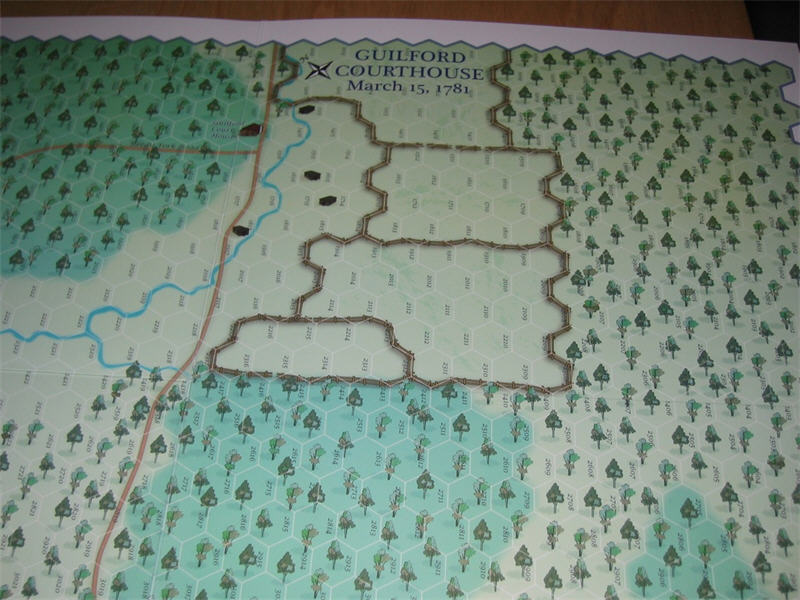
{default}Enter Lock ‘N Load Publishing, which is doing its level best to fill this gaming gap with Flintlock: Black Powder – Cold Steel. The first boxed set of games in what purports to be an ongoing series, Vol. 1: Carolina Rebels covers Lord Cornwallis’ campaign, as the British rampage through the "soft underbelly" of the Rebellion’s southern colonies at Camden, Cowpens, Guilford Courthouse, and Hobkirk’s Hill.
One would rightly expect to find Guilford Courthouse among the four battles depicted, but something that made Flintlock stand out from other Revolutionary War games for me is that it also offers somewhat obscure and yet fascinating battles. For example, I own a number of Revolutionary War games, but I had never refought the battle of Hobkirk’s Hill. To find out it was not only an important battle but allows for a tense and well-balanced war game to boot was a revelation.
To stop Cornwallis’ veteran British force, the American rebels have a mix of militia, regulars, and skirmishers, which varied widely in quality. But they also have General Nathaniel Greene, a factor that shouldn’t be underestimated. This situation, pitting a smaller but more professional army against an enthusiastic but less-well-trained one, is a good subject for a war game.
Flintlock certainly doesn’t skimp on the components. The rules are comprehensive and for the most part straightforward, with a few very good examples. More than 550 nicely done counters are functional and fairly easy to read; they certainly stand out on the verdant green cardstock maps depicting the various colonial battlefields. Unit organization can be a bit loose, especially for Colonial militia, but the basic command for each leader in the game is a regiment comprised of a varying number of companies, each company representing roughly 50 men.
Flintlock excels at putting you in the mindset of an 18th-century commander. Fire combat is not terribly effective from a distance, so you are enticed to bring your forces to close only a few spaces away from the enemy. Both sides often shoot the daylights out of each other at short range, then attempt to "shock" the enemy up close and personal, in hopes that the foe will break and run. Little things, like units not being able to move and fire in the same turn, make sense for the period depicted and require that you set up your attacks properly.
There are plenty of tactical choices to make. Leaving your formation in column allows its units to move more quickly but renders them far less effective in combat. Close formation defends much better versus an enemy shock attack but massed units make a juicy target for enemy fire. How far troops can be pushed depends not only on the simple-but-effective morale rules, but also on how many cohesion hits the unit takes before losing combat effectiveness.
Whatever a player wants to do with a given leader’s force must be done with all subunits of that force simultaneously, e.g., to change a regiment’s formation, all companies in that regiment must change formation. This means that having even one or two companies disrupted—and therefore unable to change their formation—can wreak havoc with any master plan. This works well in the game, as it forces players to think ahead and plan contingencies.
Add in a handful of rifle units, the occasional cavalry charge, command and control, the effects of smoke from black-powder muskets, skirmishers that truly feel like skirmishers, and you have a game which actually plays like a Revolutionary War game—as opposed to something retrofitted onto a Civil War or Napoleonic system. The individual games are good simulations and great fun—especially Cowpens and Hobkirk’s Hill—providing an excellent tactical challenge for war-gaming veterans and novices alike.
Much of the tension is achieved with the flow of play, itself a bit unusual. Keeping with designer Richard Berg’s philosophy that warfare is often (barely) managed chaos, the game does away with the standard "I move then you move" pattern. Instead, after one player has moved, fired, etc. with his troops, he can try to activate them all again. But each time you activate successfully, your chance of doing so again diminishes. Moreover, the other player can try to take the initiative away, suffering a penalty if he fails. While this is not totally new (Berg used a variation of this mechanic in his Great Battles of History ancient battles series, among others), it works well here. There were a number of times when my opponent or I really needed another activation to break through, and things rarely seemed to work out quite the way either of us planned. This meant that we had to adapt to rapidly changing battlefield conditions—all of which seems to me to be a pretty good representation of Revolutionary War combat. Even after playing several games, I find that the experience still seems fresh.
Having said all this, there are some things that could improve the Flintlock experience. For one, when a game mechanic—such as the activation rule—is not quite the same as in some of Mr. Berg’s other titles (such as Great Battles, etc), it would be nice to make that explicit in the rule book, especially for those of us who have rules for dozens (or hundreds) of other war games rattling around in our heads. Also, while the game has a generally well-written set of rules with a helpful glossary, but that doesn’t take the place of an index; war games are complex beasts, and anything that reduces the learning curve is welcome. Similarly, LNL should include more examples of play next time, as these were immensely helpful in figuring out what might be the intent of a particular rule. There are also some bits of errata, such as all of the American militia counters at Cowpens being labeled as muskets, when in fact they were armed with rifles.
These quibbles aside, however, Flintlock nicely fills a needed niche in war gaming. It is tense, fun, and evocative of the period – recommended both for fans of the genre and for any gamer who wants something different and tactically challenging. Here’s hoping that future releases in the Flintlock line smooth out the few rough spots and keep bringing us back for more manic musket action. Now if you will excuse me, I’m off to put down a little rebellion in Carolina, and I just know I can turn the rebel flank this time …
ACG Intel:
Richard Berg’s Flintlock: Black Powder, Cold Steel – Volume I: Carolina Rebels



Terry Lee Coleman is former Senior Reviews Editor of Computer Gaming World magazine. He has written about board and card games for several years in such publications as Fire & Movement, The General, BROG , and others. While Terry grew up not far from Shiloh, he wouldn’t mind living within a few miles of Hobkirk’s Hill.

It’s funny the reviewer should mention it’s nice to see a Revolutionary War game not retro-fitted onto a Civil War or Napoleonic set of rules. The Command system in Flintlock is practically a direct copy of his command rules in Men of Iron – published by GMT Games. That being said, if the command system works for the battle, who am I to knock it. I quite like Men of Iron and would love to give Flintlock a try.
Men of Iron is not a Civil War nor Napoleonic set of rules. So Rob’s statement is correct. FWIW, I like the MoI system as well.
Correction, Terry’s statement is correct.
Thanx for the nice comments, Terry . . . In most of my games i try hard to evoke the era/subject/ and the factors involved.
RHB