
Rear Area Security in the Operational Art of War
Everyone to the front! Um…except you guys!
Rear area security deserves comprehensive treatment in the Operational Art of War. What may be said here can readily apply to many other war game systems. It is difficult enough to win a fight when the enemy is in front of you. Letting the enemy get behind your "front line" puts critical support assets in harm’s way. Rear area security can mean the difference between giving your infantry a full compliment of ammunition, grenades, artillery and air support when sending them up to take Mamyev Kurgan or Hill 305 or letting them "lead the way" with nothing more than fixed bayonets.
Proper security engages in three activities: a) preventing threats from developing, b) detecting threats quickly, and c) eliminating threats efficiently. It engages upon these activities with two basic levels of priority — general and asset specific. General security in TOAW relies upon the mechanism of "hex ownership" and is concerned with "owning all ground behind the front lines". Specific assets include everything from vital roads, bridges and rail lines; ports, airfields and objective areas; and combat support elements such as headquarters, artillery, mobile supply and air units.
{default}I. Everything Behind the Front Lines
With general security, it is not just a matter of converting ownership of hexes with anything and everything but doing this efficiently. Economy of force is an appropriate term to apply in all aspects of TOAW. Every situation is different, but the need to economize is a constant. No need to send a full regiment when a company will do. There is a cost in supply and readiness for every hex moved and for every engagement.
In large offensives, the focus is to push forward as hard and fast as possible. This usually means keeping the majority of your forces in the best terrain available, making maximum use of the road net for purposes of supply and readiness. Every unit, regardless of size, will convert the ownership of all adjacent uncontested hexes at the beginning of each turn. In TOAW, it is possible to break your units down into smaller components (in half or thirds). Divisions can be divided into regiments, regiments into battalions, etc.
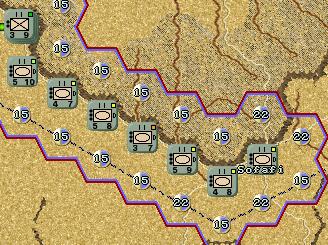
Campaign for North Africa 40-43 by Bob Cross
Major elements of Libyan Tank Command advancing
along the road to Sofafi (start of T2 — 9/21/1940)
We could send our tank battalions through the uncontested desert wastelands along the Egyptian border. It would be far more economical to assign the task to an infantry battalion, dividing it into three companies. Front line forces should not be indiscriminately diverted to conversion duty, wasting supply and readiness, unless there are no other candidates for the job.
In converting ownership of hexes, you are looking for three basic things: 1) Using your lightest and least significant combat forces possible, 2) using units with a high MP allowance and broken into thirds (to recombine later), and 3) converting hexes with units going the least out of their way in keeping up with their formations. The units which best fit the bill for this are light flak, engineers especially along river routes, recon, fusilier, and light cavalry. Military police can be added to this list if not needed to reduce movement costs in directing traffic.
