



Operation Phantom Fury – Beginning of the End of al Qaeda in Iraq
Fallujah, November 7, 2004
Operation Phantom Fury
The Beginning of the End of al Qaeda in Iraq
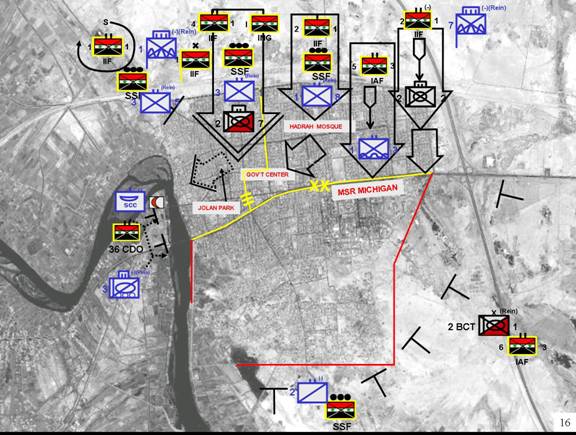
At sunset on Sunday, November 7, 2004, the soldiers, sailors and Marines of Task Force Wolfpack raced north in their Light Armored Vehicles, tanks and trucks to secure the "Shark’s Fin," a large peninsula west of the insurgent stronghold in the ancient Iraqi blue-collar city of Fallujah. Two bridges spanned the Euphrates River, connecting the Shark’s Fin with downtown. An angry mob had strung up the bodies of two Blackwater contractors on the older footbridge in spring of 2004. It is hard to believe that it has been five years since the beginning of the largest, and most important, battle of Operation Iraqi Freedom. As the Wolfpack was moving to secure the Fallujah Hospital and the western approach to the Euphrates River bridges, a massive military force was assembling, north of the city. The Wolfpack’s attack was a battalion-sized diversion.
{default}Two Army mechanized task forces and four reinforced Marine infantry battalions were preparing to inundate the enemy, all along the northern edge of the city. The actual attack would come twenty-fours later, at sunset on November 8, 2004, as two Marine regiments swept into the city. Lieutenant Colonel Jim Rainey’s 2-7 Cavalry led Colonel Mike Shupp’s Regimental Combat Team (RCT-1) into the northwestern Byzantine neighborhoods. To the east, Lieutenant Colonel Peter Newell’s 2-2 Infantry attacked south on the eastern edge of the city alongside Colonel Craig Tucker’s RCT-7 Marines.
The enemy had been preparing for the inevitable assault for months. They had built barricades, set IEDs and dug in deep. Most of the four-thousand jihadists were there to fight and die. Task Force Blue Diamond, the 1st Marine Division, led with their tanks. The 70-ton armored vehicles were unstoppable. They mowed down fanatic fighters in the streets and blew through barricades as enemy RPGs bounced off their thick skins, leaving little more than black scorch marks. Four battalions of Marine infantry swarmed into the city behind the armored juggernaut. The insurgents tried to stand and fight. It ended badly for those that thought they could defeat American tanks and Bradleys.
Sergeant Matthew Smith led RCT-1’s attack through the breach with a tank-mounted plow. Staff Sergeant Anibal Reyes followed Smith with a roller attached to the front of his tank. They plowed through a minefield and slammed through barricades at the edge of the city.
Once inside the city, the enemy unleashed everything they had. They thought they could take on the tanks and win. The tankers responded with coax machine gun fire, spewing streams of steel. The tank’s main guns were belching fireballs the size of a house, momentarily lighting the street like it was daytime and shaking the ground as their supersonic projectiles shattered buildings and killed any insurgent in their path.
Smith and Reyes were ordered to push forward to make room for the rest of Jim Rainey’s tanks. Slowly, the two tanks ground forward into the maelstrom. Smith and Reyes waited nervously at the first major intersection for the battalion’s tanks and Bradleys to fill in behind them. Swarms of insurgents tried to maneuver around in back of the tanks, only to find more tanks and Bradleys pushing into the city through the gap in the barricade. There seemed to be no end to the armored assault.
Rainey’s Bradleys followed his tanks through the breach and fanned out to the west. Any enemy fighters remaining at the barricades at the edge of the city must have been scared silly as they watched an entire mechanized battalion roll through their flimsy barricade – tank after tank, Bradley after Bradley. The Americans just kept pouring into the city. Some insurgents were foolish enough to stand and fight. Their bullets plinked harmlessly against the armor plate like rain on a tin roof.

Four battalions of Marine infantry swarmed into the city behind the tanks and Bradleys. If the enemy waited for the Marines to approach, or if they fired on the Marines when they came into view, artillery and mortars would be quick to respond – usually bringing the building crashing down around them. American snipers silently brought instant death. If the enemy remained inside and waited for the Marines and soldiers to get closer, they learned quickly what it was like in Hell. Sixty-millimeter mortar shells would rain down. M1 tanks would fire at point blank range. Fifty-caliber and 7.62mm-machine guns would spray their position. They would be pounded with 40mm grenades, AT4 rockets and Javelin missiles. If they waited until the Marines were on their doorstep, the Marines would swarm their position and not back off until everyone in the house was dead. Their only chance was to surrender or hunker down, hoping the Marines would pass them by.
It took the soldiers and Marines nearly a week to reach the southern edge of the city. The 1st Cavalry Division’s Blackjack Brigade, along with the Marines’ 2nd Reconnaissance Battalion had cordoned the city in the south. Both Marine regiments relentlessly hammered the enemy in the north onto Colonel Mike Formica’s Blackjack Brigade anvil in the south. The enemy was hit hard in that first week, but they were not defeated. Many had gone to ground. The most fanatic fighters barricaded themselves in fortified houses throughout the city.

The Marines needed seven weeks to completely clear Fallujah, with several deadly firefights in late December. Two Marines were nominated for the Congressional Medal of Honor for their heroic actions. Both of the Marines’ awards were downgraded to Navy Crosses. In all, there were seven Navy Crosses awarded, twenty-two Silver Stars and more Bronze Stars with Vs for valor than I have been able to count. Eighty-five soldiers, sailors and Marines were killed in the fight and hundreds were wounded.

Operation Phantom Fury, the second battle for Fallujah, was the largest fight of the war and the heaviest American urban combat since Hue City during the Vietnam War. There was never any doubt as to the outcome. By Christmas our forces had cleared every room in every building, completely eliminating the insurgent threat inside Fallujah. The fledgling Iraqi Army contributed to the fight to free Fallujah by clearing mosques and hospitals and then they worked to maintain security within the city. The fight for Fallujah was the beginning of the end for al Qaeda in Iraq. There would be many years of hard work to come, but freeing the people of Fallujah was the first real success in Anbar Province. The Iraqis named the Operation al-Fajr, after a passage in the Qur’an. The loose, English translation is "The Dawn" or "Daybreak." The religious passage talks about wrongdoers returning to the grace of Allah. It speaks of an approaching New Dawn.
Watch for New Dawn: the Battles for Fallujah by Richard S. Lowry (author of Marines in the Garden of Eden and The Gulf War Chronicles). It tells the entire story of Operation Phantom Fury and will be in bookstores in May of 2010. Visit www.RichardSLowry.com to learn more about Richard and his work.

Richard,
I like your opening monologue here! I think folks that read this book will not only be surprised that the 1st Marine Division actually led the attack with its two attached Army battalions (2-7 CAV and 2-2 Infantry) but they will also learn that this was quite possibly the most integrated and intense joint urban fight at the tactical level in many years.
Hopefully you were able to capture all the details of how the 2-7 CAV and 2-2 Infantry employed their tanks relative to how RCT-1 and RCT-7 employed Marine tanks during this battle. Although there were clear differences, I think that the effects of both were complementary. In the case of 2-7 CAV, their use of an armored column Thunder Run down PL HENRY creating shock against the enemy and holding the LOC proved pivotal for the rest of RCT-1 being able to attack along a main LOC then fanning out to conduct detailed clearing.
It was always good to see those 2-7 CAV tanks and Bradleys holding the LOC which in my mind essentially became a “life-line” for the Marines conducting the room-to-room clearing. When I say life-line, I mean to say that PL HENRY was used as a high-speed approach to resupply, re-attack, medevac, etc for the units in RCT-1. It also served as a boundary between RCT-1 and RCT-7. Holding that line open was only possible by the efforts of 2-7 CAV. The enemy also seemed to recognize the prominence of this road and I recall clearly how the 2-7 CAV soldiers never had a shortage of enemy rushing towards them.
Anyway, I was suddenly reminded by your link popping up on my Facebook that the 5th Anniversary of this battle is almost here. Sometimes it feels this was so long ago, other times it feels like it was yesterday.
I wish you the best of luck in your book, hope all is well and if you are celebrating the Marine Corps birthday soon, Semper Fi!
Maj Rob Bodisch
I was part of that operation, I cant believe that it all happen 6 years ago, but the mission, the battle, and the aftermath are still fresh in my mind, I was with 3/5 1st platoon India company, and to me it was on honor to be part of something that was bigger than anything I can imagine, to be inbedded in histories pages and to have served and known the majority of the men that were awarded these citations and metals brings chills to my spine because some can just talk about their actions and their bravery, but I for 1 saw, witness, and supported these men’s actions, semper fi marine corps, and for all those who participated in this event God bless you all, we have now reached immortality.
Be advised that 3/5 1st. Marine Division is one of the most highly combat ready regiments in the Marine Corps. They fought in every major battle in all wars. I was in 3/5 too. But over 40 years ago. Semper Fi. I’d go to battle with you any day.
For more information about “New Dawn”, including an exerpt, or information on the author, Richard Lowry, check at http://www.richardslowry.com or http://www.savasbeatie.com/books/book_page.php?bookVAR=NEW_DAWN&bookType=about&authorID1=RSLowry&authorID2=empty&authorID3=empty&authorID4=empty&authorID5=empty.
Its been 12 years and I still remember every detail. While this was a joint task force but essentially a Marine operation I would have liked to see have seen our patch associated with the battle. 2nd Infantry Division 1-9 Infantry – Manchus. Our platoons held the two western bridges(contractor bridge, route michigan), we rescued a marine re-supply that was ambushed, pushed back the flood of insurgents fleeing from the main force to the North, and spearheaded the battle 24 hours prior to the main force arriving. I lost brothers to that battle and would have their sacrifice etched in its history.