
No Festivities for the Inauguration of Winston Churchill
When the elation and triumph of a lifetime dream ought to have otherwise prevailed, Winston Churchill was quite possibly the loneliest man in Britain.
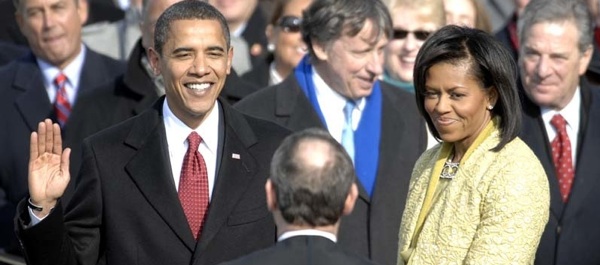
On January 20, 2009, we inaugurated the forty-fourth president of the United States in a time-honored ceremony filled with an American version of pomp and circumstance that signifies a peaceful transition of the office of president. For a brief moment there is an unusual dignity where even political enemies set aside their differences to witness history. What makes this occasion so special is its ability—at least this year—to bring the American people together. It doesn’t matter what political colors one wears: on this day we are all Americans. The inauguration also signifies our collective commitment to a democratic way of life. That some two million people would brave 20-degree weather to stand for hours just to witness and be part of it says more than words.
{default}The swearing-in ceremony at the stroke of noon (slightly late this time) is followed by the ceremonial departure of the outgoing president, who is escorted by the new president to a waiting helicopter outside the east wing of the Capitol. After Marine-1 lifts majestically into the sky it makes the now traditional final flight over the Mall and the White House to provide the former president a final glimpse of the city that he had called home for four or eight years.
Music, prayer and poetry are all part of this magnificent event, which is followed by a parade in honor of the new president. Before that, however, there is a ceremonial drive down Pennsylvania Avenue from the Capitol to the White House. In recent inaugurations it has become almost customary for the president and first lady (to the horror of the Secret Service!) to walk at least part way along Pennsylvania Avenue to greet the thousands lining the sidewalks. This year the parade past the reviewing stand erected in front of the White House seemed endlessly long. No wonder: there were some 13,000 participants: from marching bands to riders on horseback, honor guards, Indians in full regalia, the surviving members of the Tuskegee airmen, and motorcycles.
That evening the new president attends as many as ten galas around town, doing at least one ceremonial dance at each until the early morning hours. When the day ends at two or three a.m. the following morning it signals the end of yet another peaceful transition of power. As if nothing has occurred, on January 21st it’s suddenly time for business and the work of the presidency.
* * *
The British all but invented ceremonial pomp. During Queen Victoria’s Diamond Jubilee celebrations in 1897, one of the centerpieces of this imposing event was the British Army. When Queen Victoria attended a service of Thanksgiving at St. Paul’s Cathedral, the streets were lined with 50,000 splendidly arrayed troops on horseback to formally salute their sovereign. Even today the daily changing of the guard at Buckingham Palace and the annual Queen’s birthday celebration and parade are colorful events that draw hordes of spectators.
However, a change of British government is an entirely different sort of event. Whenever the party holding a majority in the House of Commons wins a general election or a prime minister is replaced (either through resignation or a vote of ‘no confidence’ in Parliament), there follows a time-honored sequence of events. The new PM is summoned to Buckingham Palace where the reigning sovereign formally asks him or her to form a government. The event takes place behind closed doors and is never privy to photographers or the press. There is no swearing in ceremony, no bands, no clergy offering prayers or benedictions, and no speeches broadcast over the BBC, and certainly no cheering crowds.
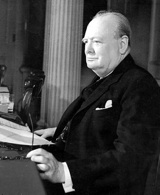 Winston Churchill’s selection to the prime ministership on May 10, 1940, was easily one of the bleakest in British history. At dawn that day Hitler’s armies invaded the West and quickly ran overran Luxembourg, Belgium and Holland. France, too, was invaded and by end of June was forced to surrender in the same railway car in Compiègne where the First World War officially ended in 1918.
Neville Chamberlain had long since proven himself an inept war leader, and after the disastrous invasion of Norway by British and French forces in April 1940—that resulted in a humiliating defeat and withdrawal—Chamberlain’s days were numbered. On May 10 he tendered his resignation to King George VI. Although the Norway campaign was the brainchild of Winston Churchill, it was Chamberlain who took the fall, thus opening the door for Churchill, then first lord of the admiralty, to become the new prime minister.
On that historic day the summons to Buckingham Palace came at six p.m. As he was driven the short distance from the Admiralty to the Palace he exchanged no words with his driver and bodyguard, Inspector Walter H. Thompson, but instead sat in unusually silent contemplation. “I was taken immediately to the King,” he later wrote. There were a few awkward moments after “he bade me sit down” and “looked at me searchingly and quizzically,” before inquiring: “I suppose you don’t know why I have sent for you?” Churchill replied, “Sir, I simply couldn’t imagine why,” producing a laugh and the formal, time-honored means by which British monarchs request the formation of a new government. Churchill accepted without further pretense, promising to immediately form a coalition government, form a new War Cabinet consisting of five to six members, and to submit before midnight five names whom he intended to bring into his new government.
Privately, George VI was both disappointed and extremely wary of Churchill and his buccaneer reputation. Although unenthusiastic over Churchill, the King’s misgivings proved short-lived. Churchill quickly won him over by a combination of charm and performance.
As he returned to the Admiralty from his audience with the King, Churchill sat alone and pensive in the backseat of his automobile. The son of Lord Randolph Churchill, who once told him he would never amount to anything, was now prime minister of Great Britain. Quietly accepting Thompson’s congratulations, Churchill was momentarily nearly overwhelmed with the enormity of the task placed squarely into his hands. Tears came into his eyes, and as he turned away he muttered something to himself. Then he set his jaw, and with a look of determination, gained control of his emotions. Yet, despite his steely sense of purpose, Churchill was unable to completely hide the magnitude of what was now his responsibility. “God alone knows how great it is,” he quietly remarked to Thompson. “I hope it is not too late. I am very much afraid that it is. But we can only do our best.”
Although later that night he admitted to “a profound sense of relief,” for a brief moment, when the elation and triumph of a lifetime dream ought to have otherwise prevailed, Winston Churchill was quite possibly the loneliest man in Britain.
* * *
In the late evening hours of May 10, 1940, Churchill and the British nation began what would prove to be a long, often lonely, but ultimately triumphant ordeal. In the Great War, Churchill had been merely a player; in this war his years of military experience and preparation would serve him well as not only the political leader of his nation—its source of inspiration to resist the terror inflicted upon the British people and their cities—but as its military warlord. The ordeal ahead might well have devastated Britain but for one elderly man’s supreme will to resist. Although he once said: “I know now that it will come to me to deal with Mister Hitler,” Churchill never counted on having to fight a war on two fronts in 1940: to hold back Germany’s attempts to crush Britain, and to fend off those in his own government who would have made peace with the German dictator. It was an incredible challenge he had waited all his life to undertake.
The date is burned into the memory of every Briton old enough to have understood its significance. Churchill’s daughter, Mary, was at the family home, Chartwell, and remembers hearing the news announced on the BBC. She prayed. His confidant, Major General Edward Spears, heard the Berlin wireless announce Britain’s change of government. “Mr. Chamberlain has resigned and is followed by Winston Churchill . . . [the] most brutal representative of the policy of force, the man whose programme is to dismember Germany, this man whose hateful face is well known to all Germans.”
Shortly, the rest of the world learned that Britain’s leadership had changed on one of the most fateful days in the history of Western civilization. As for Winston Churchill, May 10, 1940, now meant simply that, for better or worse, Britain’s fate rested in his hands. Historian A.J.P. Taylor would later write of him, that when Britain needed him the most he became “the saviour of his country.”
Indeed, someone like Gen. George S. Patton would have brusquely declared that what Britain needed in 1940 was a confident, indisputable son-of-a-bitch to take charge; someone unafraid to make the difficult life-and-death decisions that befall a war leader; to take charge of a nation in a state of disbelief that it was again at war—a war that was not supposed to occur after the terrible sacrifice of the “war to end all wars.” For all of his many admirable qualities, the only other candidate for prime minister, foreign secretary Lord Halifax, was not a war leader of the ilk required to defeat Adolf Hitler. On May 10, 1940, just such an S.O.B. as Patton might have wished for took charge of Britain’s fate when the responsibility to lead the nation was thrust upon Winston Churchill who would later remark that, “Some people pretend to regard me as The British Lion. But I am not the Lion. I am simply the Roar of the Lion.”
George Orwell and Churchill’s personal physician, Sir Charles Wilson (later Lord Moran), may have spoken for Britain of what Churchill would come to epitomize. Orwell has observed that Britain finally had “a leader who understood ‘that wars are won by fighting,’” while Wilson wrote that what the nation required “was a man utterly blind to reason, a man who refused to see the sound and compelling reasons for despair and surrender.”
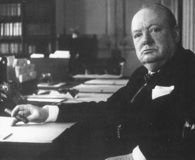 The man who had just become prime minister at the moment of the gravest crisis in British history was never in the best of health, smoked way too much, was thought to drink too much, and had been a political outcast for nearly a decade. Now, this controversial man, who many thought dangerously unfit to lead Britain, was suddenly charged with the most profound burden ever placed upon the shoulders of a leader. Churchill finally went to bed around 3:00 a.m. and when he arose the following morning said to Clementine: "Only Hitler can turn me out of this job.”
No one did until the summer of 1945. As for a formal ceremony to mark Churchill’s new role, it would have been out of place and unseemly for a nation to rejoice on a day when the future of the British nation was bleak and about to get even bleaker.
Portions of this article appear in the author’s Warlord: A Life of Winston Churchill at War, 1874-1945, published by HarperCollins and in April 2009 in the United Kingdom by Allen Land/Penguin.

An interesting article which touches on many key issues.
Nowadays, the accession of a new Prime Minister following a general election is regularly accompanied by cheering crowds, media appearances and a speech in front of 10 Downing St. However, this is not so much a formal piece of ceremonial, but more a channel in the age of mass media to bring the event to the public. On the other hand, when a leader is ousted by losing the confidence of his or her own party in Parliament, which is what happened to Chamberlain in 1940 and Thatcher in 1990, the same degree of publicity does not follow (after all, there was no election, the people were not consulted) though I seem to recall John Major giving an accession speech when he took over from Mrs T.
This type of leadership change shows the power of party in the British system, and in other parliamentary democracies. Such power is ruled out by the US constitution, designed as it was deliberately to limit government. In the UK a party with a secure parliamentary majority has effective control of executive and legislature and can in theory change anything and everything, including constitutional matters, just on the agreement of the cabinet, comprising 20 or so key ministers.
This system has been called an “elective dictatorship”, and Churchill declared in his memoirs that he did not believe any of the other war leaders, even the dictators, had a more close, effective control of his country’s war effort than Churchill had in the UK.