




Interview with Navajo Code Talker Chester Nez
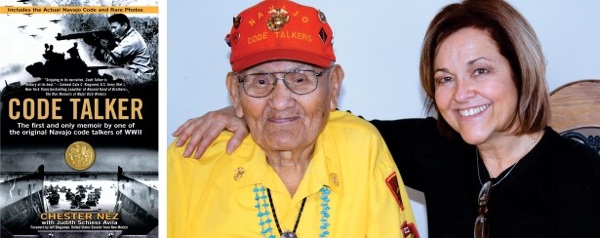
World War II Navajo code talker Chester Nez and co-author Judy Schiess Avila
After Tim Tow reviewed the book Code Talker: The First and Only Memoir by One of the Original Navajo Code Talkers of WWII for Armchair General, we asked Tim to conduct this interview with the authors, Chester Nez and Judith Schiess Avila. Tim has studied the history of military intelligence and writes on technology and military affairs. Watch for his upcoming article "The Rise and Fall of the American Heavy Tank" on ArmchairGeneral.com.
{default}Tim Tow (to Chester Nez): Are there some common misperceptions about the Navajo code talkers that you wish to correct?
Chester Nez: Many people think that the code talkers simply spoke Navajo, when we actually developed a doubly encrypted code utilizing both English and Navajo.
Also, some people think that we were "special" Marines who didn’t have to go through basic training. In reality, we all went through basic, just like any other Marine recruit. On the reservation we led a very physical life, so basic training was tough, but not too tough.
TT: What was the most complex message that you had to deliver using the code?
CN: The complexity was more in the process than in the actual messages. We acted as coding machines, transmitting messages that would have taken a couple of hours in just a couple of minutes. We could never make a mistake, because many communications involved bombing coordinates. Since our troops were generally head to head with the Japanese, we couldn’t afford any errors, because we didn’t want our bombs and artillery to hit our own men.
My first transmission—one that did not involve coordinates—was one I will always remember: Beh-na-ali-tsosie a-knah-as-donih ah-toh nish-na-jih-goh dah-di-kad ah-deel-tahi, which translates to: Enemy machine gun nest on your right flank. Destroy.
TT: Is there any incident from your time as a code talker that particularly stands out in your memory?
 CN: We were constantly warned that we couldn’t get captured—because the Japanese would torture us to learn about our code. It’s ironic that I was "captured" by American Army troops while on the island of Angaur. They put a .45 pistol to my head and accused me of being a Japanese soldier impersonating a Marine. Luckily, the communications officer stepped in before any real damage was done.
TT: Can you think of a use for the "Navajo code" today?
CN: Not as a communications tool. Technology has replaced our code. However, it could be used to help in teaching the Navajo language—something to pique the interest of the students.
TT: What is your opinion on the depiction of the Navajo code talkers on film and in fiction? Did you see the 2002 movie Windtalkers?
CN: I think the media has done a pretty good job as far as its reporting goes—but many people still do not know what a code talker is. I have visited several schools, explaining what we did and showing the kids how important the Navajo contribution was. The movie Windtalkers did a nice job but did not delve into the code talkers as much as I would have liked. The primary dilemma posed was whether or not the Nicholas Cage character could shoot the code talker he guarded if Japanese capture was imminent. I’d like to see a movie that depicts the code talkers developing the code and using it in battle in a much more comprehensive way. I also would have liked to see more Navajos used in the movie. Roger Willie, a Navajo man, pronounced the code perfectly, but other actors did not.
TT: With your perspective on Navajo and mainstream American culture, what do you regard as the biggest strengths of each?
 CN: Our code combined the strengths of each—the complexity of Navajo, further compounded by utilizing English words translated into Navajo as an alphabet. The Japanese never broke our code—the only unbroken code in modern warfare.
Navajo culture believes in nature and in family. Our relationship to our environment and to each other is very important. I wish that white culture emphasized these things more strongly.
TT: What’s a question that you’ve never been asked but wish someone had asked?
CN: I have been asked so many questions. I cannot think of any that have not been asked. However, I do love teaching people about how we developed our code and how my Navajo people helped their country—so ask away!
TT (to Judith Schiess Avila): What brought you to this project? What motivated you to write about the code talkers?
Judith Schiess Avila: I’ve been interested in Native American culture since moving to the Albuquerque area. New Mexico is a fascinating mix of cultures. When I learned about the code talkers and their courage in the face of the difficulties they encountered, I wanted to know more. Then a friend told me about meeting Chester. I got his phone number from my friend, called, met for lunch with Chester and his son, Mike, and talked for hours. I was hooked.
TT: What is unique about this book on code talkers compared to other books?
JSA: This is the only book about code talkers from an actual code talker. The others are good, but they were written by historians from an outside perspective. Chester gives the inside scoop on joining the Marines and developing the code. He also gives readers a tremendous insight into Navajo culture at the time he grew up. His story reveals how a hard life—herding Grandma’s sheep, attending boarding school where the Navajo language was forbidden, witnessing the government massacre of Navajo livestock—made him strong. His young life prepared him, mentally and physically, to be a code talker.
TT: Often, manuscript length restrictions force authors to cut some of their material. Was there anything you had to leave out of the book that you want to mention here?
JSA: Actually, Penguin/Berkley was so supportive of our memoir and so excited about Chester’s story that they asked us to expand it by 30 percent!! We didn’t have to leave anything out.
However, Chester did remember some stories after the book had already gone to press. At Penguin’s request, we have written a 50-page e-special book, including those stories and talking about how Chester’s life has changed since his memoir came out. That will be published in December 2012 as an e-book (no paper copies). The title is The Life and Times of the Code Talker.
TT: Thank you both for your time. Is there anything you’d like to add in closing?
CN: I hope people read my memoir!!
JSA: Anyone who wants Chester’s memoir, Code Talker, signed by Chester and me can get one from Latham Nez (his grandson) at ThatDamnIndian@hotmail.com or 505 453-6735.
You can visit Judith Schliess Avila at her Website, www.JudithAvila.com—Editor.
Click here to read Tim Tow‘s review of Code Talker: The First and Only Memoir by One of the Original Navajo Code Talkers of WWII.
Click here to read an article about the Code Talkers.

Latham, it was great talking to you.i know you will recognize jenny and myself when you see us even though you met a ton of people when you were in Portsmouth,NH. like I said we would like to have you all back to be honored at our veterans powwow on jan 25 on a Saturday.it is something we’ve been working on since we saw you! we hope you will be able to come and we have a good set-up for all of you with a whole house at your disposal. we also have David Flores working with us to make sue your every need is taken care of. you are welcome to stay1,2,or however long you like to do an eastern tour. so looking forward to hearing from all of you and hope we can pull this off. my cell is 603 630-4757. pete
It was a great honor and pleasure of meeting Judy, Chester and his son for the wonderful surprise on Saturday, 5 April at the National Marine Corps Museum. Many of the people present were going through the Docent training, as I was as well. Enjoyed knowing Chester and what an opportunity for him to see the National Museum of the Marine Corps. His recollection of the names on the wall – whom he knew very well – of the first group that went through the Code Talkers training. His body may age, but his mind remains sharp. Chester’s actions during WWII saved many lives and the outcome of what could have been a very costly war. Thank you Chester for your dedication to tell the story about the Code Talkers and the involvement of American Indians in the military – serving with honor and distinction. God Bless you and your family. r/Faafetai Mamea, MGySgt, Retired.
Hello, a good friend’s, whose grandfather just died, was told his grandfather worked with the codetalkers. Did you come across his name in any of your research? It was Luther Jennings Hutcherson.
Great article! Thanks for asking these questions and thank you to Chester for his service and sacrifice and for telling his story!