



Hitler’s Foreign Armies On World War II’s Eastern Front
Editor’s Note: The November 2012 issue of Armchair General magazine features Richard N. Armstrong’s “What Next General?” article “Manstein at Stalingrad, 1942,” which places readers in the role of German Field Marshal Erich von Manstein facing the daunting task of breaking through to relieve the beleaguered German 6th Army trapped by Soviet forces in Stalingrad. Given the significant impact on that World War II turning-point battle played by the forces of Germany’s Romanian, Italian and Hungarian allies, this article complements and expands upon Armstrong’s “What Next General?” article by presenting an insightful overview of the various foreign armies supporting Germany and how they influenced Eastern Front combat operations.
{default}Unlike Germany’s lightning wars quickly won against Poland, Norway, Denmark, the Low Countries and France, Hitler’s invasion of the Soviet Union on June 22, 1941 — Operation Barbarossa — began to unravel in western Russia’s vast spaces. Hitler and his military leaders debated over key objectives and underestimated Russian tenacity and depth of manpower. Surprised by critical logistical shortfalls, the Germans found themselves in a longer than anticipated war which became increasingly costly in casualties and materiel losses. Hitler realized that he had to call on his Axis allies for more troops and wage a coalition war on the Eastern Front.
PRE-INVASION
Finland: In June 1940, in the wake of Germany’s conquests elsewhere in Europe, Stalin’s Soviet Union occupied the Baltic States (Estonia, Latvia and Lithuania) in a power-play that renewed Soviet pressure on its northwestern neighbor, Finland – which had fiercely resisted a Soviet invasion during the 1939-40 Winter War before eventually succumbing to the Red Army and resuming an uneasy peace with Stalin. By late summer, to counterbalance Soviet pressure, the Finns had received German shipments of military equipment and supplies, and had concluded an agreement to permit German troops to transit Finland. During the winter of 1940-1941, Finnish and German general staffs established closer contacts. In preparation for Operation Barbarossa, Finland agreed to cover the concentration of Germany’s Force North transferred from Norway and to conduct combat operations with this force in an attack on both sides of Lake Ladoga to tie down Russian forces.
Romania: Romania aligned with Germany in November 1940. Although the Germans’ principal interest in the country was its Ploesti oilfields – vital for fueling German armies – Romanian leaders also agreed to participate in Germany’s attack on the Soviet Union. Romanian motivation was to retrieve its former territories, Bessarabia and Northern Bukovina, lost to the Soviets in Stalin’s 1940 land grab. Before the Barbarossa invasion, German general staff planners included the Romanians as well as the Finns since the invasion used both countries’ territory and planned to employ their military contingents on the wings of the German advance.
Hungary: Although Hitler and Hungary’s Regent, Admiral Miklos Horthy, did not meet until April 1941 following the German invasion of Yugoslavia, they had by December 1940 signed a treaty of “constant peace and eternal friendship” between the two countries – in effect, Hitler had enlisted Horthy in his single-minded crusade against Soviet Bolshevism.
Italy: Benito Mussolini, the Italian Fascist dictator and Hitler’s original Axis partner, initially held back Italian participation in the fight against Soviet Russia until after the invasion.
INVASION
During the Barbarossa invasion, Axis allied troops were over-shadowed by the stunning German panzer advances that carved out huge pockets of cut-off Soviet forces and produced hundreds of thousands of Russian prisoners of war. Hitler’s allies fought along less sensational invasion routes.
 The Finnish Army with five corps retook territories lost in the 1939-40 Winter War and advanced further to occupy Russia’s East Karelia, northwest of Lake Ladoga. German and Finnish troops, however, failed to take the key Soviet port, Murmansk. By December 1941, after reoccupying the Mannerheim Line (lying north of Leningrad and protecting Finland) and other territories seized by the Soviets in 1940, the Finnish army showed little interest in pressing forward against Leningrad.
Deployed with German Army Group South, Third and Fourth Romanian Armies straddled the German 11th Army attack into the Ukraine. By July, German 11th Army with combined corps of German and Romanians advanced deeply from the Dniester River to the Bug River. They surrounded the key Black Sea port of Odessa and contained coastal fortifications into late September when a Red Army counterstrike penetrated deeply inflicting heavy casualties on the German offensive’s perceived weak link – the Romanians. Since the Dniester River crossing, Romanian forces had lost 98,000 in casualties.
Hungary joined Germany’s invasion of the Soviet Union on June 27, 1941 with a poorly trained and ill-prepared Hungarian corps attacking with Germans through Carpathian Mountain passes into the Ukraine. Hungarians and Romanians sent contingents to Hitler, each seeking to gain his support in resolving their territorial dispute. Their mutual animosity required operations that kept the two contingents separate to avoid armed clashes.
In July 1941, Mussolini sent the Italian Expeditionary Corps in Russia — two motorized and one cavalry divisions. The corps fought with Army Group South in late summer 1941.
Spain did not join the war, but after June 1941 sent, as volunteers, its Blue Division, 19,000 soldiers and a small air squadron. The Blue Division fought well (mainly near Leningrad), gaining Hitler’s praise for fearlessness. However, the Spaniards were withdrawn from the Eastern Front in 1943 after 45,000 volunteers had served.
CALL AND RESPONSE
In January 1942, after the bitter German defeat at the gates of Moscow, Hitler asked Hungarian, Romanian and Italian leaders for increased participation on the Eastern Front. Combined operations, however, were based solely on a general military agreement with no combined supreme command or overall plan. German and Finnish forces, for example, had little coordination in supply and maintenance. The Germans, fearing intelligence leaks, kept their operational plans to themselves.
 Horthy had difficulty supporting his East Front Hungarian forces and persuaded Hitler to reduce the Hungarian military presence there in September 1941. However, by Christmas 1941, with the debacle around Moscow, Hitler called for greater Hungarian military and economic contributions. Hungary raised a new 200,000-strong army.
Huge equipment and personnel losses forced Hitler to request more Italian forces. Mussolini, convinced Germany would soon bring a successful end to the war, sent three infantry divisions to join the Italian corps and thereby form the Eighth Italian Army.
The Romanians, with ambitions to lead an army group-size force, continued sustaining its two armies with fresh troops and equipment to the best of its capabilities.
COALITION ISSUES
The Axis coalition revealed disastrous “frictions” in combining armies with different languages, organizational cultures, levels of technology and training that were greatly magnified by shortfalls in Germany’s war economy. Germany failed to become the “Arsenal of Fascism” to offset the United States increasingly vital role as the “Arsenal of Democracy.” Germany never fulfilled its own military needs – let alone those of its strained allies – and had to pass along captured military arms to its allies. This situation resulted in a bewildering conglomeration of military equipment and made logistical support a nightmare.
Germany’s allies lacked comparable capabilities for mobile, armored warfare which made them no match in arms or mobility against the Soviets. In good tank country, German allies were particularly vulnerable, especially to Red Army breakthrough offensives against extended frontages.
Disparity in armor, mobility and firepower revealed that Hitler’s allied forces were incapable of exploiting major breakthroughs achieved by the German Army, consequently they performed frontal infantry assaults resulting in heavy casualties even when successful. In general, German allies had fewer weapons and less reliable equipment as well as incompatible training and doctrine. German staff officers relegated them to secondary roles such as mopping up and securing the flanks of German spearheads.
 German advisers noted Romanian soldiers’ resiliency and subsistence on less rations than German troops. The Romanians marched well, but with little motorization had to rely solely on horse-power transport. Their unfamiliarity with motor vehicles, especially armored vehicles, made them difficult to prepare to defend effectively against Soviet tank attacks.
By summer 1942, German commanders knew the foreign armies in the offensive were far too weak to accomplish assigned tasks. Only the Romanians, who supplied the major foreign contingent, participated in large numbers in German offensive operations.
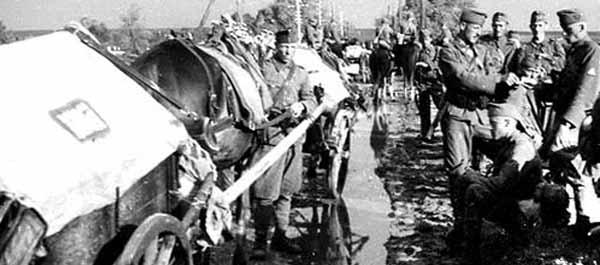
The German army itself, of course, was not a completely mechanized force; however, it was comparatively more advanced than its allies, especially in the ability to fight armored warfare. Although German artillery and supplies were drawn mainly by horses, Romanian field bakeries used oxen and Romanian antitank guns were horse-drawn – thereby seriously restricting the battlefield mobility vitally necessary for antitank guns to survive and be effective. In general, all allied foreign divisions lacked motor transport.
Language barriers and the limited number of translators and interpreters brought problems resulting in broken communications. Fundamental coordination and liaison required surmounting technical language and mandated brevity in operating procedures. Coordination among headquarters with different communication equipment and procedures created lapses in troop movements with uninformed orders often at critical junctures in combat. A tactical example of problems caused by limited language capability occurred in the German mobile reserve behind the Third Romanian Army comprised elements of the 14th and 22nd Panzer Divisions and the 1st Romanian Panzer Division. Soviets forces overran the German signals unit with the Romanian panzer division and its Romanian-speaking leader was wounded. The Romanian division fought 24 hours without any knowledge of either enemy or friendly situations.
Crossing a language barrier requires language training. German was taught in Finnish schools, so most Finnish officers understood German. Hungarian officers who graduated from the General Staff Academy were required to have a fluency in German, but this fluency would not be at the lower units or lesser grades. Italian and Romanian forces had few German speakers, mainly senior officers conversant in German or French. German officers from their War Academy learned English or French. German military officers who served as military attachés to allied countries staffed small German liaison detachments to the foreign allied units.
By mid-war, the Hungarians would find Italian forces on its flank, as Italians would find Hungarian and Romanian, and Romanians would work beside German and Italian units. But difficulties in conversing with each other remained a stumbling block.
DISASTER AROUND STALINGRAD
In Operation Blue, the German summer offensive of 1942, Army Group South was supported by 20 German and 21 foreign army divisions (6 Italian, 10 Hungarian, and 5 under-strength Romanian divisions). By July 1942, the Seventeenth German Army, Third Romanian Army, the First and Fourth German Panzer Armies concentrated under the command of Army Group A to capture the Caucasus. The Sixth Army, ordered to capture Stalingrad, had the Third (minus mountain infantry left with Army Group A) and Fourth Romanian Armies protecting its left and right flanks. The Romanian divisions, only seven battalions strong, covered a 12-mile front. They had no heavy artillery and few effective antitank weapons — mainly horse-drawn 3 7mm Pak anti-tank guns which could not penetrate Soviet T-34 tank armor.
The Red Army counteroffensive around Stalingrad, launched in mid-November 1942, fully exploited the vulnerabilities of Hitler’s foreign allies. The Soviets attacked both flanks of the Stalingrad salient, cutting off 300,000 men of the German Sixth Army and elements of the Romanian armies in and around the city. From this Soviet counteroffensive, the Italian Eighth Army, widely spread on the west bank of the Don, had its right flank exposed to encirclement. On December 16, 1942, the Red Army struck against the Italians who withdrew in frost-bitten winter conditions, suffering 25,000 dead, 60,000 prisoners and 30,000 wounded. The remnants of the shattered army returned to Italy. The Second Hungarian Army, on the northern flank of the Italians, suffered a similar disaster with 84-percent casualties. The survivors of that army returned to Hungary in May 1943.
The Third and Fourth Romanian Armies lost 155,010 dead, wounded and missing (mainly prisoners). This represented over a quarter of all Romanian troops engaged on the Eastern Front. The Axis defeat ended the German Army’s last grand offensive on the Eastern Front.
IN THE FACE OF DEFEAT
After Stalingrad, the destroyed German-allied armies became more integrated at the corps and division levels within German army-level command and sectors. In March 1943, Hitler ordered a spring offensive, Operation Citadel, against the Kursk salient.
By summer 1943, the Hungarians had only a corps north of the Kursk salient, and the Romanians integrated into the German 17th Army were defending the Kuban bridgehead, Taman peninsula and the Crimea. Mussolini had withdrawn his Italian Eighth Army from Russia, and by July 1943, he was out of power.
 In late August 1944, the Red Army trapped large German and Romanian forces in eastern Romania. Romanian King Michael arrested Marshal Ion Antonescu, taking Romania out of the Axis camp, exposing Germany’s southern flank and opening southeastern Europe to the Red Army.
After the Finns recaptured territories lost in the Winter War, the Soviets regrouped and conducted operations that bled the Finnish army on the northern flank. With the collapse of German Army Group North, Helsinki signed an armistice with Stalin, ending its cooperation with Germany, on September 4, 1944.
Declaring a unilateral armistice with the Soviet Union, Horthy, the Hungarian Regent, hoped to block Soviet military progress from the East. Immediately, German units occupied Horthy’s Royal Castle and kidnapped his son forcing Horthy to abdicate. The Hungarian Army ignored Horthy’s orders and continued to fight in the German Army Group Fretter-Pico against the Red Army offensives in Hungary. While avoiding encirclement, the Hungarians were unable to replace equipment and personnel losses. By December 1944, all remaining Hungarian units defended Budapest. When most of the Hungarian army was destroyed in March 1945, only scattered remnants resisted, moving to southern Austria. The Hungarian Army officially dissolved in May 1945.
CONCLUSION
Germany utterly failed as an “Arsenal of Fascism.” A fragile war economy led to not only shortfalls in military arms but also a complete lack of standardization. This combined with a general lack of technical and specialized skills in allied foreign armies made field maintenance at best improvised and produced a large disparity in fighting capability.
After Stalingrad, Hitler’s foreign allies slipped away: Italy (1943); then Romania, Bulgaria, Croatia and Slovakia (1944). By September 1944 Finland withdrew formally from the war. In January 1945, the German satellites were all defeated, save for Hungary, whose days were numbered.
Germany could not meet the Western Allies’ advantages in war materiel and depth of manpower. Hitler’s coalition on the Eastern Front proved no match for the most successful military coalition in history – the monument to allied cooperation and military effectiveness led by the United States and Britain, and including as an absolutely vital partner Stalin’s Soviet Union. Hitler’s foreign armies on the Eastern Front were more a liability than an asset.
Colonel (Ret.) Richard N. Armstrong has recently revised and published, as an eBook, his classic study, "Soviet Operational Deception: The Red Cloak." He is currently an adjunct history professor at the University of Mary Hardin-Baylor.

Not to be overlooked in terms of foreign contingents are the Slovaks who fielded a division that served on the eastern front.
In addition many other foreign nationals served in Waffen SS units,to mention Dutch, French and Scandinavians to mention just a few of the volunteers.
A liability?! Such mechanical thinking is the result of placing statistics and post war reports over the true nature of things, and especially over the lives lost on the Eastern Front. I find it offensive to be considered a liability an army which sacrificed hundreds of thousands of soldiers. Romania played an important role as an oil source, but its intervention was vital during the Crimean evacuation, sending its best ships to evacuate both German and Romanian troops.
Also Romanian troops had little trouble with insurgency in the Axis occupied sectors of the Soviet Union, given their cooperation with locals, opposing excessive cruelty, rape and drunkness. Also, sharing the same faith with Russians and Ukrainans, the Romanian troops engaged in rebuilding churches and shrines, therefore keeping a positive attitude of the local population.
The Romanian army was far from a liability.
Hitler’s successes were in the brilliance of Blitzkrieg. Only the large wealthy nations proved capable to absorb outrageous losses, then adopt German thinking & tactics. The glaring faults in Hitler’s army were eventually revealed. He was a gambler who had tremendous initial success, nothing more. The Nazis rolled the dice & failed.
All small nation armies suffered a similar fate in WWII. WWII proved modern conventional warfare is the purview of wealthy nations (there is a reason only 5 nations are permanent members of UN security council). Romania should not feel insulted. Asymmetrical tactics will eventually be adopted by large states in a conventional conflict. Time will not be on your side, if you have some new tactic/technology for world domination. Unfortunately, a new brilliant idea is inevitable.
UK, USA, & USSR had success with allied exile armies, because THEY trained & equipped them. Hitler did not use this approach. He couldn’t afford it financially, or politically, because his message was one of racial segregation & genocide. He failed to understand all blood is red, irrespective of ethnicity.
I agree with the author’s conclusions. What I found insightful were his discussions of language training in the officer corps prior to WWII. The groundwork for wars are laid years in advance.
Each of the Axis satellite armies operate with varying degrees of success in offensive operations. The Hungarians especially were successful at Uman with their motorized troops. And their resistance against the Soviets was amazing during 1944. The Rumanians proved to be good troops although they suffered from poor training and outdated equipment. Considering the performance of Soviet armies in 1941 the Rumanian Armies did very well indeed. The Italians were an enigma. They had no excuse for poor armaments, poor logistics, dismal motorization, obsolete artillery and inadequate anti tank weaponry. Their divisions were too small, could not sustain combat nor produce the volumes of firepower to defend themselves. In spite of this their elite units, their mountain, cavalry, and semi-motorized divisions (there were no true motorized divisions in Russia) performed well, and despite the German stories of Italians collapsing at the first rumor of Russians, the Italians often launched fierce counter attacks and stubbornly fought for their positions.
The Waffen SS volunteers generally were excellent, equally the best of the Germans, except for the dismal penal units like the Kaminski Brigade or the Muslim units.