
December 1940 – Things Were Much Worse
During one record night some 177,000 people sought shelter in London’s tube stations.
As the end of a very difficult 2008—a year of few highs and mostly lows—drew to a merciful conclusion, I was reminded that during the Second World War December was frequently a pivotal month during which great events—both triumphal and disastrous—seemed to occur. Pearl Harbor in December 1941 and the Battle of the Bulge in December 1944 come immediately to mind.
{default}For Britain, December 1940 was one of the most significant months of the war, one that offered both hope and despair: good news and bad news. The British had been fighting losing battles against Germany since the war began in the autumn of 1939. It seemed like no sooner had one fiasco ended before another one followed: mounting shipping losses from the increasingly deadly and effective U-boats; the humiliating defeat in Norway in April 1940, followed in May by Dunkirk. The summer of 1940 saw the increasing threat of a German invasion of Britain and the commencement of the daily bombing of London and other British cities by the Luftwaffe. On September 7, 1940, the Blitz officially began, and there followed months of desperate battles in the air as the RAF fought Goering’s Luftwaffe to a draw – enough to stave off invasion and effectively win the Battle of Britain. Yet, the cost was extremely high. The bombing took a heavy toll of destruction and death. Parts of London became almost unrecognizable.
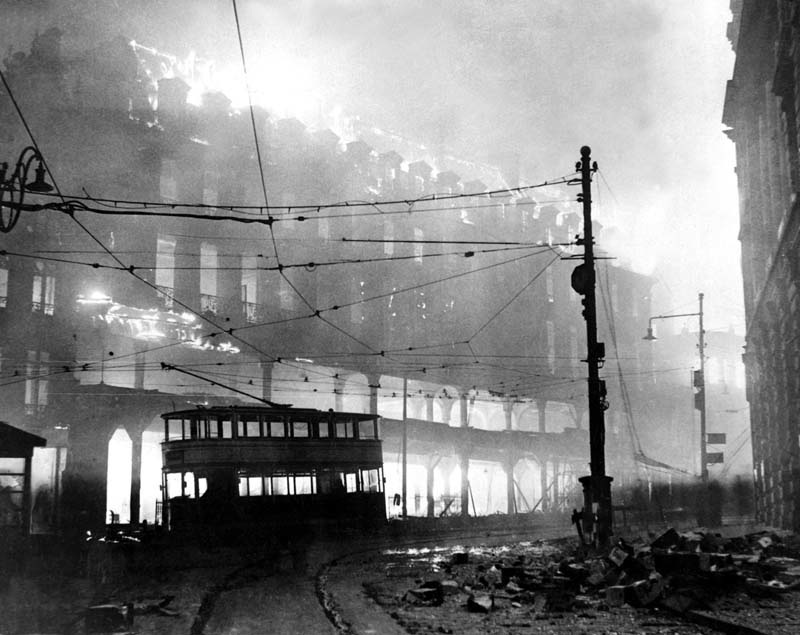 Londoners took refuge in the Underground, which became instant bomb shelters but even these were not altogether safe when bombs occasionally penetrated or roadways collapsed and water mains flooded and drowned people. During one record night some 177,000 people sought shelter in London’s tube stations. However, London was not alone in sustaining heavy damage and loss of life. Birmingham, Coventry, Bristol, Liverpool, Plymouth and other cities were also heavily bombed.
One of the few bright spots of 1940 was Operation Compass, which took place in the remote Western Desert of North Africa in December. For the first time in the war the British won a major victory when Wavell’s small but effective desert army attacked and routed a far larger Italian Tenth Army along the Egyptian-Libyan border. During the ensuing ten weeks British and Commonwealth troops of Lt. Gen. Richard O’Connor’s Western Desert Force advanced over 500 miles, capturing 130,000 prisoners, including 22 generals, and seized some 400 tanks and 1,300 artillery pieces. By the time Compass ended in early 1941 the Tenth Army had ceased to exist. For the first time in the war the British had recorded a badly needed victory. Unfortunately the decision to halt Compass in early February 1941 came at a time when the road to the key port of Tripoli was wide open and might have been captured. Instead a controversial and ultimately futile decision was made to divert British forces from North Africa to Greece, a venture that ended in disaster and another Dunkirk in the spring of 1941.
Although the success of Operation Compass sent a signal, however small, that Britain would fight Hitler and Mussolini to the bitter end, Christmas 1940 became a particularly grim time in London, a city without the voices of children, some 80 percent of whom had been evacuated out of harm’s way to the countryside, or to Canada and the United States. Also silent by government order were the church bells that would only be rung to warn of an invasion. And just as Churchill, and indeed all of Britain rejoiced over O’Connor’s great victory in North Africa, the Germans delivered the strongest reminder yet that control of the war was still in their hands. For three precious days after Christmas they refrained from bombing, but the calm ended with the great firebombing raid of December 29 that was rivaled only by the great fire of 1666 that destroyed most of the City of London and left 200,000 homeless. (* See note at bottom of page 2.)
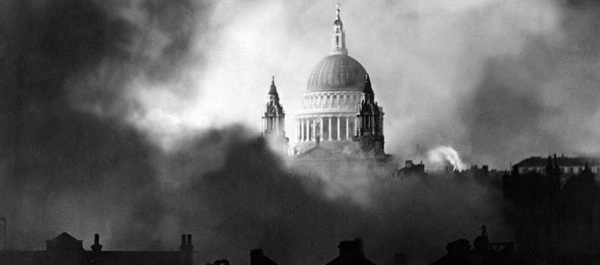
The devastating raid resulted in some 1,500 fires, the majority of which were in the hardest hit area, the City of London, where the fires ravaged an entire square mile, destroying the Guildhall and damaging or destroying other famous landmarks. In the background of flames stood the magnificent backdrop of Christopher Wren’s St. Paul’s Cathedral, which, although damaged, somehow survived the onslaught to become a symbol of Britain’s defiance and resilience. “The streets were lit up by fires,” recalled Major General John Kennedy, the army’s director of military operations. “The whole horizon was aglow over the City.” The Blitz would continue in full fury until May 11, 1941.
* * *
As we look ahead to an uncertain 2009 in a very unstable world and an economy beset by recession, higher unemployment and more home foreclosures, we nevertheless have much to be thankful for. John Kennedy’s observations of the devastation wrought upon London and how valiantly people coped bears repeating. He witnessed the air raid from the roof of the War Office.
The dome of St. Paul’s was silhouetted against the sky. Next morning . . . many fires were still burning. The people of London had become hardened to bombing by this time, and no matter how bad the night had been, life always went on more or less normally the next day. I never ceased to marvel how the waitresses in the [United Service] Club, and the clerks and messengers in Whitehall stuck to their jobs and their routine with such wonderful spirit and phlegm. It was even more remarkable perhaps, that the staff officers in the War Office, many of whom knew full well how grim the military situation was at that time, were always full of fun and confidence. (The Business of War: The War Narrative of Major General Sir John Kennedy [London: Hutchinson, 1957], p. 70.)
As I was writing this piece, into my mailbox came a Christmas note from my friend, Patton’s daughter-in-law, Joanne Holbrook Patton. Her inspiring words are an appropriate message for all Americans in 2009:
“We know that we have more blessings than we can count. We are well aware that many others cannot say the same, especially in these difficult times. We will continue our prayers for peace and try to do our part to make a difference that matters. Always, we are conscious of the challenge Beatrice Patton, my mother-in-law, gave to her family, paraphrasing St. Luke:
"Of those to whom much has been given, much shall be required.”
A Happy New Year to All!
*One of the London churches destroyed that night was the Church of St. Mary, Aldermanbury, a Christopher Wren church that stood a few blocks from St. Paul’s Cathedral. After the war, the bombed out church was disassembled and moved to Fulton, Missouri, where it was reassembled, stone by stone, and restored to its original Christopher Wren glory. Since the 1960s, this “Blitz survivor” on the campus of Westminster College (the site of Churchill’s 1946 "Iron Curtain") has housed the Winston Churchill Memorial & Library, a fitting tribute to Britain’s wartime Prime Minister who rallied the free world against Hitler’s tyranny. For more information, visit churchillmemorial.org.

0 Comments
Trackbacks/Pingbacks