

Churchill and Polo
The Winston Churchill we all tend to think of was elderly, balding and rather overweight. However, as a young officer in the British cavalry in the late 1890s Churchill was an avid polo player. He was first introduced to the sport shortly after receiving his commission in early 1895 and joined his regiment, the 4th Hussars. He took to the sport at once and played it with dedication and great ferocity. Those who crossed him on the polo field soon learned that the rather frail looking young officer belied a competitive spirit that gave no quarter and expected none in return.
Polo is one of the world’s most ancient sports and is thought to be the oldest team sport, dating to the B.C. period of Persia. Well before the British first discovered polo in India in the 1850s, the sport had already been judged useful for training cavalrymen. Called the Game of Kings, a polo field still survives in Tamerlane’s palace grounds in Samarkand.
{default}Polo was not only an enormously important part of his life but also of his development as a war leader. This month’s article contains extracts from my forthcoming book: Warlord: A Life of Winston Churchill at War, 1874-1945, to be published in the USA in November 2008 by HarperCollins, and in the United Kingdom by Penguin in the spring of 2009.
* * *
In September 1896 the 4th Hussars were deployed from Aldershot to Bangalore, India. Churchill’s arrival in Bombay aboard the steamship S.S. Britannia was inauspicious. Typically eager to be the first to do something, he and several other officers were given permission to embark before the main party and hired a small skiff to take them ashore. As they reached the notoriously dangerous quayside, the heavy swells caused the skiff to rise four or five feet, and when Churchill grabbed an iron stanchion while attempting to transfer to the dock, he lost his grip and slipped on the wet steps, painfully wrenching and probably dislocating his right shoulder. The injury was serious enough that it bothered him for the remainder of his life. His shoulder would frequently displace, sometimes from the simplest of motions, such as reaching for a book, swimming or the occasion when he made an expansive gesture during a speech in the House of Commons. He was unable to play tennis and in order to play polo had to strap his arm to his chest. Of greater importance was that he could no longer use a sword and instead relied on a Mauser “Broomhandle†pistol for close combat. The injury, recalled Churchill, was “a grave embarrassment in moments of peril, violence and effort.â€
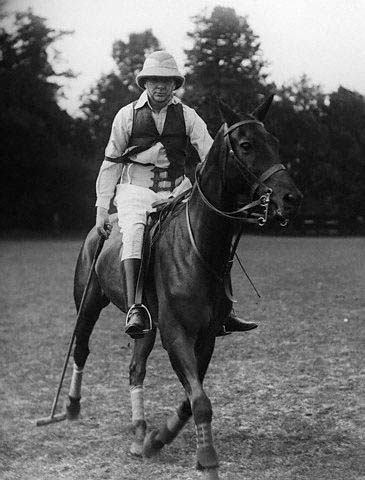
Winston Churchill during a polo game in 1921
With no wars to wage, sports took their place. The lives of the officers revolved principally around their military duties and the grand sport of polo, which was played avidly both for recreation and in a quest for the coveted Inter-Regimental Cup held by the best British team in India. Despite his nagging shoulder injury, Churchill qualified to become a member of the regimental team and played the demanding sport skillfully. Polo was a near obsession for Churchill and the other polo-playing officers of the 4th Hussars: “the serious purpose of life,†as he once described it. The highlight of the day was polo. Churchill made it a point to play no less than eight chukkas per session and sometimes as many as twelve, an exhausting regimen for the fittest of men, far more so for a one-armed polo player. Normally it took several years for a newly arrived regiment to be able to compete with any degree of success in the inter-regimental competition against other veteran British units. Rising to the challenge, the determined polo-playing officers of the 4th Hussars decided it was time for an exception to the rule and within two months of their arrival were already competing for another coveted trophy in Hyderabad they were thought to have no chance of winning. Neither the heavily favored 19th Hussars (the regiment the 4th had just relieved) nor the crowd took the fledgling team from Bangalore seriously, particularly when they appeared on the field with a one-armed player as part of their team.
[continued on next page]

Well done! I first learned about Churchill reading “Polo the Emperor of Games” . The last account was all that was printed-the author was noting the great players through history. I’ve often wondered how it would be to see a movie of Winston in his polo years!? The nostalgia could be as good as the movie “The Sting” but much more powerful!
I’ve been playing polo for 5 years now. When Winston played, you could ride at players head on and use the mallet in either hand-very dangerous!
You may want to send some of this article to Dr. Arnn at Hilsdale college. He’s featuring a course on Winston Churchill. What you want to bet that he’ll not get the polo to leadership connection like you have!