

Flodden 1513 – Book Review
 Book Review: Flodden 1513, Scotland’s Greatest Defeat
John Sadler, Stephen Walsh, Osprey Publications
Anyone interested in the long conflicts between England and Scotland will want to know about the Battle of Flodden. James IV is often criticised because of his loss at Flodden. It is a large part of why Scotland is not its own nation today. It is also the topic of Flodden 1513: Scotland’s Greatest Defeat, a new addition to Osprey Publishing’s Campaign Series of books.
{default}The book has an excellent collection of photographs, drawings, and maps. However, there are some problems with these. The photos are interesting in themselves but they are difficult to relate to the subject. Country of origin describes armour and weapons. For example, a Swiss style helmet, an Italian Brigandine, or German field armour. But it is not clear whether these are examples of what the English, Scottish, or both used. There is also a photograph and very short discussion of the massive Scottish cannon Mons Meg given as an example of how the Scottish outweighed the English in poundage of shot. However, it is a poor choice because Mons Meg was not at Flodden.
There is also a minor problem with the maps. They are aligned with North facing the bottom right of the book. This can be a little disorienting at first.
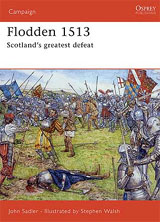
The illustrations, by Stephen Walsh, are quite good however the reader needs to be aware that they are an artist’s rendition and not primary sources, but they are an excellent inclusion. The illustrations describe the battle well and include a numbered legend that describes the figures and action. The book cover is a reduced version of one of these.
The book goes beyond discussing the actual battle of Flodden. There is a brief discussion of the Anglo-Scottish war of 1513 and its origins. The author links the Anglo-Scottish conflict to the French invasion of Italy in 1494 and the eventual need for Scotland to decide between its agreements with England and France, as they became conflicting. I would have liked this section to be longer than six pages. It is good background but the author could have demonstrated the links between events better. It is a good introduction for the uninitiated but leaves the reader wanting more.
The section describing the commanders is also quite brief but there is continuous examination of them throughout. The author deals mainly with James IV of Scotland and Thomas Howard, Earl of Surrey, Second Duke of Norfolk. He counters the idea that James IV was an inept leader. James IV made errors at Flodden and the author points out that personally leading the Scottish troops is often considered one of James IV mistakes but also expresses his recognition that this was necessary was actually a strength. He also points to the government James IV left behind as an example of his strong leadership. We are left with an impression of how these men came across, physically and temperamentally.
The actual battle takes up most of the book and it makes some interesting and surprising points. Firstly, the battle of Flodden was not necessary for the Scottish. The Scottish had achieved their goals and the campaign would have been a success if they had dispersed rather than met the English at Flodden. There is a good comparison of weapons and tactics. The most surprising revelations are in the discussion of imbalances in the field. The Scottish had adopted Swiss methods of battle, they had greater weight of shot for their cannons, and they held the high ground. But these things, counter-intuitively, were disadvantages for the Scottish. This is the most interesting and well written aspect of the book.
Flodden is an important battle for the history of warfare. It was one of the last battles were the longbow played an important role. It was one of the first battles in which the cannon played a large part. It is also an excellent study of how imbalances in the men, leaders, equipment, and ground effect an outcome. Flodden was also decisive for the future of Scotland. It was an unnecessary battle for the Scottish and claimed the life of their King, James IV.
Flodden 1513: Scotland’s Greatest Defeat has some failings. The graphics need more precise description and the background is vague. However, the discussion of the actual battle is excellent and more than makes up for the weak points. There are quite a few things to be learned about the leadership of James IV and how imbalances that appear to be advantages may actually be disadvantages. Failure to examine and recognise this was decisive at Flodden. Overall this is an excellent book but too brief. I enjoyed it and learned a great deal. I came away wanting to know more but still quite satisfied.
Discuss this review in our forums!

We are just about to release a a double CD album (for the price of one) –
‘The Flooers o'[ The Forest’ – Songs, Music Poems and Prose of Flodden. If you would like more info. please contact us.
Ian