

Benjamin Oliver Davis, Sr.
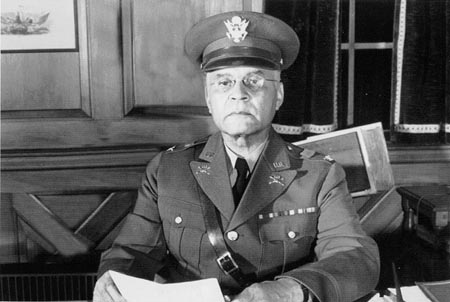
THE FIRST AFRICAN AMERICAN GENERAL OFFICER IN THE REGULAR ARMY AND IN THE U.S. ARMED FORCES
Benjamin O. Davis, Sr., was born in Washington, D.C., on July 1, 1877. He entered the military service on July 13, 1898, during the War with Spain as a temporary first lieutenant of the 8th United States Volunteer Infantry. He was mustered out on March 6, 1899, and on June 18, 1899, he enlisted as a private in Troop I, 9th Cavalry, of the Regular Army. He then served as corporal and squadron sergeant major, and on February 2, 1901, he was commissioned a second lieutenant of Cavalry in the Regular Army.
PROMOTIONS
He was promoted to first lieutenant on March 30, 1905; to captain on December 24, 1915; to major (temporary) on August 5, 1917; and to lieutenant colonel (temporary) on May 1, 1918. He reverted to his permanent rank of captain on October 14, 1919, and was promoted to lieutenant colonel on July 1, 1920; to colonel on February 18, 1930; to brigadier general (temporary) on October 25, 1940. He was retired on July 31, 1941, and recalled to active duty with the rank of brigadier general the following day.
{default}SERVICE
His first service as a commissioned officer of the Regular Army was in the Philippine Islands with the 9th Cavalry on the Island of Samar. In August 1901 he was assigned to duty with the 2d Squadron, 10th Cavalry, and returned from the Philippines with that organization for service as Adjutant at Fort Washakie, Wyoming. In September 1905 he was made Professor of Military Science and Tactics at Wilberforce University, Ohio, remaining there until September 1909, when, after a brief tour of duty at Fort Ethan Allen, Vermont, he was detailed as Military Attache to Monrovia, Liberia, until January 1912.
He then was assigned to duty with the 9th Cavalry at Fort D.A. Russell (predecessor of Fort Francis E. Warren), Wyoming, and at Douglas, Arizona. He remained with his regiment on border patrol duty until February 1915, when he again was assigned to duty as Professor of Military Science and Tactics at Wilberforce University, Ohio. He remained there until the summer of 1917, when he went to the Philippines for duty as Supply Officer of the 9th Cavalry at Camp Stotsenburg. He returned to the United States in July 1920, and was assigned to duty as Professor of Military Science and Tactics at Tuskegee Institute, Alabama, where he served until July 1924, when he became Instructor of the 372d Infantry, Ohio National Guard, stationed at Cleveland, Ohio.
In July 1929 he returned to Wilberforce University as Professor Military Science and Tactics serving until late 1930 when he was detailed on special duty with the Department of State in connection with affairs relating to the Republic of Liberia.
In late 1931 he was assigned again to serve as Professor of Military Science and Tactics at Tuskegee, Alabama, where he remained until August 1937 when he was transferred to Wilberforce University.
During the summers of 1930 to 1933, he was placed on detached service for duty with the Pilgrimage of War Mothers and Widows, making frequent trips to Europe on behalf of that organization. For his work on this assignment he received letters of commendation from The Secretary of War and from The Quartermaster General.
In August 1937 he was transferred from Tuskegee Institute to Wilberforce University. After a year at that institution, he was assigned as instructor and Commanding Officer of the 369th Infantry, New York National Guard. This organization was later changed to the 369th Coast Artillery (Antiaircraft) Regiment. In January 1941 he was ordered to Fort Riley, Kansas, for duty as a brigade commander with the 2d Cavalry Division. The following June, he was assigned to Washington, D.C., for duty as Assistant to The Inspector General.
He was assigned to the European Theater of Operations in September 1942 on special duty as Advisor on Negro problems and upon completion of this special duty he returned to the United States and resumed his duties in the Inspector General’s Department.
In November 1944 he became Special Assistant to the Commanding General, Communications Zone, European Theater of Operations, stationed in Paris, France, and in November 1945 was granted a period of detached service for the purposes of recuperation and rehabilitation. In January 1946 he again became Assistant, The Inspector General, Washington, D.C. He retired on 14 July 1948, after having served fifty years. General Davis died on November 26, 1970. His remains are interred in Arlington National Cemetery, Arlington, Virginia. His son, Lieutenant General Benjamin O. Davis, Jr., (U.S. Air Force, Retired), is the fourth African American graduate of the U.S. Military Academy and the nation’s second African American general officer.
DECORATIONS AND HONORS
General Davis’ U.S. military decorations consisted of the Bronze Star Medal and the Distinguished Service Medal (DSM). His DSM medal, awarded by General Order 10, dated 22 February 1945, stated that General Benjamin O. Davis was awarded the DSM "for exceptionally meritorious service to the Government in a duty of great responsibility from June 1941 to November 1944. The War Department release issued about General Davis’ DSM on February 11, 1945 included the following citation:
For exceptionally meritorious service to the Government in a duty of great responsibility from June, 1941, to November, 1944, as an Inspector of troop units in the field, and as special War Department consultant on matters pertaining to Negro troops. The initiative, intelligence and sympathetic understanding displayed by him in conducting countless investigations concerning individual soldiers, troop units and other components of the War Department brought about a fair and equitable solution to many important problems which have since become the basis of far-reaching War Department policy. His wise advice and counsel have made a direct contribution to the maintenance of soldier morale and troop discipline and has been of material assistance to the War Department and to responsible commanders in the field of understanding personnel matters as they pertain to the individual soldier.
Additionally, General Davis was awarded an Honorary Degree of LL.D. from Atlanta University, Atlanta, Georgia. His foreign awards and honors consisted of the Croix de Guerre with Palm from France and the Grade of Commander of the Order of the Star of Africa from Liberia.
SUGGESTED ADDITIONAL SOURCES:
Fletcher, Marvin E. America’s First Black General: Benjamin O. Davis, Sr., 1880-1970. Lawrence, Kansas: University of Kansas, 1989.
Lee, Ulysses. The Employment of Negro Troops. Washington, D.C.: U.S. Army Center of Military History, 1966; reprint, 1986, 1990.Â
