



The Battle of the Scheldt
The army was moving west towards their final objective: Walcheren Island. Operation Infatuate, the third operation of Simmonds plan, had two British units amphibiously assaulting at Flushing and Westkapelle on the Walcheren, while the Canadians would assault across a narrow causeway connecting the Beveland to Walcheren Island. The Germans were well established at the end of the causeway, and the causeway itself was elevated 8-10 feet above sea level. The Germans had their 88s and MG42 in place, and had them trained on the causeway itself. On the 31st of October 1944, the Canadian 5th Brigade was given the task to assault across the causeway. The troops were met with a withering hail of shells, mortar and machine gun fire. After three days of fire and numerous casualties, the R駩ment de Maisonneuve, with two officers and roughly 60 men manage to establish a bridgehead on the German side of the causeway, about 600 yards inland. They were pinned down and were finally relieved by British soldiers.
{default}On 1 November 1944, 4th British Commandos under Canadian command crossed the Scheldt and landed at the town of Flusing. A few hours later, the British Special Service Brigade landed on the west shore of the island near the town of Westkapelle. While British soldiers invaded Walkeren, the Canadian soldiers were finally relieved. The last German defenders surrendered within days, and the Germans conceded defeat. Together with D-Day, this was probably the most important battle ever fought by the Canadians.
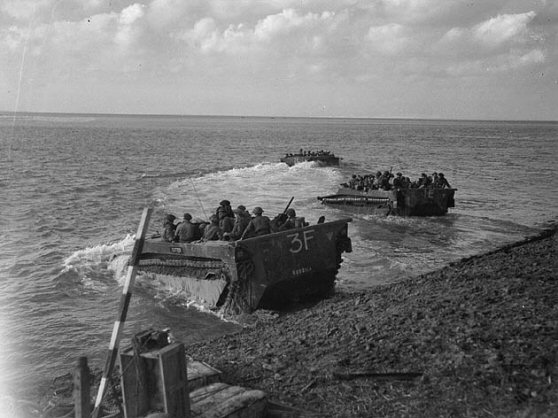
Buffalo crossing the Scheldt.
Field Marshall Montgomery sent a note of congratulations to Gen. Simmonds: "Now that operations designed to give us the free use of the port of Antwerp were nearly completed, I want to express to you personally and to all commanders and troops in the Canadian Army, my admiration for the way you have all carried out the very difficult task given to you." The battle of the Scheldt caused 12,000 Allied casualties killed, wounded or missing. Half of them were Canadian. Three weeks after the end of the battle, the Royal Navy cleared mines from the estuary. The first Allied ship which entered Antwerp was a Canadian made vessel, the Fort Cataraqui. On 28 November 1944 a ceremony was organized to greet the convoy, but no one invited Canadian Army representatives to the ceremony. Not one Canadian Army officer was present, and Canada’s contribution to the battle had gone by unnoticed.

My father was Merchant Navy (Steward) and was on the second merchant vessel (Empire Asquith) behind Fort Cataraqui. The convoy was under attack from V1 rockets, U-Boats and mines. It should be pointed out that the people of Antwerp – the Flemish, were also grateful to the relief of Antwerp by the Canadian forces as well as British commandos (never mentioned, the Royal Navy and last but not least the forgotten service ‘The Merchant Navy’
My old ship HMS Aristocrat a paddle ship having been in Normandy DDay, was involved with the battle on the Scheldt and was one of the first ships into Antwerp.
I’m always disappointed that she never gets a mention in any account of history.
I remember it well. If the book called a ‘Paddler goes to war’ is read you will find it there.
Netflix has just released a new movie based around the battle. https://www.nextflicks.tv/review/the-forgotten-battle/