
August 1914 and the Madness That Followed
The so-called Great War was “great” only in the sense of the colossal numbers of men who died fighting a conflict that might have been prevented, but instead spun out of control, and was overseen by clueless politicians.
The month of August is a time of leisurely late summer vacations, fun and sun. For families with children it is the final time before the start of a new school year. In Europe, August is the traditional vacation month. Great cities like Paris become virtual ghost towns as people head for the countryside, the mountains, or the beach.
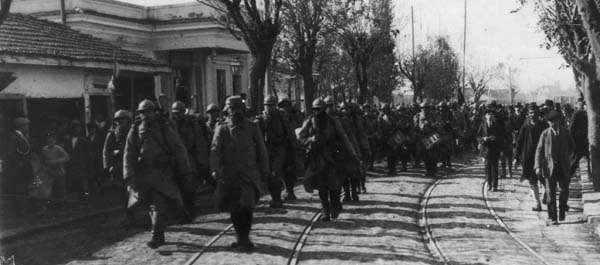
{default}Such was certainly the case in August 1914 when war suddenly shattered one of Europe’s most glorious summers in memory. Where only days before there had been peace, Europe quaked under the boots of marching armies bent on annihilating one another. Although the war would encompass a number of nations, the central battleground became France.
 A century that had started with such great promise was suddenly and fatally thrust into a conflict that eventually engulfed much of the world and claimed the lives of an estimated twenty million civilians and soldiers, and wounded another twenty-one million. For nearly a century since that fateful month in 1914 historians have pondered in vain the need for this war, for its folly, and questioned what recklessness turned an attainable peace into a deadly conflict that should never have occurred. Historian John Keegan has asked the lingering question why “the principle of the international treaty” brought Britain into a war “that scarcely merited the price eventually paid for its protection.”
In Great Britain, the same wishful thinking that had occurred in the Boer War from 1898 to 1902 gripped the British public: the widespread belief, including some in public office who ought to have known better, that the war no one wanted was no big deal and would surely be over by Christmas. Yet, what ensued was beyond comprehension. World War I demonstrated with horrific consequences that modern warfare had evolved well beyond the slaughter seen on a smaller scale at Omdurman in the remote Sudan in 1898, when Gen. Hubert Horatio Kitchener’s British expeditionary force, using artillery and Maxim machine-guns, massacred hapless warriors armed only with spears and a few rifles.
Thus committed, it was the thousands of ordinary young men on each side of the conflict that paid the terrible price for the intransigence of their political leaders in what, in retrospect, was the most colossal folly in the history of mankind. As Winston Churchill would later note so perceptively in 1930 and what others have learned in other times and places, committing a nation to war sets in motion events that run beyond all control. What began in Europe quickly spread like a pandemic and engulfed much of the world. Much of the war was fought in nameless places memorable only for their toll of death. From the mud and trenches of Belgium and France the war spread to the Dardanelles, the forbidding rocky landscape of Gallipoli, and Eastern Europe where, at Tannenberg and on other battlefields, men fought and died for scraps of terrain that were often measured in yards, and of questionable military value.
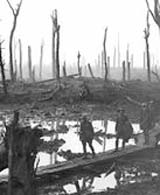 Before it ended, once placid sites like Verdun and the Somme, Passchendaele and Ypres entered the lexicon of horror and pointless death, their only legacy the cemeteries of white and black crosses and memorials that sprouted like wild mushrooms and still haunt visitors by the sheer size of their numbers.
The so-called Great War was “great” only in the sense of the colossal numbers of men who died fighting a conflict that might have been prevented, but instead spun out of control, and was overseen by clueless politicians. Nearly an entire generation of young men on all sides of the war would die. In all, the death toll was staggering. Although the exact numbers are at variance in myriad accounts, a close approximation of military deaths is 942,135 British and Empire, 1,380,000 French, 1,700,000 German, and 942,135 Russians.
If ever there was a monument to the folly of war it was World War I, a conflict so needless that nearly a century later its rationale remains breathtakingly incomprehensible. There was no incident like the bombing of Pearl Harbor or armed invasion such as that of Poland in 1939. Instead, what triggered it began innocently on June 28, 1914, when the assassination in Sarajevo, Serbia of the Archduke Franz Ferdinand and his wife, went relatively overlooked until late July when there was a frenzied exchange of diplomatic notes, threats, counter-threats, and offers of various compromises emanating to and from Berlin, St. Petersburg, Vienna, Paris, and London that ultimately achieved nothing.
What produced the crisis was a series of rigid, complex, interlocking treaties that bound the great powers of Europe to each other, treaties that left few options except war. The Gordian knots of the alliances seemed to trump all else, including common sense. Germany under the unstable and ambitious Kaiser Wilhelm II suffered from an inferiority complex and envy of Britain and was determined – whatever the cost – to forge his nation into a major European power.
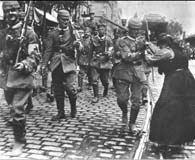
Britain and Germany misread one another’s intentions – Germany that Britain would not enter the war; and Britain that, with her interests threatened, she had no other choice. What followed was one of history’s gravest misjudgments. By August 1, 1914 the major nations of Europe had mobilized their armies. Each was on a war footing and, like gunfighters they awaited whoever drew first. It was like watching two trains speeding toward one another on the same track and realizing that there was nothing that could be done to stop the inevitable collision.
Over the next four years there would occur unprecedented bloodshed. By the end of 1914, all hope of an early end to the war had already faded away. Both the Eastern and Western Fronts were frozen in stalemate, and there had yet to be a decisive confrontation between the two powerful navies for control of the sea. The foolish notion assumed by so many that the war would be over by Christmas was a distant memory. After only five months at war it had quickly evolved into a deadly conflict of stalemate and attrition. In the trenches that ran nearly five hundred miles from Switzerland to the North Sea the death toll on both sides grew to staggering proportions. Men died from artillery shells that exploded indiscriminately, from the use of poison gas, and from machine guns that cut down anyone missed by the artillery fire.
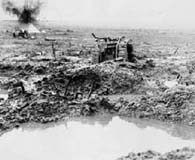 The death of soldiers in combat is an inevitable and painful part of war. World War I carried that precept to undreamed of heights. Soldiers became little more than participants in a numbers game, and casualties, death, or loss due to wounding (or for other reasons) was callously categorized as “wastage” by the British War Office. As William Manchester points out, there were so many troops manning the extensive trench lines that there was one soldier for every four inches of trench line – over seven million men. “In the course of an average day on the western front, there were 2,533 men on both sides killed in action, 9,121 wounded, and 1,164 missing.”
On August 2, 1914, Churchill, then First Lord of the Admiralty, had written prophetically to his wife Clementine that, “the world has gone mad.” And so it had, even though none of this seemed even remotely possible at the time. Yet within days of Britain’s declaration of war TheEconomistwas already presciently calling it, “Perhaps the greatest tragedy in human history.”
Instead of a glorious August the lights went out all over Europe and cast a dark cloud of death and destruction that to this day begs the question: “Why?”
Carlo D’Este is Armchair General magazine’s Consulting Historian and a member of the ACG Advisory Board. His critically-acclaimed books include “Patton: A Genius for War,” “Eisenhower: A Soldier’s Life,” and his latest biography, “Warlord: A Life of Winston Churchill at War, 1874-1945.”
For further reading on this subject, D’Este recommends “The Proud Tower” and “The Guns of August” by Barbara Tuchman, “The World Crisis, Vol. I” by Winston Churchill, “The First World War” by Michael Howard and “The First World War” by John Keegan.

Obviously, history isn’t D’Este’s strong suit. I’d expect a better explanation of the causes of WWI from a 4th grader.