




Allied Air Power Was Decisive Factor In Western Europe
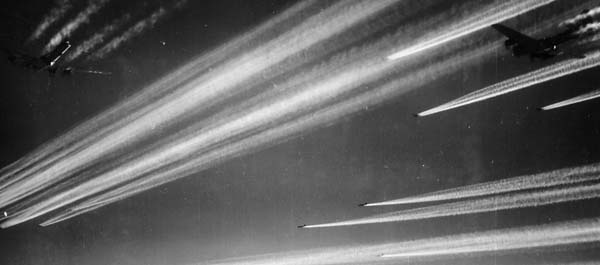
According to many of the top Nazi and German military leaders: Speer, Goering, Keitel, Jodl, Doenitz, Allied airpower was the decisive factor in the Germans losing the war.
Over the years there has been much controversy about the Allied air campaign and particularly Bomber Command’s role in the campaign. Many Bomber Command veterans and those who lost love ones have been made to feel a sense of shame in their role. I often wondered if my uncle, F/Sgt. John Kopchuk who was killed on June 22, 1943 as a navigator in 429 Squadron, Bomber Command had died in a vain attempt.
{default}There has been a great deal of controversy about the area bombing campaign of the RAF’s Bomber Command during WWII. The controversy surrounds several issues. Was it worth the cost? Did it accomplish what it set out to do – destroy German morale and the German economy? How could we have bombed civilians and kill women and children? The controversy about the area bombing campaign started during WWII and continues to this day. The RAF lost 55,000 airmen including 10,000 Canadians during the campaign. Close to 40% of England’s economy was devoted to the Bomber Campaign and building bombers. Many argued that if the effort had been put into landing craft or other war material the war would have ended sooner.
The questions about the value of the bombing campaign was actually answered by the United States Strategic Bombing Survey (USSBS) which was conducted at the end of WWII starting right in 1945. The USSBS was commissioned by the then US President, Roosevelt in 1944 to determine whether the Combined Allied Strategic Air Campaign was effective in hastening the defeat of Nazi Germany. They studied, in depth, both the US and RAF bombing campaigns. They examined the issue of German morale, the effects of bombing on the German economy, whether or not air superiority was achieved, did they reduce aircraft and oil production and did they manage to destroy the transportation system? The results of the Survey were then published in the Fall of 1945.
As the report states, “Allied air power was decisive in the war in Western Europe. Hindsight inevitably suggests that I might have been employed differently or better in some respects. Nevertheless, it was decisive. In the air, its victory was complete. At sea, its contribution, combined with naval power, brought an end to the enemy’s greatest naval threat — the U-boat; on land, it helped turn the tide overwhelmingly in favor of Allied ground forces. Its power and superiority made possible the success of the invasion. It brought the economy which sustained the enemy’s armed forces to virtual collapse, although the full effects of this collapse had not reached the enemy’s front lines when they were overrun by Allied forces. It brought home to the German people the full impact of modern war with all its horror and suffering. Its imprint on the German nation will be lasting.”
Target Priorities for Bomber Command
 During WWII, Bomber Command was given several directives by the Air Staff establishing what their primary targets were to be. The most controversial was the one issued February 14, 1942: "the primary object of your operations should now be focused on the morale of the enemy civil population and in particular, of the industrial workers".
In Jan 1943 they were given the Casablanca Conference Directive, "your primary object will be the progressive destruction and dislocation of the German military, industrial and economic system, and the undermining of the morale of the German people to a point where their capacity for armed resistance is fatally weakened. With that general concept, your primary objectives, subject to the exigencies of weather and of tactical feasibility, will for the present be in the following order of priority: (a) German submarine construction yards. (b) The German aircraft industry. (c) Transportation. (d) Oil plants. (e) Other targets in enemy war industry. The above order of priority may be varied from time to time according to developments in the strategical situation. Moreover, other objectives of great importance either from political or military point of view must be attacked…."
Then in Jun 1943 the Pointblank Directive, " To this end the Combined Chiefs of Staff have decided that first priority in the operation of British and American bombers based in the United Kingdom shall be accorded to the attack of German fighter forces and the industry upon which they depend. … The primary object of the bomber forces remains as set out in the original directive issued by the Combined Chiefs of Staff (dated 21 Jan 43, The Casablanca Directive) i.e.: ‘the progressive destruction and dislocation of the German military, industrial and economic system, and the undermining of the morale of the German people to a point where their capacity for armed resistance is fatally weakened.’"
All of these directives prioritized target types and targets for Bomber Command. It was not Bomber Command that decided how they would wage war with Germany. The question is how successful was Bomber Command in fulfilling its directives. Did it accomplish the tasks assigned to it or did it fail? Did Britain waste 40% of it’s war effort on the Bombing Campaign? Were the 55,000 airmen killed for nothing?
German Submarine Construction Yards
Bombing caused physical damage to submarine building yards and facilities from time to time during the war, but until the Spring of 1945 this damage was not serious enough to affect production. The direct effects of raids during the last days of the war and the indirect effects of the bombing of transportation brought production to a practical standstill.
The raids on Hamburg in July and August of 1943 had an effect on submarine production at the Blohm & Voss plant. Immediately following the raids the plant’s labour force dropped from 12,000 to 2,000 employees and normal attendance was not resumed for almost 3 months. It is estimated that the loss of production was from 4-6 weeks.
An RAF attack on the Germaniawerft and the Deutsche Werke submarine yards shut them down in April, 1945. In addition to similar attacks like this, production was further restricted by the transportation failures and general economic collapse of Germany in the last phase of the war.
The RAF laid a large number of mines along the coast of France and the coast of Norway and Denmark as well as in the Baltic. Four submarines operating from France were destroyed from mines and fourteen in the Baltic. Submarine training was delayed and interfered with by the mining of the Baltic and Northern waters.
It is difficult to estimate the production loss due to bombing in 1945. The Germans planned to produce a total of 423 subs but only delivered 180. This difference is the result of air attacks, technical production difficulties, poor scheduling of component deliveries and over-all transportation failures.
German Aircraft Industry
 The Combined Bomber Offensive of the RAF & USAAF applied every known form of attack to cut off the flow of usable aircraft to Hitler’s fighting squadrons. The RAF bombed cities and industrial areas by night to disrupt and to demoralize labour and to destroy such factories that might be located in the target area. The USAAF bombed airfields and factories by day to destroy as many finished aircraft as possible and to further cripple production. At the same time they were attacking the aircraft industry they were also attacking rail centers, bridges, marshaling yards, oil refineries, synthetic fuel plants and fuel dumps. "In the end the total weight was too much. Germany’s industrial machine could not endure such punishment and finally collapsed. How much each form of attack contributed to the end result is impossible to determine. It appears from this study that some 18,000 aircraft of all types were denied the German Air Force in the period of intensive attack between July 1943 and December 1944."
"If the aircraft industry had not been dispersed it probable that an equal or even larger production loss would have been suffered."The USSBS best estimate that the 18,000 aircraft lost to the Germans could be evenly distributed between "direct losses caused by destruction of the airframe plants, and indirect losses caused by dispersal and by inefficient operation under dispersal conditions."
"Whether or not the German Air Force could have used all these additional aircraft effectively (because of the shortages of fuel or of pilots), it is obvious that the attacks against the German aircraft industry paid dividends. By keeping such a number of defensive fighters out of the air at times when the air war was critical, the job of wrecking Germany’s manufacturing industries, her transportation system and her cities, was rendered that much easier and the war was probably shortened by some months."
In 1943 the total number of single engine German fighter aircraft to defend Germany doubled. However, this increase was not due to increased fighter production. Some 180 fighters were withdrawn from the Eastern Front and 120 from the Mediterranean. Eventhough the Western front saw an increase of about 380 aircraft, 80% of the increase was from fighters being transferred in from other fronts.
If you examine the German aircraft production numbers for 1944 it appears that aircraft production was stimulated by the air attacks. However, the German production increase in 1944 was planned six to nine months previously. "How much more the production curve would have risen had the attacks not been made is only a matter for conjecture."
"Before the Combined Bomber Offensive the German aircraft industry had at least a 100% excess capacity of plant and equipment. This is indicated by the fact that single-shift operation of most facilities was normal procedure prior to 1944."
In 1944 the Speer Ministry reported to Hitler that 39,000 aircraft were produced, of which 26,000 were fighters. There are 17,000 German aircraft (8,000 fighters) which the USSBS could not account for based on the number of aircraft delivered and the number destroyed. It was known that Hitler demanded miracles from his subordinates. Under these circumstances it is not entirely impossible that Messrs Speer and Seur, controlling aircraft production, "rigged" their accounting to make a satisfactory showing. The conclusion is than nowhere near 39,000 aircraft were produced in 1944.
"Strategic bombing forced the dispersal of the aircraft industry. This disruption alone paid the cost of Allied bombing. Disruption of production was caused by the physical movement of goods and machinery, the loss of efficiency due to the dilution of management, an increased load on the already overtaxed transportation system were all factors in the final result. In the end dispersal defeated itself, because once the transportation system failed, it became impossible to keep final assembly points fed with the necessary component parts and subassemblies to produce finished aircraft. It was largely after that system failed that they decided to re-centralize the plants underground, for efficient and economical operation. This decision came too late to be effective in the German war programs but the cost of the effort added tremendously to the strain on the national economy."
"Until early 1943 less than half the available capacity was utilized in the German aircraft industry. The industry was coasting along on a one-shift per day basis. The big push for expansion started in 1943 when the German High Command realized the potentialities of the Allied air attack. The realization came too late. The weight of attack that was delivered late in 1943 and early in 1944 set back production plans by many months and denied the German Air force some thousands of aircraft at a time when it needed them most."
"By the end of 1944 disintegration of the entire economy had set in. Transportation was disorganized to the point that essential materials could not be delivered to the manufacturers, nor could finished products be taken away. Airframe assembly plants, although relatively invulnerable to direct attack because of dispersal and underground installations, could not get deliveries of engines, accessories or subassemblies. Centralized planning broke down completely. Production of aircraft fell precipitously to a point far below the normal requirements of the German Air Force. By war’s end the manufacture of aircraft was at a standstill."
Transportation System
 Prior to the war, Germany possessed one of the most complex, adequate and well-maintained railroad systems in the world. It’s strong inland waterways system connecting the important rivers of North Germany, which connected the Ruhr coal areas with Berlin, accounted for 21-26% of the total freight traffic movement. Commercial highway transportation accounted for less than 3% of the total. On the whole, the system was adequate for the demands placed upon it until the Spring of 1944.
Prior to the main Allied invasion in Normandy in June, 1944 the major task of the air forces was the disruption of rail traffic between Germany and the French coast through bombing of marshaling yards in Northern France. At the time of the invasion itself a systematic and large-scale attempt was made to interdict all traffic to the beachhead. After the invasion, until the end of the war, every major ground operation by the Allies was preceded by attacks on transportation, designed to isolate the battle area.
In September 1944, the strategic air forces shifted primary attention to transportation targets. Here again the RAF and USAAF combined to deliver a huge tonnage of bombs. Most German experts attribute the final German downfall to the hopeless economic confusion caused by the disruption of the transportation system. German Infantry Officers have testified to the difficulties imposed on operations as a result of these attacks.
Eventhough the Germans claimed to increase aircraft production threefold in 1944, there were not enough fighter aircraft to augment the Luftwaffe’s order of battle and at no time in 1944 was the GAF able to compete numerically with the Allied air forces. It is clear that the attacks on transportation contributed in no small measure to the dilemma confronting the GAF.
By the close of 1944 air attacks upon the railroad system had imposed serious delays upon the tactical moves of the Germany Army and often prevented units from reaching their desired destinations. The attacks also reduced the available transportation capacity for economic traffic in Germany to the point which could not hope to sustain, over any period of time, a high level of war production. The loss of transportation facilities completely disorganized the flow of basic raw materials, and even the distribution of finished products. Under these conditions orderly production was no longer possible. Moreover, the weight of attack in the early months of 1945 was such as to prevent any recuperation of transportation facilities and contributed to their further decline. The great handicap of the Germans in trying to repair transportation facilities is they lacked heavy earth-moving machinery and used manual labour.
Oil Plants
 Raids against oil and gasoline production started in May 1944 and continued through the Winter of 1944 with outstanding success. German oil reserves were rapidly consumed and by the year’s end the situation was desperate. As early as June 1944, Production Minister Speer indicated to Hitler his grave concern over the attacks on oil and gasoline production. From the start of the attacks against fuel production German output declined. In the Summer of 1943 the Luftwaffe was using 198,000 tons of aviation fuel per month and plans were in place to increase production to 320,000 tons per month. By the Spring of 1945, as a result of air attacks the Luftwaffe only obtained 6,000 tons per month.
The diminishing supply of aviation gasoline resulted at once in serious operational limitations. Training of new pilots, which had already been drastically limited because of fuel shortages, were cut to the bone. Pressure was brought to conserve fuel even on operational flights. Motor transport, essential for German Air Force repair and supply was reduced merle to the vanishing point. The GAF, which had once threatened the ability of the RAF to continue night bombing attacks was so completely demoralized that by early 1945 the RAF carried out daylight bombing operations in great force with a minimum loss.
German Industrial System
An intense area raid by the RAF usually drove down production of a bombed city by as much at 55% in the month immediately following the attack. Unless further interrupted, production usually returned to 80% within three months and completely recovered in six to eleven months. Some cities, such as Hamburg, suffered a permanent loss in production.
As a result of demands to increase production the work week was increased to 72 hours. With the strain of the extended work week and the shock of the air attacks the German authorities stated there was a gradual decrease in efficiency, which towards the end of the war amounted to perhaps as much as 20%.
The attacks against cities resulted in an overall production loss estimated at 9% in 1943 and perhaps as much as 17% in 1944. This loss did not have a decisive effect upon the ability of the German nation to produce war material. This is because the production could be absorbed by production not essential to war production. Don’t forget, throughout the war 90% of German workers only worked on the first shift, 7% on the second shift and 3% on the third shift. The Allied war effort had factors going 24 hours per day.
The most important effect of area raids on utilities was the cutting of the Ruhr gas lines in the latter part of 1944. The cutting of those lines shut down important plants in Dusseldorf, Essen, Krefeld and Berlin and contributed to the collapse of German Steel production.
The campaign of city attacks was heavily felt by the civilian population. Not only did the attacks have a permanent effect on morale and political thought, but they also made life in Germany during the last two years of the war progressively more difficult. The raids disrupted family life, destroyed homes and deprived the larger communities of the normal amenities of civilized living. The industrial loss which they produced, for the very reason that it was absorbed by less essential production, fell very largely on the manufacture of consumer goods. However, the cushion was gradually worn away; during the latter part of 1944 and the early months of 1945 the evidence suggests that the diminishing resources in consumer goods were becoming a source of real concern to the German government.
It seems reasonable to conclude, that, had other factors not intervened, the attack on the cities would in time have aggravated the German war production problem by requiring an increasing diversion of effort to maintain civilian life at the minimum standard necessary if the war were to continue.
Effects of bombing on German Morale
 Strategic bombing was the major means by which the Allies were able to strike a direct blow at the morale of German civilians. Almost one-third (22,000,000) of Germans were subject to night bombing by Bomber Command and day bombing by the USAAF. One-half of one percent (305,000) of Germans were killed by bombing and 1 percent (780,000) were injured. One-fifth (20,000,000) of all civilians were deprived of water, gas or electricity, many for long periods. One of every 15 Germans (4,885,000) were evacuated to another area. Every German, whether or not he experienced these direct effects of bombing, suffered such indirect results as shortage of food and supplies, and the disruption of transportation. There was no German civilian who did not experience hardship or suffering as a result of bombing.
According to Speer the devastating attack on Hamburg in July and August of 1943 had put the fear of God in him. As he pointed out at a meeting of Central Planning on July 29th, 1943: If the air raids continue on the present scale, within three months we shall be relieved of a number of questions we are presently discussing. We shall simply be coasting downhill, smoothly and relatively swiftly… We might just as well hold the final meeting of Central Planning in that case. Three days later I informed Hitler that armaments production was collapsing and threw in the further warning that a series of attacks of this sort, extended to six more major cities, would bring Germany’s armaments production to tha total halt.
Bombing seriously depressed the morale of German civilians. Its main psychological effects were defeatism, fear, hopelessness, fatalism and apathy. War weariness, willingness to surrender, loss of hope for German victory, distrust of leaders, feelings of disunity and demoralizing fear were all more common among bombed than unbombed Germans. By the beginning of 1944, three fourths of all Germans regarded the war as lost. Air warfare was less important than other military developments in producing defeatism, but bombing aided greatly in convincing civilians of Allied superiority, both through the severity of the raids and through the unchecked passage overhead of fleets of Allied aircraft.
Bombing did not stiffen morale. The hate and anger it aroused tended to be directed against the Nazi regime which was blamed for beginning air warfare and for being unable to ward off Allied air attacks.
Lowered civilian morale expressed itself in somewhat diminished industrial productivity. German controls were fairly successful in keeping traditionally obedient and industrious workers at a routine level of performance, but they could not overcome increasing apathy induced by bombing. The reason that poor German civilian morale did not translate itself into action seriously endangering the German war effort until the latter months of 1944 and early 1945 was largely due to the terroristic control of the population by the Nazis and, in part, to the cultural patterns of the German people.
During the closing months of the war, the cumulative effects of strategic bombing definitely began to outweigh the powerful Nazi forces which above all else had held the German people to the war-industry grindstone during the two preceding years. Poor morale did ultimately break out into widespread popular behaviour imperiling the German war effort. But the actual outbreak was the result of several momentous and coinciding German catastrophes, the approaching loss of the war, the loss of German land to the enemy, the cumulative devastation and disruption of the German home front by bombing, the military, political and economic chaos which prevailed in the wake of disastrous setbacks. It was this combination of circumstances that strategic bombing was able to achieve its maximum morale effect.
Secondary Effects of Bombing Campaign
Helping to Win the Battle of Britain
 During the Battle of Britain, Fighter Command was on the ropes. The Germans were bombing the British fighter airfields. As a result of this there were fewer and fewer fighters to attack the German bombers. The British fighters were destroyed on the ground and the fighters that were still flying couldn’t take off from the airfields because the runways were destroyed. Then, by accident a German bomber dropped his bombs on London. Churchill ordered a retaliatory strike on Berlin. After Bomber Command hit Berlin, on 25 August 1940, there was a decisive change in Hitler. He wanted to strike back against the British cities. So he changed the strategy of the Battle of Britain and had his bombers go after London, striking it for the first time on 2 September 1940. This gave the fighters and the airfields the breathing room they needed and ultimately the Germans lost the Battle of Britain. If there was no Bomber Command to hit Berlin, the Germans may well have defeated "The Few" of Fighter Command and then invaded Britain.
Hitler
 By 1943 Harris and Bomber Command were big enough to start hitting Germany hard. First it was the Battle of the Ruhr in the Spring of 1943, then the devastation of Hamburg in the Summer of 1943. These events had infuriated Hitler to the point that "whatever interest he might still have in the idea of pinpoint bombing strategy was forgotten in his stubborn determination to retaliate against England." As Speer further explains, "Hitler succumbed to the idea that a few massive air attacks on London might persuade the British to give up their pounding of Germany and force Britain to end the war."
Hitler’s continued obsession with revenge against the British caused him to interfere with the development of German’s jet fighter the ME262. Speer reported that the ME262 was nearing large scale production in September of 1943, but Hitler wanted the fighter changed into a bomber to hit England. Because of Hitler’s interference the ME262 did not enter combat until 1945. The Allied air war might not have turned out the same if the ME262 had entered combat in early 1944.
Atomic Bomb
In 1942 Germany basically scraped trying to produce an atomic bomb because of the increasing air raids had created an armaments emergency which rules out such an ambitious enterprise.
Defensive measures
According to Albert Speer, the Minister of Armaments and War Production, Germany’s heaviest expense was the elaborate defensive measures against the Allied air war. In the Reich and in the Western theatres of war the barrels of ten thousand antiaircraft guns were pointed toward the sky. The same guns could have well been employed in Russia against tanks and other ground targets. Had it not been for this new front, the air front over Germany, our defensive strength against tanks would have been about doubled. Moreover, the antiaircraft force tied down hundreds of thousands of young soldiers. A third of the optical industry was busy producing gunsights for the flak batteries. About half of the electronics industry was engaged in producing radar and communications networks for the defense against bombinb. Simply because of this, in spite of the high level of the German electronics and optical industries, the supply of our frontline troops with modern equipment remained far behind that of the Western armies.
Conclusions
Allied air power was decisive in the war in Western Europe. Hindsight inevitably suggests that it might have been employed differently or better in some respects. Nevertheless, it was decisive. In the air, its victory was complete. At sea, its contribution, combined with naval power, brought an end to the enemy’s greatest naval threat – the U-boat; on land, it helped turn the tide overwhelmingly in favor of Allied ground forces. Its power and superiority made possible the success of the Allied invasion in Normandy (June 6, 1944). It brought the economy which sustained the enemy’s armed forces to virtual collapse, although the full effects of this collapse had not reached the enemy’s front lines when they were overrun by Allied forces. It brought home to the German people the full impact of modern war with all its horror and suffering. Its imprint on the German nation will be lasting.
The policy of using air power against German cities did not represent a decision between attractive alternatives; it was to a large extent imposed on the RAF by the limitations of its air weapons. Prior to the development of the long range fighters and non-visual bombing aids and techniques the RAF could not undertake daylight bombing without prohibitive losses, nor could it achieve sufficient accuracy in night bombing to attack other than very large targets.
According to many of the top Nazi and German military leaders: Speer, Goering, Keitel, Jodl, Doenitz, Allied airpower was the decisive factor in the Germans losing the war.
In summary the attacks on oil and transportation launched in mass after air supremacy had been obtained were two vital factors preventing the revival and resurgence of the GAF. The Luftwaffe, whose task it was to ward off attacks on oil and transportation, suffered its death blow in failing to accomplish that task.
As for the morale issue of bombing civilians was it justified. As many of the Bomber Command veterans told me, "they were working in the factors making equipment for the German war machine."
Bomber Harris summed it up in a reunion of Bomber Command veterans in 1975 in his speech when he said, "Don’t talk to me about morality in war, there is no such thing."

Mr Kopchuk’s last point can’t be stressed enough. Allied bombing kept vast number of 88’s, tactically the strongest German chesspiece, off the fighting fronts, along with vast numbers of support troops, signal and optical equipment required at ths fronts
Overall the article does a bad job at properly addressing the main issue of effectivenes and morality as regards the policy of trying to win the war by mass murder of civilians from the air. The final quote of Arthur Harris that allegedly there is no such thing as morality in war is a thinly veiled declaration of bancruptcy as far as anything like values is concerned. If there is no such thing as morality in war, why then bother about outrages such as the Rape of Nanking, SS massacres like in Malmedy and the like?
The real issue is if it could be justified to devote 40% of Britains wartimwe budget into the indiscriminate killing of mainly women and children in Germany, annihilating the cultural substance of the continent’s center forever and conducting the greatest book burning of history along the way.
Britain’s political and military leaders DID have other options. The fast mosquito bombers, fast enough to evade interdiction and capable of precise pinpoint attacks on strategic targets such as communication and transportation lines and key industrial facilities, were availlable early in the war. It was a conscious decision made by RAF Bomber Command not to increase their production but to stick to the buildup of Lancaster, Wellington and Halifax bombers fleets to exterminate cities as a whole.
Nazi Germany had access to a virtually unlimited pool of forced workers labour. Therefore, the idea of crippling the war economy to a standstill by killing off the workforce was flawed from the start.
As the article rightly points out, the disruption of railway lines brought elements of the German war industry to a standstill. Sadly, this was only brought about shortly before factories were overrun by Allied ground forces anyway.
Overall, the historical record shows clearly how effective pinpoint attacks on fuel refineries, gas lines, waterways and especially railway lines were to bring the Nazi war machine to a standstill. The Allies had a choice between bringing the Nazi war machine to a standstill by intelligent tactical raids or conducting a war of extermination against Germany’s civilian population and its cultural heritage and identity.
For the most part, the right choices were made too seldom and too late. Time and again military barracks and installations just outside of cities were left entirely unscathed while Allied bomber fleets would rather carpet bomb historical city centres and the residential districts around them: a first wave of bombers would crack open the medieval city centres. Several following waves would then start and sustain a firestorm in the wreckage with incendiary bombs. Consecutive waves with explosive bombs would then secure maximum casualties among firefighters, ambulances and the masses of fleeeing civilians, trying to evade the firestorm.
Had the Allies concentrated their resources on really disrupting the bottlenecks and ifelines of the Nazi war industry infrastructure with minimum civilian casualties instead of engaging in a mindless rampage of mass murder and culturecide, the war might very well have ended in 1943. The overall death toll in WWII might then have been less than half of what we ended up with!
It is important to honestly face this unpleasant truth because those who fail to learn from the errors of the past are condemned to repeat them.
cool blog
Mr. Sven Roth,
As with you and many more who are revisionists of history the issue was not one of mass murder of civilians. There has been many reasons for this view of Bomber Command’s enormous contribution to the winning of WWII. Perhaps it was the fact that when Winston Churchill was asked point blank in the British parlament if they were bombing civilians he would deneign it or avoid answering the question. In so doing, Sir Arthur Harris was made the scape goat of the bombing campaign of WWII.
Sir Arthur Harris carried out the directives issues to him. In Feb 1942 AVM Bottomley sent the following directive to AM Baldwin: “the primary object of your operations should now be focused on the morale of the enemy civil population and in particular, of the industrial workers.”
In Jan 1943 the Casablance Confeence Directive decided by Churchill, Roosevelt and Stalin stated: “your primary object will be the progressive destruction and dislocation of the German military, industrial and economic system, and the undermining of the morale of the German people to a point where their capacity for armed resistance is fatally weakened. With that general concept, your primary objectives, subject to the exigencies of weather and of tactical feasibility, will for the present be in the following order of priority: (a) German submarine construction yards. (b) The German aircraft industry. (c) Transportation. (d) Oil plants. (e) Other targets in enemy war industry. The above order of priority may be varied from time to time according to developments in the strategical situation. Moreover, other objectives of great importance either from political or military point of view must be attacked….”
Then in Jun 1943 came the Pointblank Directive from AVM Bottomley to Harris ” To this end the Combined Chiefs of Staff have decided that first priority in the operation of British and American bombers based in the United Kingdom shall be accorded to the attack of German fighter forces and the industry upon which they depend. … The primary object of the bomber forces remains as set out in the original directive issued by the Combined Chiefs of Staff (dated 21 Jan 43, The Casablanca Directive) i.e.: ‘the progressive destruction and dislocation of the German military, industrial and economic system, and the undermining of the morale of the German people to a point where their capacity for armed resistance is fatally weakened.’
Let there be no mistake or misunderstanding it was politians who decided the tasks and roles of Bomber Command, not Sir A. Harris or those who served in Bomber Command.
Let us remember that from 1940 until the invasion of Italy there was no way for the Allies in the West to hit back at the Axis. The main and only way was through Bomber Command and the US Army Air Corp. I have spoken to several civilians who lived in England during the war and they said they used to cheer from the roof tops as the bombers were flying overhead to hit targets in Germany. We can’t use moral standards of today to judge what was happening at the time.
The US’s pinpoint bombing campaign was far from a pinpoint bombing campaign. Their formations were from 780 yards wide to 1000 yards deep. When the lead bomber dropped his bombs everyone else dropped their bombs. The US caused much collateral damage. It was shown at the time that Bomber Commands ability to hit a target at night was better than the US’s ability to hit targets during the day. They could only better BC ability to hit a target when it was a clear day with no clouds.
So everyone was hitting civilians.
Many of the veterans, of BC, I have spoken to said the German people voted in Hitler, supported his policies and worked in the factories that they were bombing. Everyone was fair game as a target, even those in Dresden.
As for using more Mosquito’s, Bomber Harris himself responded to this one: the Mossies carried less bombs so they couldn’t inflict as much damage. They couldn’t have built enough airfields nor trained enough pilots to do the job that the heavy bombers (Lancasters and Halifaxes) were doing. The infrastructure couldn’t have supported it.
The idea of the bombing was not to kill the workers it was to destroy their morale. This they did achieve. Many German civilians interviewed after the war spoke about how they had given up because of the allied bombing campaign.
Yes, the record did show how effective the bombing of the oil refineries was effective. One of the items Bomber Command lacked during the war was effective intelligence to determine how effective or not they were on any target. Many times Harris sent his bombers after precision targets based on what the air minitry said. He based these decisions on, if this or that target is destroyed it will bring this or that production to a standstill. BC hit those targets and destroyed them and the production didn’t come to a standstill. So as Harris put it, he stuck to his main directive to undermine the morale of the enemy. Which again, he was successful at doing.
A war can’t be won by air power alone. This has been proven in wars since. Air power can be a major factor in the winning of the war, however the infantry still has to go in and take the ground.
Bomber Command was extremely effective in every role and task it was given and was a major contributing factor to winning the war. So let us accept this fact. You may not have liked the way they did it, however they did do it and they helped to win the war. So stop trying to judge what they did based on your morality applied during 1939-45. It won’t work.
Dear Mr Roth,
I would recommend that we keep the excitement out and stick to the facts.
Let us therefore stay clear from phrases like “mass murder of civilians”. If Hitlerhad 1.000 heavy bombers in 1939 he would have used them. We all know it.
“Killing of (Germany’s) workforce” never was an official policy of Bomber Command. To suggest otherwise is to spread untruth, to put it mildly.
“Mosquito was available early in the war”. Operationally (if you know the meaning of the word) it was available on a larger scale in mid 1942. Was “early in the war” ?
Mosquito was “capable of precise pinpoint attacks”. Indeed, but only when using the Oboe system which was operational no further than the Ruhr Valley. Check it out for yourself.
“Historical record clearly shows how effective pinpoint attacks were”
Oh dear… Any precise examples ? Were the famous Dambusters effective ? To the best of my knowledge – no.
Precise air attacks are a myth. If the famous American bombsight Norden was such effective why did the Americans reverted to the carpet bombardment in Japan ? Why did they buy license to produce British H2S radar ? Beacuse over the European continent they couldn’t get any any near the target. Europe is not the sunny Texas where the Americans practised their “pinpoint’ accuracy.
I’m sure you do realize the importance of a long night during the night bombing. For half a year (May till October) the British couldn’t bomb most of the German targets because they were located too far from their bases.
It’s good you know of a place like Malmedy. For you information: of such places we have in Poland about 100, maybe more. By the way – to put it mildly you do an injustice to the men of Bomber Command by comparing them to the SS-men from Malmedy, or any other place.
The Allied flyers were shot at and very often killed. How many of the SS-men form “Malmedy” were killed while actually butchering the civilians ?
I most certainly agree with you: “it’s important to honestly face the unpleasant truth.
Regards
wam
And don’t forget effect on morale for people in occupied europe. This was the only sign of hope. Looking at the contrail during the day and hearing BC at night was for many the only sign that one day germany could be defeated.
Dear Mr. Kropchuk,
thank you for your elaborate answer. My apologies for the very late reply.There are nicer things to spend your spare time on than discussing the carpet-bombing of population centres.
As for responsibility, there can indeed be little debate that Arthur Harris of RAF Bomber Command didn’t operate in a vacuum and indeed got the directives which sanctioned his trademark strategy of carpet bombing civilian population centers. If we are prepared to criticise this form of warfare, this doesn’t let anyone off the hook who was in the command chain. Harris kept reiterating that solely flattening Germans cities would win the war alone.
Concerning your point that for much of the war it was only the Bombers through which the western Allies could hit back at Hitler’s forces, I think we shouldn’t overlook the ongoing war in North Africa from ’41 to ’43. One o the ironies of the war is that Britain lacked a large Bomber force when it was really threatened with an Invasion.It was only when Britain’s existence was no longer on the line that RAF Bomber Command started the 1000 bomber raids.
As for the morale effect on the British side, i.e. British civilians cheering from the rooftops at RAF bombers, that was certainly true. Interestingly, it was usually those who had never experienced severe bombing who cheered most about bombing German civilians. In Places like Coventry, Hull or London’s East End, as British opinion surveys of the time clearly demonstrated, a majority of the people polled where AGAINST RAF bombing raids on German civilians. That should indeed be food for thought. What’s more, I would find it hard to justify the killing of half a million civilians, including 80,000 children with such a moderate morale boost on the Allied side.
But of course there are other factors of justification on top of that.
You have rightly pointed out that the preciseness of USAAF pinpoint attack left much to be desired and often caused numerous civilian casualties. You concluded this observation with the words “thus, everybody was killing civilans”.
One aspect this reasoning complete fails to acknowledge, though, is the scope of killing civilians, resulting directly from the very purpose of the bombing runs. It is two entirely different things to cause collateral damage when attacking specific war-relevant installations on the one hand or, on the other hand, to intentionally maximise civilian casualties by simply attacking a city as such by designating the city center as the taget marker zone. Any serious discussion of the bomber war must address this most basic distinction instead of trying to obfusciate it.
You also mentioned that several BC veterans had told you that Germans had voted in Hitler, supported his policies and worked in his factories which would render any inhabitant of Germany a legitimate target.
While I can readily understand from a human point of view that this is they way BC veterans would combat any hints of guilt about their dangerous and costly missions, I don’t think that ordinary BC servicepeople who were in their 20s and 30s then, would be the first choice of experts when it comes to assessing if the people who they were bombing from an altitude of 10,000 feet really deserved this kind of massacring.
Let’s take Hamburg, for instance, the target of operation Gomorrha. Dou you know how many people voted for Hitler there in the last free elections? 27%. I don’t know if a support rate of 27% in 1932 would justify in your book the destruction of the whole city and the massacring of its population in 1943. Whats more, it would be preposterously fallacious to assume that even those meagre 27% voted for something like a world war or even the Holocaust in 1932.
I once talked to a man who lived in Hamburg and had indeed voted for Hitler in 1932. Our conversation was very frank and honest.After all, he was in his 90s,at the end of his life, and he happened to be my grand-uncle. At the beginning of our conversation I had asked him if he hadn’t felt a genuine sense of loathing for the Nazi thugs in the streets. He said that he had entertained that sense of loathing rather for the communists. He was a small business man and had feared a communist takeover. “And that’s why I voted for Hitler” he added to my surprise. Had he foreseen what Hitler would later do? Hardly. Three years later he was classified as a “quarter-Jew” by the Nuremberg race laws. So much for being “fair game” because of a vote a decade earlier…
What I found most puzzling in your argumentation was that you actually combined the official policy of denial of the British and US government during the war (“killing civilians wasn’t the objective”) with the internal and post-war justification that “everyone was fair game, even those in Dresden”.
I think that both statements are already wrong on their own merits and furthermore cannot be logically claimed at the same time:
– If someone directs an airplane into a building filled with civilians it would be ludicrous to say he wasn’t engaged in intentionally killing those civilians. If he dropped instead a cluster of 500 lb bombs on that building he still couldn’t claim he wasn’t engaged in killing those civilians. And if someone sends 1,000 planes to drop 10,000 bombs on an entire city he still couldn’t claim that he wasn’t engaged in killing a huge number of civilians. When Harris gave the executive order “to destroy Hamburg” (that was the entire definition of the operational goal of operation Gomorrha) or later on to “flatten Berlin from one end to the other” he ordered the dstruction of civilian population centres with everything they contained, including, of course the civilians living there.
– The notion that “everyone was fair game” in the area bombing campaign is disturbingly revealing in its frankness. Obviously, it denies any distinction between combatants and noncombatants. It advocates extermination of populations as a legitimate method of warfare. I don’t want to engage in any value-driven assessment of this statement.It speaks for itself.
I certainly do not agree with Bomber Harris: “Don’t talk to me about morality in war, there is no such thing.” The ethical aspect is most imporant, however, I will not bring that up today.
Concerning the effect of the German Aircraft Industry
I have been looking at the original document of the THE UNITED STATES STRATEGIC BOMBING SURVEY summary report using this link:
http://www.anesi.com/ussbs02.htm#taogap
I have searched some of the quotes in this Armchair General article none of the them. What is this article quoting?
I am skeptical both of the United States Strategic Bombing Survey and this article’s reading of it. I find this part particularly hard to believe: “Strategic bombing forced the dispersal of the aircraft industry. This disruption alone paid the cost of Allied bombing.” The dispersal being worth 40% of Britain’s war effort -not to mention the American war effort- sounds just plain silly.
Sensemaker
I was 13 when WW2 ended . I can only repeat some discussions I had with my brother who served two years in the combat scouts and was twice decorated.He often spoke of the german citizens he met during our invasion of Germany . First he discussed the obvious wealth in the farm lands of Germany . Second he discussed the fact that no German citizen said that he was a nazi . Then he also discussed the means of questioning the German prisoners he and his fellow scouts captured ,behind German lines . The American officers were not confined to the Geneva convention. War is hell he said and noone in the American Army wanted war . Can we same the same of the Germans ? When the American officers got information from the German prisoners they saved American (and perhaps German lives) by shortening the war. There are no rules in war.It is not a game to be played by rules but a desperate struggle . You can criticise Harry Truman for dropping the A bomb but it undoubtedly saved hundreds of thousands of lives ,perhaps millions.It was a strategic decision to demoralize the Japanese, and it did . I was shown ( on a business trip to Japan ) photos of Tokyo after our fire bombing , it was flattened .It looked like pictures from Hiroshima. Ask a veteran of the Pacific war about Truman’s decision. It’s easy for arm chair strategists to moralize . We fought a limited war in Viet Nam , strategized by politicians ,and lost . According to our Generals at the time we didn’t have to lose . If you were to talk to the families of millions of Vietnese who were killed by the Communists after the war I would imagine that they would rather we had won. My brother’s group of scouts opened one of the concentration camps , ask the inmates if we should have bombed the German cities. War is a dirty business and it always will be.